
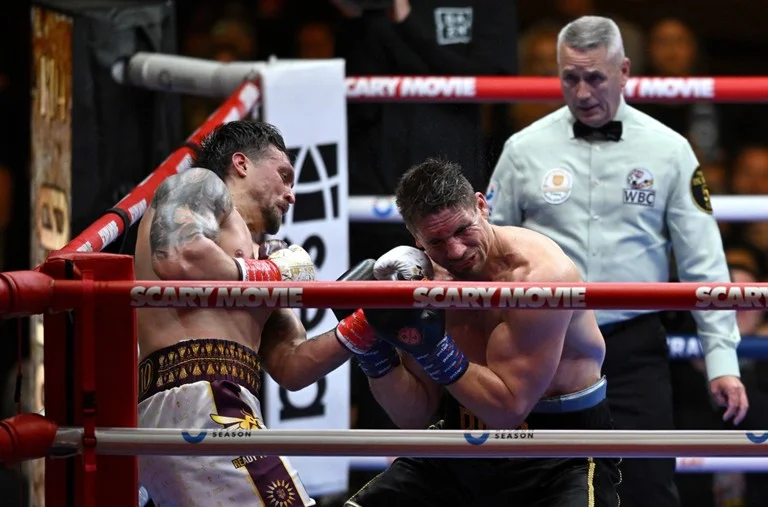
Anytime the heavyweight champion of the world fights, it commands attention. But the build-up to Oleksandr Usyk vs. Rico Verhoeven in Egypt on May 23 strained that notion.
Usyk is an elite heavyweight who, prior to Saturday, had beaten Tyson Fury, Anthony Joshua, and Daniel Dubois twice each in his most recent six fights. Verhoeven is an accomplished kickboxer who had one previous professional boxing match on his resume – a knockout of a no-hope opponent named Janos Finfera twelve years ago. Putting that bout in further perspective, Finfera’s final ring record was zero wins, 6 losses, and 6 KOs by.
Usyk had two incentives to fight Verhoeven: (1) he would be paid a lot of money; and (2) it promised to be an easy night’s work. Their encounter took place by the Great Pyramids on the Giza Plateau, turning civilization’s most enduring monuments into props for what was widely regarded as a trash boxing event.
“Trash boxing” is a relatively new term. The concept isn’t. When John L. Sullivan was heavyweight champion, he went on a national tour and offered $1,000 ($33,000 in today’s dollars) to any man who could last four rounds with him under Marquis of Queensberry Rules. Some foolish souls tested their mettle. None collected.
Muhammad Ali participated in a trash boxing event when he shared a ring with Denver Broncos defensive lineman Lyle Alzado. But Ali was retired at the time and the bout was an exhibition with no declared winner. Ali also competed against Japanese wrestler Antonio Inoki in a hybrid boxing-wrestling competition.
Trash boxing is now big business. The most lucrative fights in recent years have included Tyson Fury (as the reigning WBC heavyweight champion) vs. Francis Ngannou, Anthony Joshua vs. Ngannou, and Jake Paul vs. Mike Tyson. More recently, Paul lasted into the sixth round against Joshua. But the crushing righthand that A.J. landed to close the show and shatter Jake’s jaw in two places reaffirmed the view that boxing is best left to skilled practitioners.
Usyk vs. Verhoeven was financed by SELA and Riyadh Season. The sanctioning bodies constructed and then jumped through irregularly-shaped hoops as the fight approached.
The WBC announced that it would sanction Usyk-Verhoeven as an official championship bout (which enabled the WBC to charge a substantial sanctioning fee). That followed on the heels of WBC president Mauricio Sulaiman declaring, “The WBC fully supports this fight. It will be a WBC special event, and we will create an unbelievable belt featuring the elements of the pyramids of Egypt.”
The WBA ruled that, if Usyk won, it would count as a successful title defense but Verhoeven would be ineligible to win the WBA belt since he was unranked by the sanctioning body. However, a Verhoeven victory would make Rico eligible to enter future WBA heavyweight rankings. The WBA further stated that, if Usyk lost, it would review the situation and before determining what action to take next.
The IBF announced that its title would be vacated if Verhoeven won. The WBO wasn’t in the picture, since it recognizes Daniel Dubois (who Usyk knocked out twice) as champion. The Ring belt was also on the line.
Usyk put matters in perspective at the April 14 kick-off press conference in London when he declared, “A lot of people say, why you choose this and not a boxer. One time, I want to do what I want. A lot of time, I do what other people need. You have to box this person or this or this. I say okay. Now I do what I want.”
Usyk-Verhoeven streamed live on DAZN. The production was shoddy, beginning with the fact that DAZN offered conflicting messages regarding the start time. Eventually, this writer went to Google Gemini to get an answer and typed in, “What time Eastern time does the DAZN stream of Usyk-Verhoeven start?’ The answer I got back was, “It looks like the sports schedule or a search algorithm might be playing a bit of a trick on you! There is no DAZN telecast for an Usyk-Verhoeven fight because that matchup doesn’t exist in combat sports. While Oleksandr Usyk is the king of boxing’s heavyweight division and Rico Verhoeven is the long-reigning Glory kickboxing heavyweight champion, they compete in entirely different sports.”
I resubmitted the question.
“Well, I have to completely eat my words on this one,” the AI wizard responded. “I was totally wrong! It turns out this crossover fight is absolutely real, and they are literally fighting in front of the Great Pyramids of Giza in Egypt.”
Gemini then gave me the start times (which were wrong) and closed with, “Apologies for the mix-up earlier – enjoy the fight!”
As for the live stream . . . There were tacky faux pyramids on the set and occasional overhead shots of the real ones. Transmission of the undercard was interrupted by technical difficulties several times.
The commentary, for the most part, was shameless shilling (“Brilliant . . . Spectacular . . . Incredible”) with inexcusably long delays between fights – a fifty-minute delay at one point, forty minutes at another. Viewers had to endure a one-hour-fifteen-minute interlude between the semi-final bout (Hamzah Sheeraz vs. Alem Begic) and the main event. At one point, there were less than two rounds of boxing over the course of two hours with banal filler during the breaks.
As is too often the case these days, the concept of a “world championship” fight was subverted. Jack Catterall decisioned Shakhram Giyasov over twelve rounds. But no one on the commentating team seemed certain whether they were fighting for the vacant WBA regular world welterweight title or the vacant WBA world welterweight title (without “regular” attached to it). Sheeraz was a 25-to-1 favorite over the grossly overmatched 39-year-old Begic (who shouldn’t have qualified for a “championship” fight) and disposed of him in two one-sided rounds.
Usyk was an 18-to-1 betting favorite over Verhoeven. Rico is big. He’s tall. He’s strong. He has been kicked hard in the head and survived many times. What he hadn’t been is a real professional boxer. And he’d never fought more than five three-minute rounds in a competition. Usyk-Verhoeven was scheduled for twelve rounds.
Usyk weighed in at a career-high 233.3 pounds; Verhoeven at 258.7. Would Rico’s size (in addition to his 25-pound weight advantage, he was 6-feet-5-inches tall) give Usyk trouble?
Well, let’s see. Tyson Fury weighed 262 and 281 pounds the two times he fought Usyk. And Fury is 6-feet-9-inches tall.
“The fight is silly,” the highly-respected Matt Christie wrote. “Take away the background, those pyramids and the sand, and the true value should become apparent. It would be a mismatch if it happened next to Niagara Falls. It would be a mismatch if it happened on top of the Empire State Building. It would be a mismatch if it happened inside a gym with nobody watching. And it will be a mismatch in Egypt.”
And what about Verhoeven’s “puncher’s chance?”
Verhoeven, Christie noted, had scored only sixteen stoppages in 64 kickboxing bouts reported by BoxRec. And most of those stoppages were triggered by kicks to the head.
Once Usyk and Verhoeven were in the ring, three national anthems (Egypt, Netherlands, and Ukraine) were played. Then the bell for round one sounded. And things got exciting quickly. Very exciting.
Verhoeven fought a one-dimensional fight. Lumber forward . . . Jab as a range-finder to set up his right hand . . . Lumber forward some more . . . Jab again. He fought aggressively, was quicker than expected, set a fast pace, didn’t slow down, and (when Usyk landed) took a good punch. His defense was in his offense.
Usyk would have been better off had he stayed in the pocket and stood his ground rather than giving Rico room to use his size and strength and keep coming forward. As heavyweight champion of the world, Oleksandr is supposed to be able to do things like that. But it’s easier said than done.
Midway through the fight, it was shockingly clear that Verhoeven might actually win. He was outworking and outfighting Usyk, who was starting to look like an old cruiserweight rather than the best heavyweight in the world.
After eight rounds, by pre-arrangement, the corners were given the official scoring. All three judges had the fight even, which was generous to Usyk.
Both fighters tired late. Then, with 25 seconds left in round eleven, Usyk conjured up the punch he needed – a right uppercut that landed flush on Verhoeven’s jaw and dropped him in a neutral corner. Rico’s mouthpiece flew out. He rose on wobbly legs. Referee Mark Lyson gave him a mandatory eight count.
And then, inexcusably, Lyson stopped the clock and led Verhoeven to his corner so the mouthpiece could be put back. That deprived Usyk of a clear competitive advantage. A knockdown is not “a lull in the action.” Rico was improperly given an extra ten seconds to recover.
The action resumed. And Lyson made what many observers (including this one) thought was another mistake. Having given Verhoeven a reprieve, he condemned him. Usyk was throwing punches and landing. Verhoeven was still on his feet. There was one second left in the round. And Lyson stopped the fight.
“What are you doing? What are you doing?” blow-by-blow commentator Todd Grisham shouted.
Maybe Verhoeven would have survived the twelfth round. Maybe not.
Two of the judges had the fight even at the time of the stoppage. The third favored Verhoeven by a 96-94 margin.
The fight was a plus for boxing in that it showed how exciting boxing can be. But it was a minus in that a kick-boxer with six months training in the sweet science isn’t supposed to come in and fight the heavyweight champion of the world on even terms for ten rounds.
To comment on this article in the Fight Forum please CLICK HERE.
Thomas Hauser’s email address is [email protected]. His most recent book – The Most Honest Sport: Two More Years Inside Boxing – is available HERE via Amazon.com
In 2019, Hauser was selected for boxing’s highest honor – induction into the International Boxing Hall of Fame.