
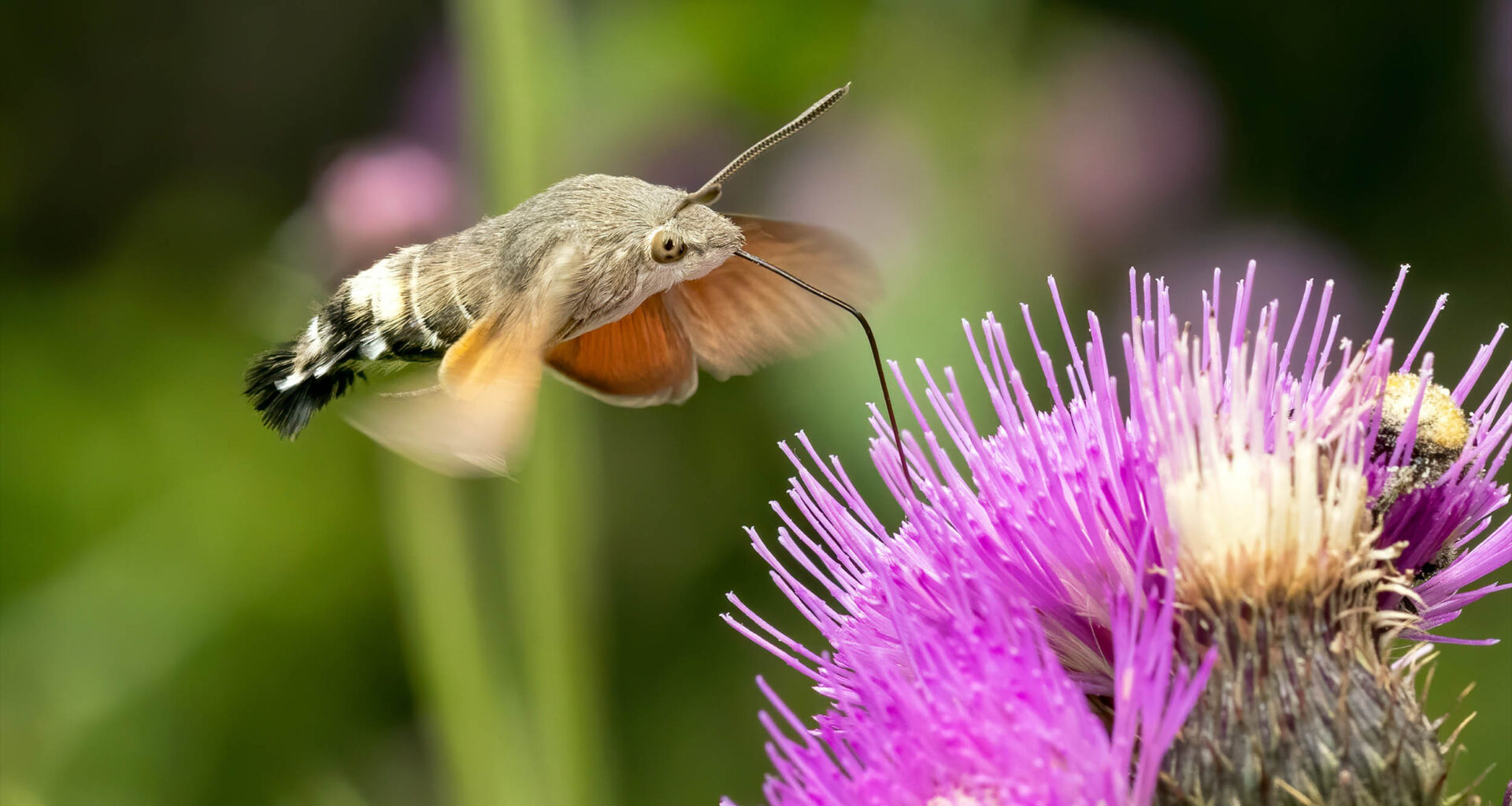
Watching a hawkmoth extend its tongue to feed on a flower may not seem like a big deal. But hidden inside that quick nighttime visit is one of evolution’s longest-running battles.
Flowers keep stretching their nectar tubes deeper to protect their nectar. Moths keep growing longer tongues to reach it. Neither side really wins.

Some hawkmoths now carry feeding tubes longer than a foot. Others have given up eating altogether.
That strange split is at the center of a new study that traces how hawkmoths evolved over millions of years.
The research follows the rise, disappearance, and return of one of the insect world’s most unusual tools: the proboscis, the long, strawlike mouthpart moths use to drink nectar.
Inspired by butterflies and moths
Long before becoming a researcher, Christian Couch spent time walking through the Butterfly Rainforest at the Florida Museum of Natural History.
Years later, after enrolling at the University of Florida, he returned to the museum as a volunteer before eventually studying hawkmoths as a master’s student.
“When I started college, I knew I wanted to volunteer in the Florida Museum because I thought it was a really special place,” Couch said. “When I found out I could do research with butterflies and moths, I was even more excited.”
His work maps the evolutionary history of hawkmoths, a group famous for their unusually long tongues.
Hawkmoth tongues and flowers
Hawkmoths are among the most important nighttime pollinators on Earth. As they feed, pollen sticks to their bodies and is carried from flower to flower. That helps plants reproduce.
But flowers and moths are not exactly cooperating.
Moths benefit from reaching nectar quickly and efficiently. Flowers benefit when moths brush against pollen while feeding. Those goals don’t always line up.
If a moth’s tongue becomes too long, it can drink nectar without touching much pollen. Flowers respond by growing longer nectar tubes. The moths respond again by evolving even longer tongues.
“There is a co-evolutionary arms race with the hawkmoth and the flower that has persisted for millions of years,” said Akito Kawahara, director of the Florida Museum’s McGuire Center for Lepidoptera and Biodiversity.
“The tongue of the moth becomes longer and longer, and the flower, too, becomes longer and longer.”
Darwin predicted the hawkmoth
Back in 1862, Charles Darwin studied a star-shaped orchid from Madagascar with a nectar tube nearly 12 inches long.
He argued that a moth capable of reaching that nectar had to exist, even though nobody had ever seen one. Scientists eventually found it.
The insect, now called Darwin’s hawkmoth, uses a foot-long proboscis to feed from the orchid.
Researchers did not observe it feeding on the flower until 1992, more than a century after Darwin’s prediction.
Why some hawkmoths stopped eating
Not every hawkmoth joined the race for longer tongues. About one-fifth of hawkmoth species do not feed as adults at all. Their proboscises are tiny or completely absent.
Instead, these moths survive on energy stored during their caterpillar stage. Adult life becomes short and focused almost entirely on reproduction.
That strategy changes how they interact with the environment. Rather than searching for specific plants, many of these caterpillars eat a wide variety of vegetation. They become generalists instead of specialists.
That flexibility may sound simple, but it creates another mystery. Plants defend themselves with toxic chemicals, yet these caterpillars can often tolerate many of them.
“The ability of hawkmoth caterpillars to tolerate different plant defenses is another thing we still don’t understand very well,” Kawahara said.
“It’s remarkable that they can do this across so many different types of plants, even with the various plant chemistries at play.”
Long tongues changed everything
Meanwhile, long-tongued hawkmoths followed a very different path. In tropical regions especially, they often became tightly linked with certain flowers.
Hawkmoth’s sense of smell helps them locate blooms with nectar tubes that match their tongue length.
That matters because flying through dense forests burns a lot of energy. Visiting the wrong flower wastes time and fuel.
Inside hawkmoth evolution
To understand how these feeding strategies evolved, Couch and his colleagues analyzed DNA from more than 300 hawkmoth specimens.
The genetic tree they built represents about 20 percent of the world’s 1,600 hawkmoth species.
The team also measured the insects’ proboscises by carefully removing and stretching the coiled feeding tubes from museum specimens.
Species with tongues shorter than 0.4 inches were classified as nonfeeders.
The results showed that the earliest hawkmoths likely did not feed as adults. Adult nectar feeding appeared roughly 44 million years ago and spread quickly afterward.
“It’s not too surprising to have multiple instances where hawkmoths develop this feeding behavior,” Couch said.
“If a resource like nectar exists, then there’s an opportunity for a moth to access it. You would expect this trait to evolve multiple times with the many different ecosystems where this resource exists.”
Hawkmoth feeding came and went
What surprised researchers was how often the trait changed back and forth.
Some hawkmoths evolved long feeding tubes, lost them, and later regained them. In evolutionary terms, those shifts happened quickly. In some cases, the changes occurred within 5 million years.
Scientists think part of the reason may lie in hidden anatomy. Even nonfeeding hawkmoths still retain some of the muscles needed to operate a proboscis.
That leftover structure may make it easier for future generations to evolve feeding behavior again when environmental conditions change.
The study adds another layer to the growing understanding of how insects and plants shape one another over time. Hawkmoths did not evolve in isolation. Flowers pushed them in one direction, and changing environments pulled them another.
And somewhere in the middle of all that, a kid who once wandered through a butterfly exhibit ended up helping explain one of evolution’s strangest stories.
The full study was published in the journal Royal Society Open Science.
—–
Like what you read? Subscribe to our newsletter for engaging articles, exclusive content, and the latest updates.
Check us out on EarthSnap, a free app brought to you by Eric Ralls and Earth.com.
—–