
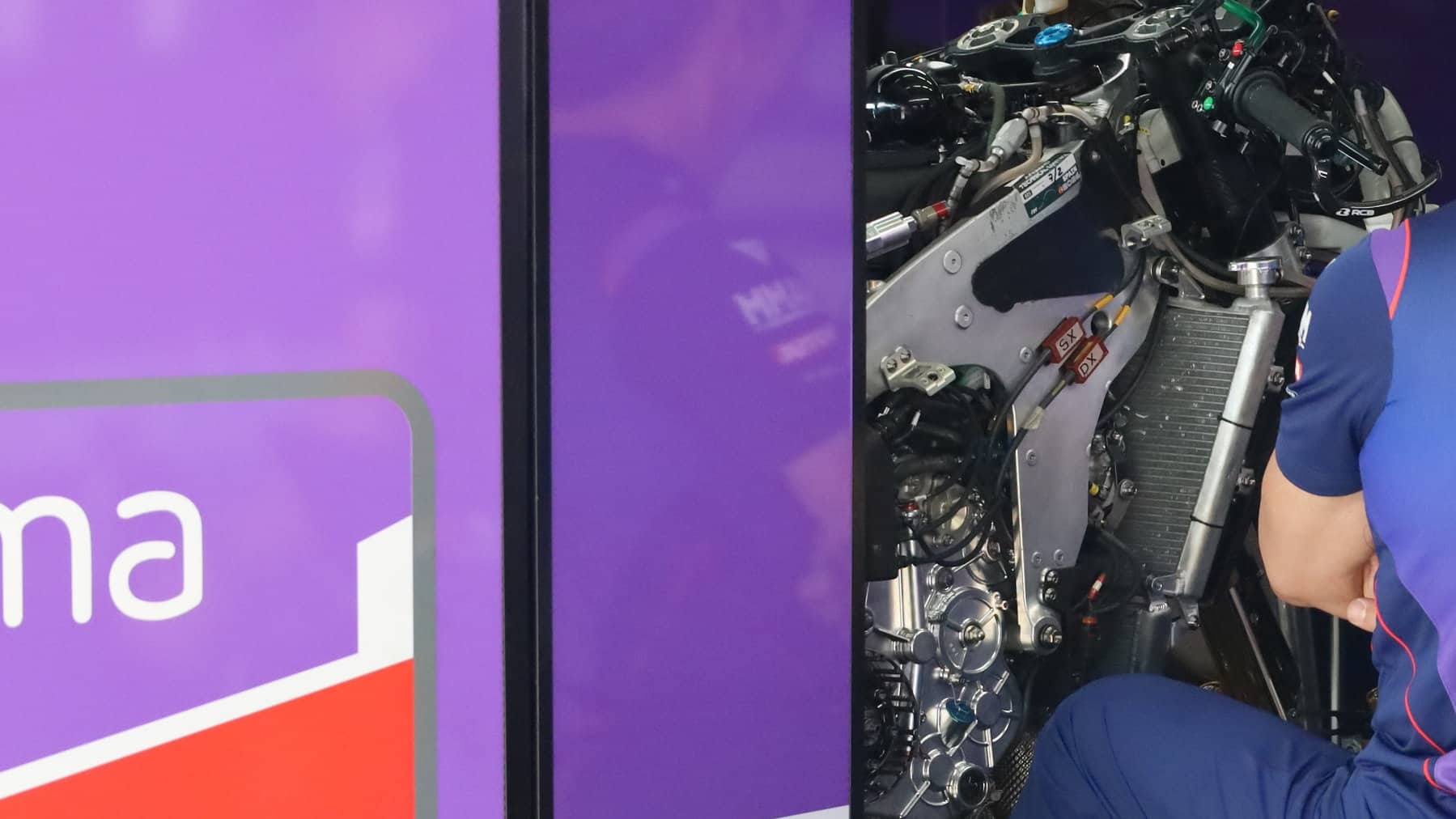
The above photo, snapped during practice for last month’s Spanish Grand Prix, doesn’t show Yamaha’s new YZR-M1 V4 engine in its entirety, but it does reveal arguably the most important detail: the engine’s orientation in the chassis.
A couple of decades ago, MotoGP manufacturers weren’t too bothered about publishing photos of their bikes fully stripped of bodywork and other ancillaries to reveal their engines in all their glory.
Sadly, that never happens today, because engineers don’t want their rivals seeing what they’re doing, including how they’ve positioned the engine in the chassis, which is a huge part of getting bike balance right to create optimum front/rear grip.
There is a big difference between how today’s 90-degree V4 engines sit in the chassis and how MotoGP’s first successful four-stroke V4 engine – Ducati’s Desmosedici – sits in the chassis.
Viewed from its right side, the 2007 Ducati GP7 (see further down the page) has its V4 sat very much like the letter L, which puts lots of weight over the front end.
Since then, manufacturers have progressively pivoted their V4 engines backwards, until they sit in the chassis more like the letter V, with each bank sitting at around 45 degrees to the vertical.
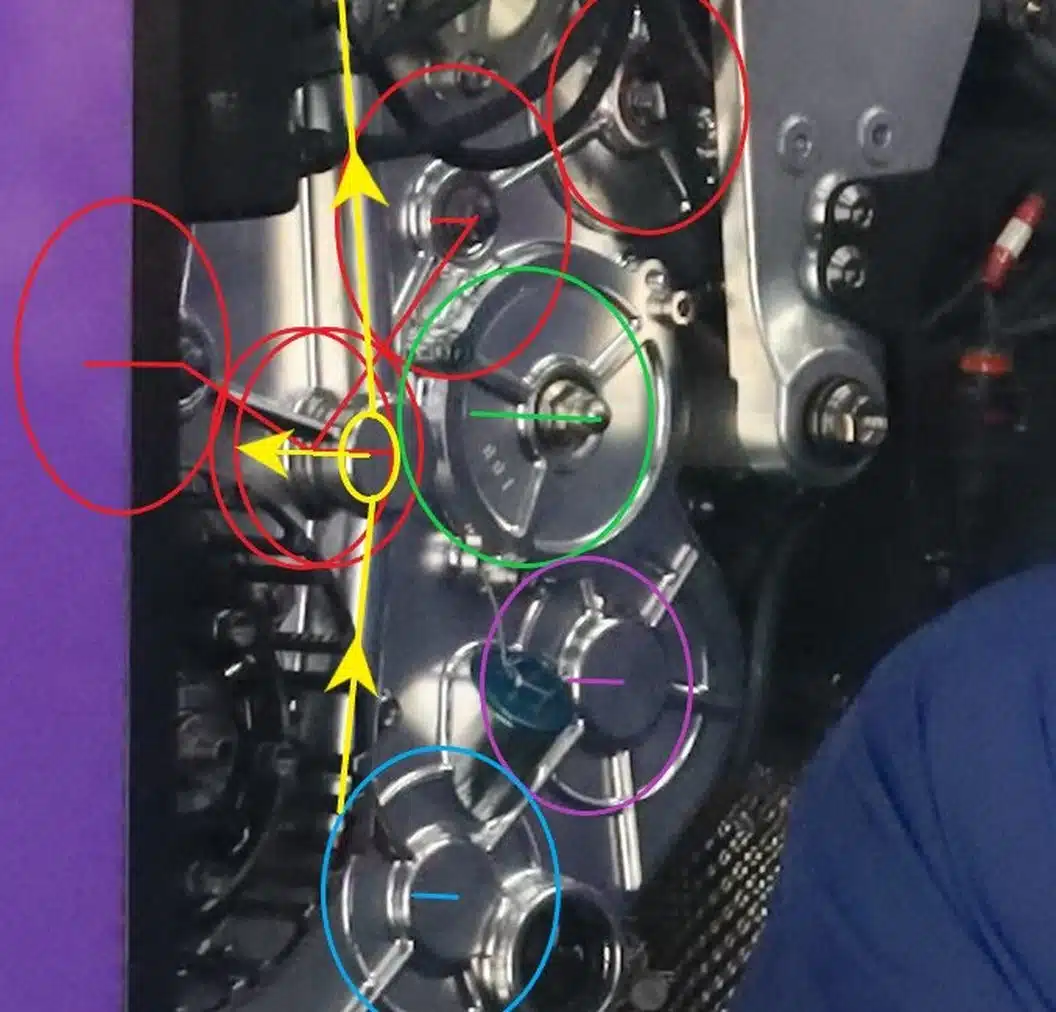
Details of the Yamaha V4 – Double red circle: crankshaft. Red circles: idler gears to front and rear camshaft sets. Yellow lines: oil feeds from oil pump to crankshaft and cylinder heads. Green circle: idler gear. Purple circle: idler gear. Blue circle: oil pump drive
My M1 engine photo confirms this orientation – the front cylinder bank’s cam box can be seen between the radiator and the frame’s engine hanger.
Why have engineers done this? Because MotoGP has been using Michelin spec tyres since 2016. The Michelins are the opposite of the Bridgestone spec tyres, used by Ducati from 2005 to 2008 and from 2009 to 2015 by everyone, as MotoGP’s first spec tyres.
The Bridgestone front was awesome, the Bridgestone rear not so much, so engineers wanted engine mass moved as far forward as possible to load the front tyre and create more front grip.
It’s the other way around with the Michelins, which make the lap time with the rear, hence engineers pivoting the vee backwards to load the rear tyre and create more rear grip.
This, of course, is one reason Yamaha finally parked its historically super-successful inline-four and replaced it with a V4, as used by Aprilia, Ducati, Honda and KTM, because inline fours put more load on the front tyre than the rear.
The irony is that we don’t yet know how Pirelli spec slicks – which will equip MotoGP bikes from 2027 – will affect bike balance…
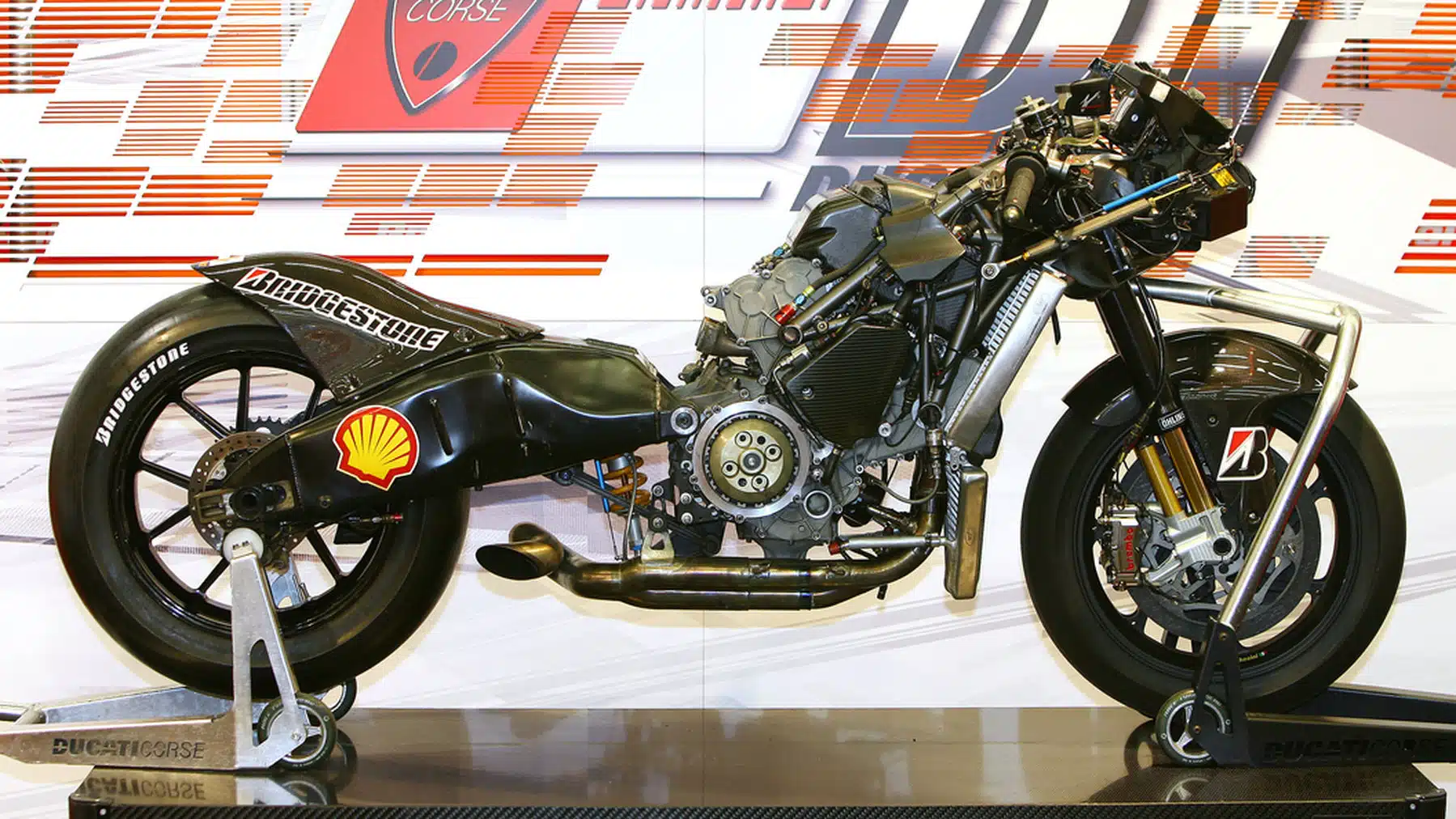
Casey Stoner’s Ducati GP7, with V4 engine arranged in an L position
Could the Pirellis be front-focused like the Michelins, making inline-fours winners again? Possibly, but current feedback from testing suggests the Italian tyres will have a better front/rear balance than the French and Japanese tyres. And anyway, the need for a V4 persists, because V4s are more powerful and make better fighting bikes, because they don’t rely on corner speed to make the lap time.