
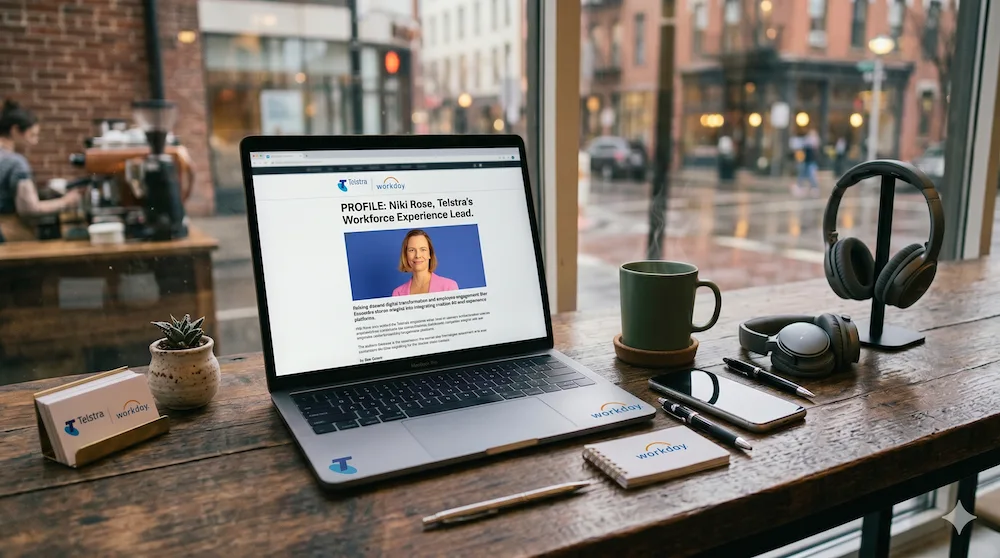
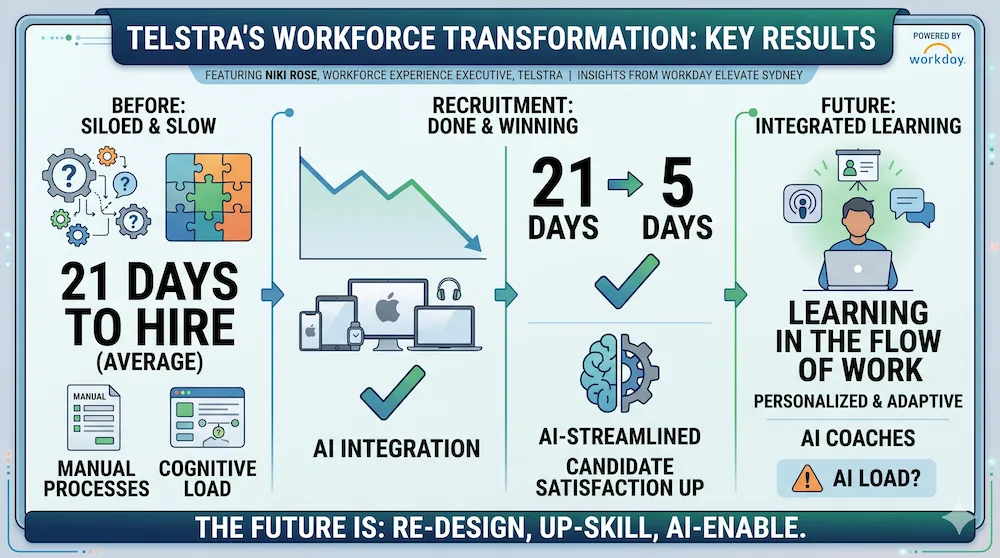
Telstra dropped time-to-hire on its high-volume roles from 21 days to 5 days, lifted candidate satisfaction above 95%, and freed up the equivalent of 7 roles in interview scheduling alone, paying for the new technology in year one with productivity gains to spare.
That was the headline from Niki Rose, Workforce Experience executive at Telstra, who closed the morning session at Workday’s Elevate Sydney event with the most concrete customer story of the day (see here for the full Workday Elevate article).
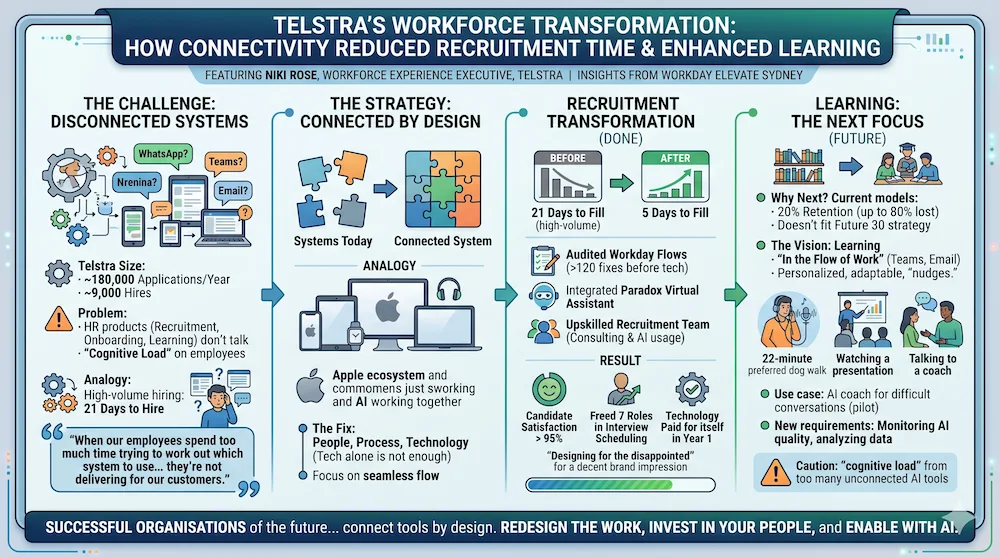
Telstra fields around 180,000 job applications a year and hires roughly 9,000 people. Until recently, that pipeline was being pushed through a stack of HR products that didn’t actually talk to each other.
Niki Rose’s presentation from the Workday Elevate 2026 keynote is embedded below. On our old system, we could manually insert YouTube embed code, but that feature is still coming. Please move the video timeline to 1:02:15 and you’ll see the lead-in to Niki Rose’s presentation. You can also watch the keynote in full and not rewind – it’s up to you. The full article is also published at iTWire here.
The “connected by design” pitch
Rose opened with a working-parent analogy that landed well in a Sydney audience of HR and finance execs. Two kids, two different schools, multiple sports WhatsApp groups, work emails, Teams messages, escalations. The cognitive load is huge, she said, “and every now and again, I miss something.”
Her point was that Telstra’s employees were stuck in the same trap at work. Recruitment didn’t connect to onboarding, which didn’t connect to learning. None of the systems shared context, so people did the gluing manually.
“When our employees spend too much time trying to work out which system to use for recruitment, to log a ticket to ask a payroll question, they’re not delivering for our customers,” said Rose. “When we think about a system that doesn’t connect our people, we are dragging out that time for our customers.”
Rose’s analogy for the fix was Apple. AirPods, phones, iPads and Macs each work on their own, but “the real magic comes when they work together because they are connected by design.” That’s the ambition Rose’s team is trying to apply across Telstra’s HR products.
The fix had three legs: people, process, technology. Rose was emphatic that the tech alone wouldn’t have moved the numbers.
This infographic independently created by iTWire using Gemini Nano Banana – the article continues below, please read on!
Recruitment: Paradox plus 120 process fixes
Telstra’s recruitment volume makes it a real pressure point. Rose was also blunt about why she didn’t just buy more tools: “I do not have an endless technology budget or a way to pay for all the technology. And I also, while I have a wonderful IT and cyber team, they can sometimes be a little slow and a little complicated.”
The team rolled in the Paradox candidate virtual assistant, but didn’t stop there. While IT and cyber worked through the implementation, Rose’s team audited the existing Workday flows and found “over 120 fixes or improvements” they could make on the process itself, with immediate efficiency gains before the new tech went live.
Just as important: the recruitment team itself got upskilled. Rose’s team worked on their consulting skills and walked them through the new process so they could actually use the AI when it arrived. “The technology also doesn’t come out of the box exactly like it will say it will do, particularly with AI. It takes time to get better,” said Rose.
The combined result: 21 days to fill became 5 days. Candidate satisfaction came in above 95%. Automated interview scheduling alone covered the equivalent of 7 roles, paying for the technology in year one.
Rose also coined a phrase iTWire readers should steal: “designing for the disappointed.” Of those 180,000 applicants, the vast majority don’t get a job, and Telstra wants them to leave with a decent impression of the brand anyway.
Learning: rebuilding the course library from scratch
Telstra’s next play is learning, and Rose’s framing was that the current model won’t cut it for the company’s Connected Future 30 strategy.
The mature library of online courses, in-person sessions, credentials and pathways isn’t delivering the shift Telstra needs by 2030. Research Rose cited puts learning retention as low as 20%, meaning up to 80% of what gets pushed through traditional learning systems doesn’t stick.
Rose’s pitch: learning that shows up in the flow of work, in Teams, in email, in the day-to-day. Learning that knows your role, your goals and what you’re working on right now, and quietly nudges you to the next best step. Learning that fits a 22-minute commute, or “your preferred dog walk around the neighborhood,” and adapts to whether you’d rather listen to a podcast, talk to a coach or watch a presentation.
There’s a leaders use-case too: an AI coach that lets a manager practice a difficult conversation in a safe space before having it for real. Telstra is piloting that today.
Rose also called out a structural change in how teams will need to staff this stuff. Running AI-driven learning needs people in new roles, watching the quality of AI output, understanding the calls coming back through, looking at far more data than learning teams have traditionally worked with. That’s a hiring brief mid-market and enterprise HR leaders will need to write themselves before long.
This infographic independently created by iTWire using Gemini Nano Banana – the article continues below, please read on!
Why iTWire readers should care
The Telstra story is useful because the metrics are concrete and the playbook is repeatable. A mid-sized Australian organisation looking at a Workday GO deployment can read across to the same three legs: redesign the process, upskill the people, then put the tech in.
Rose’s closing line was a clean summary of the approach: “Successful organisations of the future, it’s not about how many AI tools you have or can afford to buy, but how you connect those tools by design. Redesign the work, invest in your people and enable with AI.”
As a parting reality check, Rose mentioned spending the previous week in the US with Workday, Microsoft, Google and Anthropic. Her take: “It’s genuinely exciting, but also a little terrifying because I worry that all of these AI tools are going to result in more tools and more decisions and more cognitive load on already busy people.”
That tension is the one her team is actively trying to design around.