
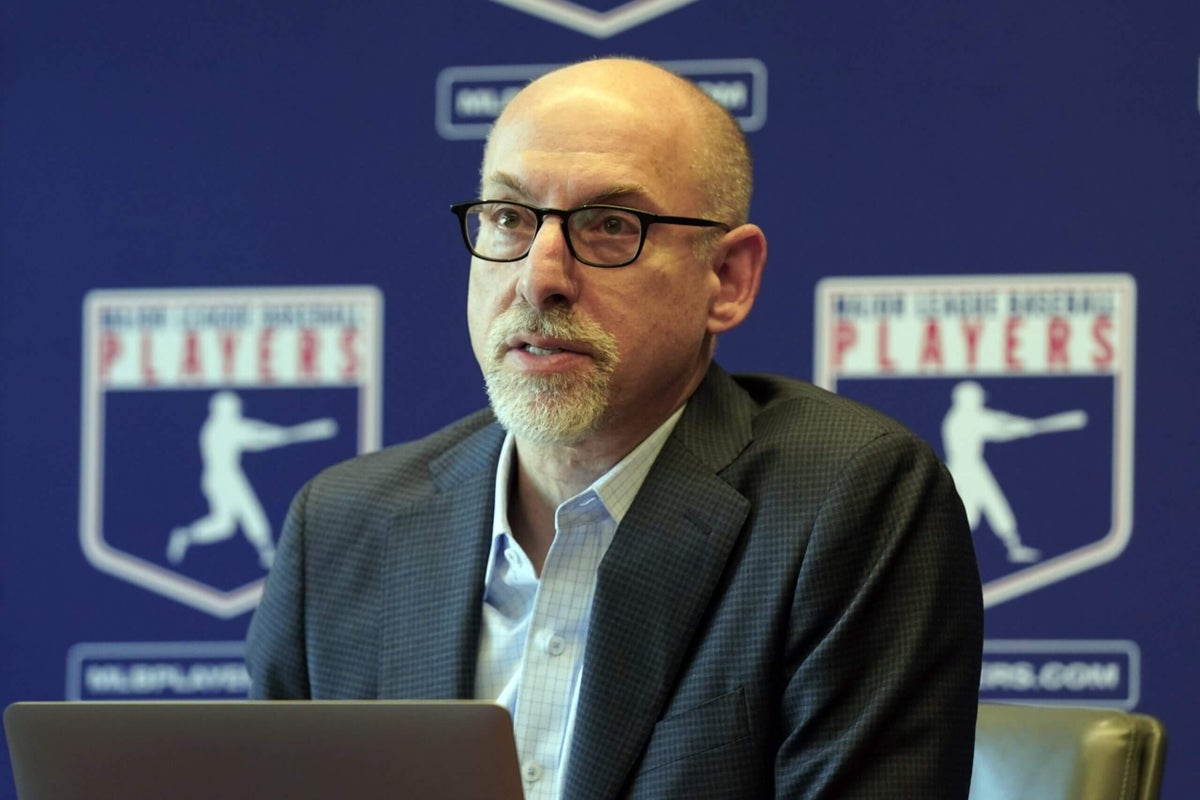
In the first proposal either side has made in these early days of collective bargaining, the Major League Baseball Players Association on Wednesday put forth a slew of changes that would increase pay for players and significantly alter the way the sport’s owners share money among themselves.
The union’s proposals appeared to be aimed at the repeated concerns owners have raised over the sport’s parity, and smaller-market teams’ ability to compete. A new “competitive integrity tax” the union proposed would effectively serve as a soft salary floor, whereby teams that don’t reach certain spending levels would be penalized.
The union also proposed roughly doubling the minimum salary in 2027, to $1.5 million from $780,000 this year; the elimination of the qualifying offer for free agents, and a $180 million starting point for the pre-arbitration bonus pool, which would grow by $15 million every year over the life of the deal.
The base competitive-balance tax threshold, or CBT, would start at $300 million, up from $244 this year. The competitive integrity tax floor would start at $150 million, half of the first tax threshold.
“Our goal is to preserve and improve baseball’s market system, rewarding competition on and off the field,” interim executive director Bruce Meyer said in a statement. “The players’ proposals provide increased revenue sharing initially guaranteeing every small market club a minimum of $240 million in revenue every season.
“This enhanced revenue sharing includes added protections to ensure clubs prioritize winning over profiteering. Ultimately, our proposals are designed to build upon the incredible momentum and popularity of our sport world-wide.”
Unsurprisingly, MLB found the union’s opening salvo underwhelming.
“We appreciate the union making a set of proposals and we look forward to continuing the bargaining process and working towards solving the competitive balance problem our fans are telling us needs to be addressed,” said MLB spokesman Glen Caplin. “We understand their proposals are designed to benefit players. Unfortunately, they do not address and in fact exacerbate the competitive balance problem our fans are telling us we must address.
“The MLBPA’s proposal would reduce the amount transferred to lower-revenue clubs, weaken the competitive balance tax, and lead to even more payroll disparity than exists today. For example, under the union’s proposal, the Dodgers would pay less in luxury tax payments, giving them an additional $70 million to spend on payroll.”
The sides met in person in New York City, the start of a jam-packed two days for lawyers and economists at the union and their counterparts inside MLB’s labor relations department. The sides are set to meet again on Thursday, when it’ll be the league’s turn to slide a proposal across the table.
That meeting will provide even more intrigue: the owners are expected to present their plan for a salary cap, details many in the industry have been waiting for.
The owners have long been expected to propose a cap-and-floor system in baseball, a change players opposed and could be willing to miss many games in 2027 to avoid. But Thursday will bring specifics for the first time: the details of where MLB wants to set the ceiling, the lower limit, and other key elements that would come with such a major change.
Among the details of the union’s proposal, a copy of which was reviewed by The Athletic:
The union wants to allow some players who are at least 30 years old to become free agents after five years rather than the standard six — an effort they undertook in the last round of bargaining as well.
More players would be eligible for Super-Two salary arbitration status — reaching arbitration with more than two years of service time, rather than the standard three. The union proposed allowing the top 44 percent of players who have reached two years of service to be eligible, rather than the current 22 percent.
The minimum salaries the union proposed would later climb to $1.65 million in 2028, $1.825 million in 2029, $2 million in 2030 and $2.2 million in 2031.
The luxury-tax thresholds would reach $315 million in 2028, $330 million in 2029, $345 million in 2030 and $360 million in 2031.
Both sides ultimately know that this week’s proposals are just starting points, and their offers are prepared accordingly. The parties will eventually walk away from some elements they asked for this week, or revise them in effort to find common ground. But that process is expected to take many months.
The current five-year CBA expires after this season, at 11:59 p.m. ET on Dec. 1. If a new deal hasn’t been reached by then, the owners are expected to start a lockout, just as they did in the 2021-22 negotiations. A deal in those talks was ultimately struck in March 2022, with just enough time to hold a shortened spring training and play a full 162-game regular schedule.
The industry expectation is that the sides will take at least as long as last time to reach a deal this go-around — if not longer.
If owners stick by their cap proposal, and if players continue to believe a cap system ultimately harms them, games could wind up canceled in 2027 as the sides try to outlast each other.
The owners will frame their arguments around competitive balance — a desire to even out payrolls in a sport where the Los Angeles Dodgers are spending five times as much as the Miami Marlins. The union’s revenue-sharing proposal offers a different approach to those concerns.
Money rules the day in labor negotiations, and a cap system has huge economic effects. It could greatly increase owners’ franchise value, for one.
In at least a small sense, these back-to-back days of meetings mark a change to the bargaining calendar from 2021-22. Last time, the union also made its first economic proposal in May. But the owners didn’t deliver their first proposal until months later, in August.
This negotiation is a particular test for the MLBPA, long considered the strongest union in sports. Players pushed out Tony Clark, the union’s longtime executive director, in February amidst scandal.
After federal investigators last year began probing Clark and the union’s handling of its finances, the union brought on outside counsel to conduct an internal investigation. That process revealed Clark had engaged in an inappropriate relationship with a union employee, his sister-in-law.
“We all see the momentum in our game,” said Baltimore Orioles pitcher Chris Bassitt, a member of the union’s eight-player executive subcommittee, in a statement. “Amazing players and incredible fans. Attendance, viewership, interest — by any measure you want to use, our game is moving in a positive direction. We’ve put forward proposals designed to continue that trend. Support, incentivize, and reward clubs who are committed to competing, especially small-market clubs. Compensate players fairly for the work they are doing. Preserve the rights that generations of players have fought for and grow the game all of us love.”
But the owners have more than ever riding on the line as well.
Commissioner Rob Manfred has said he intends to retire in January 2029, making this CBA the last he’ll negotiate on the big-league side, and it could cement his legacy. His office has national TV deals to re-negotiate for 2029 and beyond, and MLB’s media-rights structure will also be greatly impacted by any changes to revenue sharing that come out of the deal — with or without a cap system.