
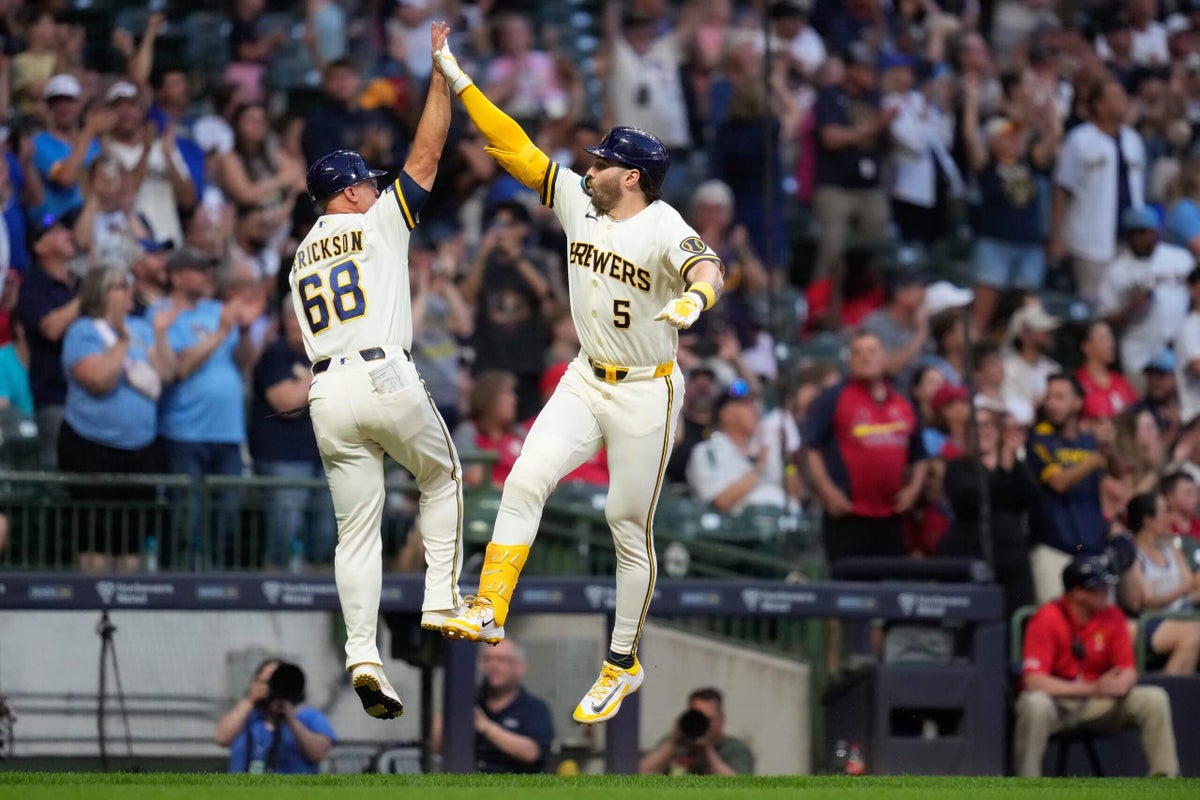
The Milwaukee Brewers’ trade for CC Sabathia in 2008 was a landmark moment in franchise history, helping lift the team to its first postseason appearance in 26 years. If the Detroit Tigers make Tarik Skubal available, another Sabathia-like opportunity could emerge for the Brewers, whose farm system, according to The Athletic’s Keith Law, is the best in baseball.
Revenue-sharing recipients — the Brewers, Athletics, Tampa Bay Rays and Cleveland Guardians — lead four of Major League Baseball’s six divisions. I’m tickled by the idea of any of them making go-for-it moves at the trade deadline. The timing would be rather inconvenient for major-league owners who want to justify a salary cap, in part, by arguing that such teams operate at too great a competitive disadvantage.
Forgive my cynicism, but the owners created this unfortunate landscape, insisting the sport’s competitive balance is out of whack when the standings, again, indicate otherwise.
The four first-place low-revenue clubs already are undercutting the owners’ view that teams with lesser resources are doomed. Per FanGraphs, the Brewers rank 19th in payroll, the A’s 26th, the Rays 28th and the Guardians 29th, respectively.
A World Series between say, the Brewers and Rays, would lay waste to the owners’ cries for greater parity, which — based on the revenue disparity that exists within the sport — are not entirely without merit. But let’s be real: The primary motivation for the owners in pursuing a cap is to establish fixed costs that would enhance their franchise values.
So, how does this play out at the deadline?
If the low-revenue clubs hold back, it will give the appearance that they are trying to remain in lockstep with the owners’ argument that they cannot compete. The last low-revenue team to win a World Series, the 2015 Kansas City Royals, went for broke at the deadline. By today’s standards, they were an outlier.
Generally speaking, low-revenue clubs are not major buyers. The Rays, an occasional exception, made an ill-fated five-player deal for Nelson Cruz in 2021 that cost them Joe Ryan. Two years later, they tried to acquire Shohei Ohtani. But more often than not, when low-revenue contenders act at the deadline, they operate as both buyers and sellers. On occasion, they even become outright sellers — see the Brewers’ trade of Josh Hader in 2022.
That season was the only one of the previous five in which the Brewers failed to win the NL Central. Since then, they have been modest buyers at the deadline, adding $2.9 million in net payroll in 2023, $6.7 million in ‘24 and $4.4 million in ‘25, per FanGraphs’ Jon Becker. But while owner Mark Attanasio gave them room to maneuver, they got little bang for the buck in each of those years, in part, because they aimed so low.
Skubal, on the other hand, would be enough of a difference-maker to tempt every contender.
With the deadline still more than two months away, it is far from certain the Tigers will move the back-to-back American League Cy Young Award winner. For it to happen, Skubal would need to show he is healthy coming off the innovative NanoNeedle elbow surgery. And the Tigers, who are tied with the Los Angeles Angels for the worst record in the American League, would need to concede they are too feeble to contend in the weak AL Central and weak AL.
For a team with a club-record $207 million payroll, that concession will not come easily, if at all.
Attanasio, who took over in 2005 and authorized the trade for Sabathia in ‘08, experienced firsthand how such an addition could electrify a franchise. But the Brewers’ recent history does not indicate they would part with the necessary prospects for Skubal, or take on the $10 million or so that his contract would cost for the final two months.
So, why should the Brewers take a different approach this time around, especially when they routinely defy those who urge them to be more aggressive, including, ahem, yours truly? They probably wouldn’t, even with the salivating possibility of unleashing a rotation of Skubal, Jacob Misiorowski and Kyle Harrison in the postseason.
But oh, the potential reward.
Sabathia, too, was a rental when the Brewers acquired him in 2008. He turned into CC Fantastica, averaging nearly eight innings per start, producing a 1.65 ERA. His final three starts were on three days’ rest. His last one, in the regular-season finale that catapulted Milwaukee into the playoffs, was a 122-pitch complete game.
Skubal, coming off surgery and months away from free agency, would not be the same kind of workhorse, not with his agent, Scott Boras, surely advising him against overuse. He might, however, deliver the same kind of impact. And while the Brewers are in a less urgent position than they were in 2008, when they had gone more than a quarter-century without making the playoffs, their farm system is bursting with prospects, not all of whom will play in Milwaukee.
In the Sabathia trade, first baseman Matt LaPorta was the most highly regarded of the four young players who went to Cleveland. He compiled a negative bWAR in the majors, as did another player in the deal, left-hander Zach Jackson. Righty Rob Bryson never even made it to the majors. Outfielder Michael Brantley, the player to be named, proved the biggest prize, developing into a five-time All-Star who enjoyed a 15-year career.
To get Sabathia, Attanasio took on just under half of the pitcher’s $11 million salary. Skubal would command a slightly higher percentage of the Brewers’ payroll. From that perspective, he should be attainable — that is, if Attanasio is willing to take a $10 million plunge with the sport facing the possibility of a lockout that could force the cancellation of games next season.
The bigger concern, for the Brewers, might be the cost in young talent.
Skubal not only would be a rental, but a rental who could suffer another elbow injury, causing the deal to backfire. The Brewers know buyers typically overpay at the deadline. They fear that if a prospect they trade becomes a star, they can’t replace him on the free-agent market.
Fair enough.
But on the left side of the infield alone, the Brewers soon might replace shortstop Joey Ortiz with Cooper Pratt, and turn over third base to another prospect, Jett Williams. Behind Pratt and Williams are two shortstops who are even younger and even more highly regarded, Jesús Made and Luis Peña, along with another third baseman, Andrew Fischer.
Look no further than the Baltimore Orioles for a team that overvalued certain prospects and held onto them for too long. The Brewers, at some point, might risk doing the same. They need to build around the players they like best, and trade some of the others.
Winning a World Series is extremely difficult — yes, even for the back-to-back champion Los Angeles Dodgers, who got bounced in the Division Series by the San Diego Padres in 2022 and the Arizona Diamondbacks in ‘23. But the Brewers, perhaps more than most clubs, should appreciate that the opportunity to make a deep run in the postseason is precious. Even with seven playoff berths in the past eight years, they are still trying to get back to the Series, where, in their only appearance, they lost to the St. Louis Cardinals in 1982.
The entire discussion over Skubal might be so much wasted breath if he returns healthy and the Tigers roar into contention. Heck, some might even contend the Brewers would be better off acquiring a proven shortstop or third baseman at a lesser cost, buying more time for their younger infielders.
I’m just waiting to see whether the Brewers, along with the Rays, Guardians and A’s, will even dare pursue significant upgrades with a labor battle looming. Those teams already are wrecking the owners’ claims that baseball lacks competitive balance. Something tells me the owners wouldn’t be too happy if one or more of those clubs makes moves to further demonstrate they are wrong.