
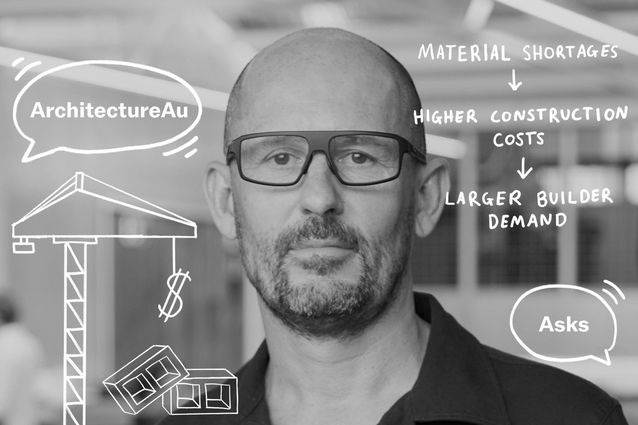
Only a few years ago, the COVID-19 pandemic triggered a global domino effect of material shortages, soaring construction costs and surging builder demand. Projects stalled or were abandoned altogether, leaving Australia’s built environment businesses struggling to find consistent work. Now, with the war in the Middle East, building materials are facing delays and construction costs are rising again – what does this mean for architects and built environment professionals still recovering from the shock of COVID-19? Will it get worse before it gets better?
After COVID-19, we were all hoping that construction costs would return to where they were previously. Obviously, that didn’t occur. In the years since the pandemic, we’ve seen about a 25 to 30 percent increase in construction costs, and combining that with the current energy crisis and transport restrictions, particularly on overseas shipping, I think it is unlikely that we will see an adjustment backwards in the near future. Some people might say it’s a cost correction or a new normal. I think professionals, trades – everyone – has started to adapt to that, and to think about how we might approach our work differently.
If we put aside the current war, its effect on fuel prices and implications in on construction costs, there are also other pressures. Australia’s unions are very powerful and they’ve managed to achieve quite remarkable pay and working conditions. As a result, trades are leaving the residential sector to go and work in the commercial environment, where unionised sites have better pay levels. That’s clearly had a significant effect on the cost of construction in both the commercial and residential sectors.
Even still, while clients have to come to the conclusion that they have to be somewhat accepting of construction costs, the property market has yet to catch up. There’s been very little growth in the property market in the last 12 months, and across Sydney and Melbourne, for example, there’s been evidence of decline in market values. With construction costs going up at the same time, the result is an immediate pressure on feasibility.
It’s very hard to make projects feasible if the property market is out of balance. That’s fundamentally why architects – particularly medium and large-scale practices – are challenged in finding new work, and experiencing stop-start issues with their current projects.
Ultimately, we have to accept that the market is what the market is at this point in time. Our job as architects is to be more proactive in relation to cost and how we design buildings, and to try to assist clients with resolving their feasibilities. We should be seeking earlier involvement from construction contractors to establish clarity around costs, helping our clients to make informed decisions that give them confidence to move forwards with projects. Our job may also involve revisiting current projects, to see if they can be approached with other, more cost-effective development models that suit alternative markets – like adaptive reuse, rather than knock-down-rebuilds, for example.
The people who do more research, and work more proactively with the clients or the architectural practices that do, are going to have the advantage in the current market.
– Jon Clements is a founding director of Jackson Clements Burrows Architects, established in Melbourne in 1998. The practice currently employs more than 90 architects and interior designers in Melbourne and Brisbane. They have delivered a diverse range of projects throughout Australia and overseas, with their work widely recognised in awards programs. Clements was appointed national president of the Australian Institute of Architects in 2015. He was president of the Institute’s Victorian Chapter between 2012 and 2014 and a member of the Building Advisory Council of Victoria between 2011 and 2014.
This article is one of five responses to the same question: “Construction costs are rising again – will it get worse for architects before it gets better?” Read Jemima Retallack’s response to the same question here and Scott Burchell’s here, Ehsan Noroozinejad’s here and Lyndall Bryant’s here.