
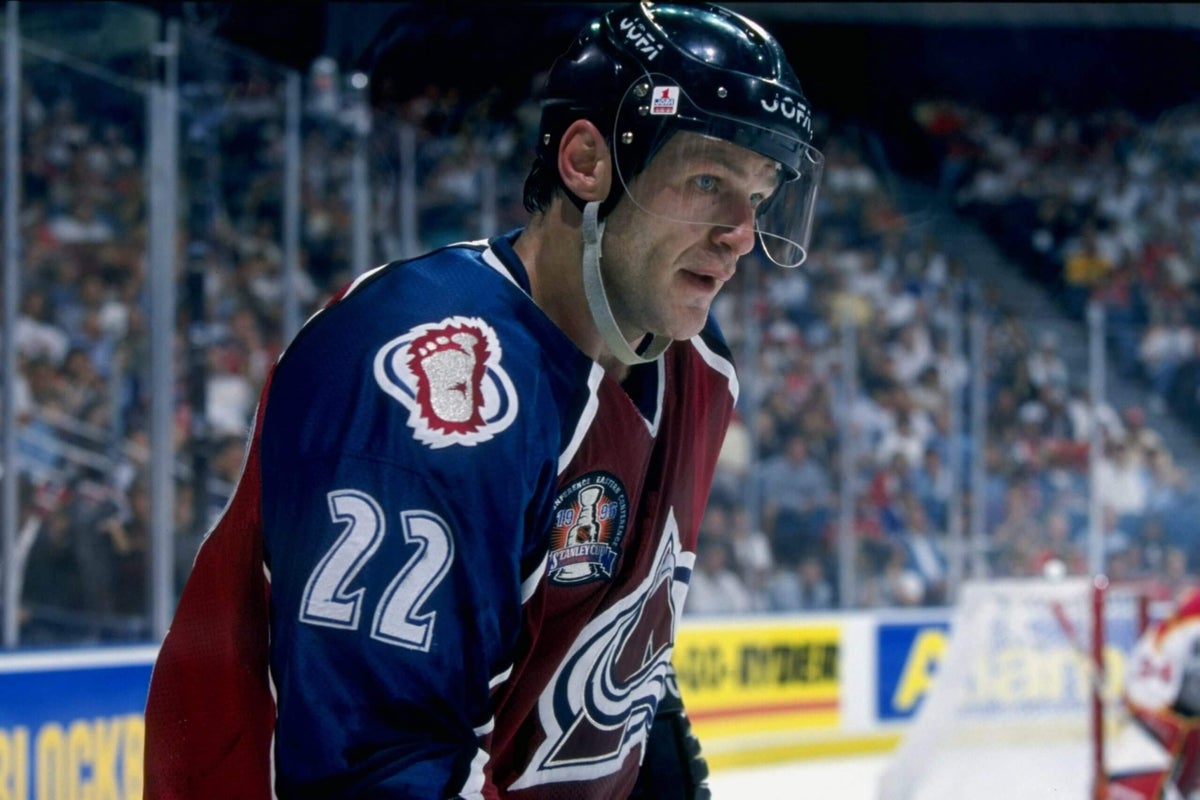
Claude Lemieux will be remembered across the NHL as a four-time Stanley Cup champion, one of the sport’s great playoff performers and, in retirement, as an agent to the next generation of top players.
His 80 career playoff goals are the ninth-most in NHL history, and he won his Cup titles with three different franchises — the Montreal Canadiens, New Jersey Devils and Colorado Avalanche — as well as the Conn Smythe Trophy as playoff MVP in 1995 for the Devils. His methods to achieving that success were at times quite polarizing, as a fierce competitor who was no stranger to the penalty box — with nearly 1,800 career penalty minutes in 1,215 regular-season games.
Within that legacy, Lemieux, whose death at 60 years old was announced Thursday, will forever be remembered for being at the center of an era-defining rivalry between the Colorado Avalanche and the Detroit Red Wings.
In the mid-1990s, the Red Wings had become a dominant regular-season team, winning the Presidents’ Trophy for the league’s best record in both 1995 and 1996. But they had fallen to Lemieux’s Devils in the Stanley Cup Final in 1995 and were down 3-2 entering Game 6 of the 1996 Western Conference final against the Avalanche. That’s when a hit from Lemieux sparked a bitter feud that led to some of the most iconic moments in the sport’s history.
Tensions were already bubbling in the series after a pair of altercations in Game 3, first with Red Wings forward Slava Kozlov slamming Avalanche defenseman Adam Foote’s head into the glass, cutting his face, and then with Lemieux punching Kozlov later that game, resulting in a one-game suspension.
But the more memorable flash point that ultimately sent the rivalry into another stratosphere came in Game 6, with the Avalanche on the brink of advancing to the Stanley Cup Final. In the first period, Lemieux leveled a dangerous hit from behind on Red Wings forward Kris Draper, driving his face into the boards, breaking his jaw, nose and cheekbone. The injury required surgery.
Lemieux was suspended two games for the hit, but the Avalanche clinched the series and went on to win the Stanley Cup that season, with Lemieux scoring just 2:44 into his first game back from suspension, in Game 3 of the Final.
In Detroit, the scars and emotions from that series lingered all through the summer and the next season. They eventually boiled over late in the 1996-97 regular season, on March 26, 1997, when Lemieux made his first return to Joe Louis Arena.
“It was really bad,” Lemieux told The New York Times in 2000. “We were getting faxes from Detroit threatening my life. I had to go in under a fake name. I had a security guy sleeping outside my room in the hotel, following me wherever I went. It got out of control. I wasn’t prepared for that game.”
On that night, in the final regular-season meeting between the two teams, there had already been two fights in the first period, before a tangle involving Peter Forsberg and Igor Larionov turned into an all-out brawl.
Darren McCarty, then a young, physical winger for the Red Wings who has called Draper his best friend, took the opportunity to go after Lemieux as retribution for the hit on Draper, going right at him with a punch and sparking a wider brawl. Even the teams’ goalies, Colorado’s Patrick Roy and Detroit’s Mike Vernon, fought each other in a moment that has become a core piece of Red Wings and NHL lore.
“The trajectory of the Red Wings organization changed that day,” McCarty said in 2023. “That’s the ultimate sticking up for your teammate, your best friend. I was best man in (Draper’s) wedding. It was deeper. It was personal.”
The Red Wings went on to win that game, with McCarty scoring the overtime winner.
“The brawl was one thing,” Draper wrote in a 2017 Players’ Tribune article. “But us winning that night changed everything. It gave us the belief that we could beat them in the playoffs. We knew we’d see them again in the Western Conference finals. We just knew.”
Indeed, the two teams met again in the Western Conference final that year, with the Red Wings winning in six games, en route to their first Stanley Cup title since 1955.
And “Fight Night at the Joe,” as it was nicknamed, became known as a galvanizing moment on that run, which was the first of three Stanley Cup titles in six years for the Red Wings.
“Do we still win the Stanley Cup without that brawl? Maybe,” Draper wrote in the Players’ Tribune. “But I know that it certainly didn’t hurt.”
For that reason, while Lemieux never played for the Red Wings, he will always be linked to one of the franchise’s golden eras via his role in shaping the iconic rivalry.
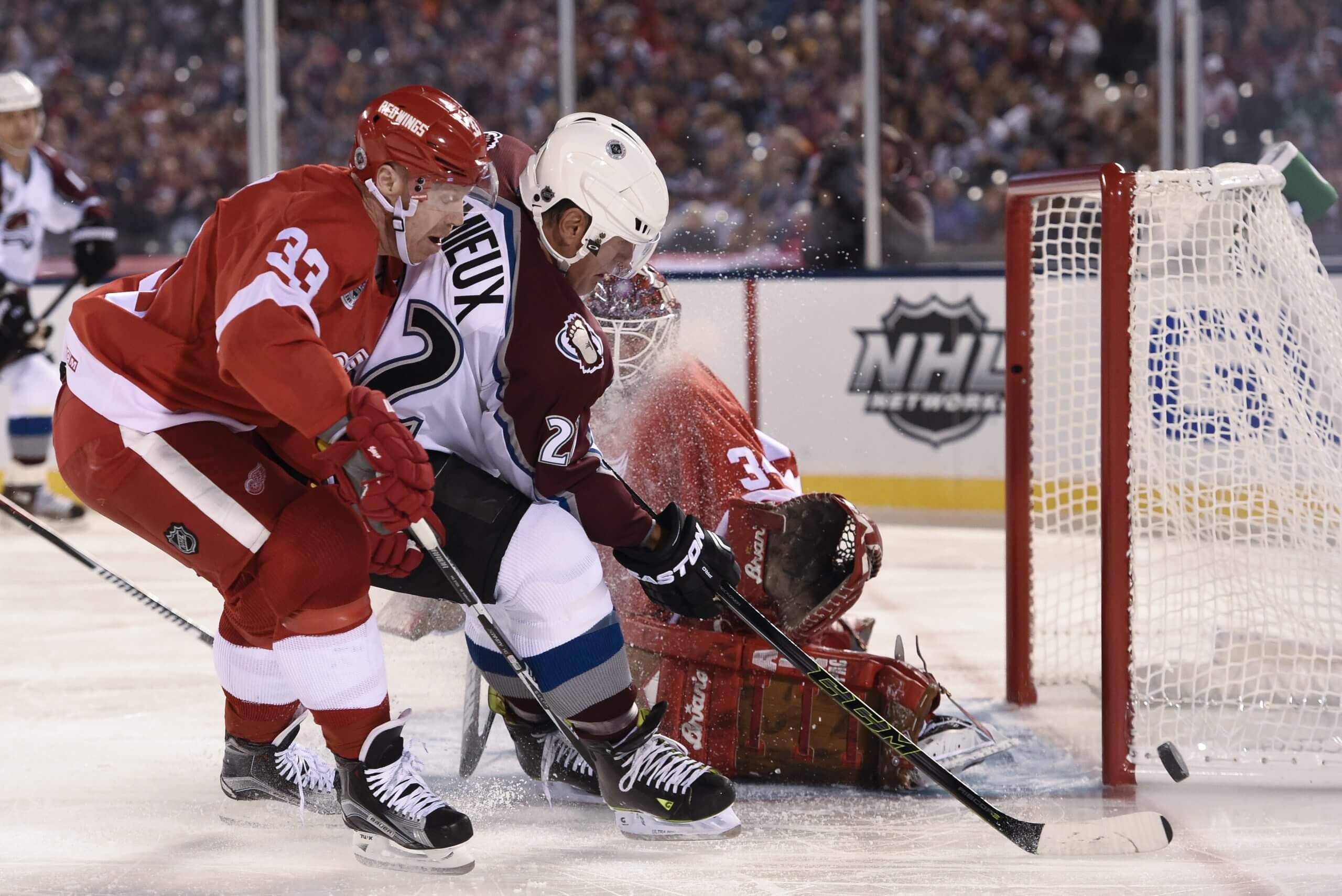
Claude Lemieux and Kris Draper battle for the puck in the 2016 Avalanche-Red Wings alumni game at Coors Field in Denver. (John Leyba / The Denver Post via Getty Images)
Lemieux and Draper remained intertwined even after they retired and moved into new parts of the hockey world. They shook hands after a 2016 alumni game, and Draper has since risen to become an assistant general manager for the Red Wings, while Lemieux, as a player agent, represented Detroit’s star defenseman Moritz Seider.
“For people that played with him, you definitely saw a different side to him when he wasn’t on the ice,” said former Red Wing Brendan Shanahan, who was a teammate of Lemieux’s in New Jersey prior to being on opposite sides of the Red Wings-Avalanche rivalry.
“Probably what I appreciate the most, and it doesn’t surprise me one bit, was that he was a really good friend to Darren McCarty when their careers were over and wanted to make sure that that relationship was a good one and a strong one. It’s weird to say my fondest memory is him befriending (an opponent) but it just says so much about Claude. Darren is famous in Detroit for that one play and Claude chalks it up as part of the game, and now ‘let’s be friends and let’s be brothers even though we were competitors.’
“He and I started out as teammates so it’s easy for us to sort of forgive and forget things that happened on the ice. But for him to seek out Darren and want to be a part of those documentaries and do autograph signings with Darren for what is not a very flattering photo of Claude, it just shows who he is. He could have just stayed enemies with Darren and that’s just not Claude.”
In a video posted to Instagram on Thursday, McCarty said that it was Draper who informed him of Lemieux’s death.
“This is extremely sad no matter what feelings from past or present you hold,” McCarty posted Thursday on X. “My thoughts and prayers to his family and friends and people who got to see the person off the ice wasn’t the person on. … Godspeed my friend.”
— Chris Johnston contributed to this report.