
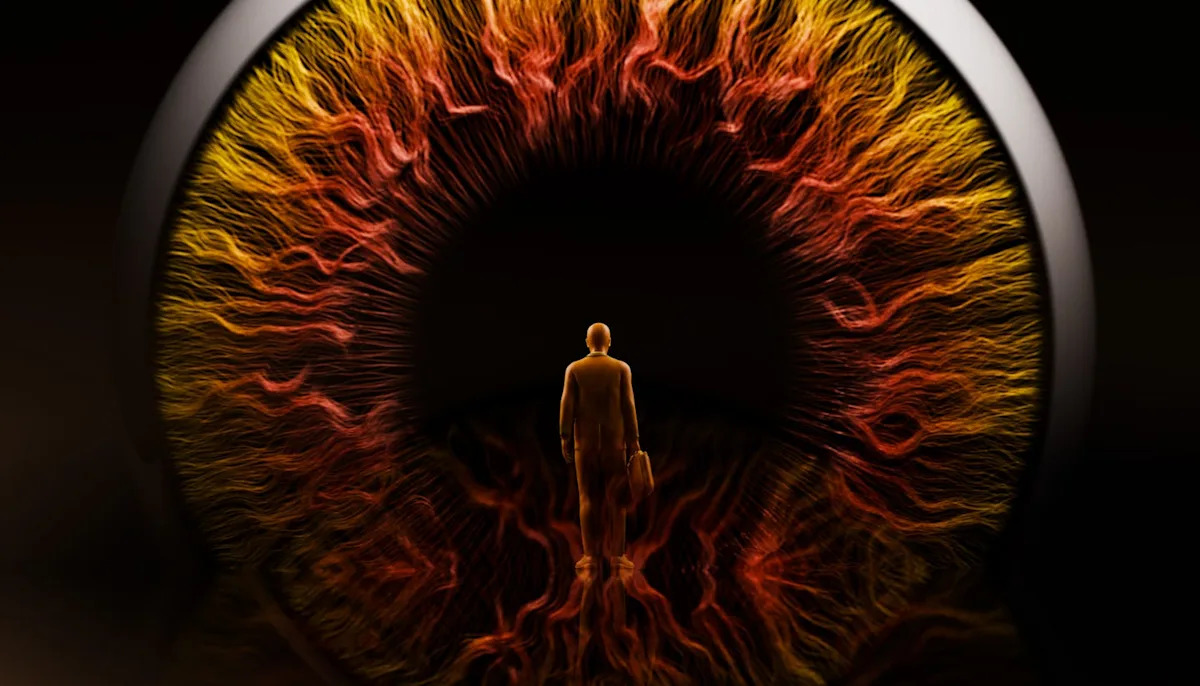
Abyssal whirlpools lurking somewhere in deep space, swallowing light and guarding the mysteries of the universe. That is what most of us imagine when we think of black holes. We would be surprised to learn, however, that each of us carries a tiny “black hole” inside our own personal micro-universe: the human head. Inside the retina, the eye tissue responsible for vision, lies a literal physical gap where visual information simply disappears. While it affects how we see, it also could be the seat of far-reaching implications—even raising provocative questions about the nature of consciousness itself and how we perceive reality.
Normally, visual regions of the cortex—the brain areas responsible for processing sight—receive direct signals from the retina through the optic nerve, the bundle of nerve fibers that carries visual information from the eye to the brain. But at the blind spot, no photoreceptors, the cells that detect incoming light, exist.
Yet, we never experience these spots as “holes” or “darkness” because the brain seamlessly fills in the missing information, constructing a continuous picture of the world. “In part, that is because our two eyes compensate for each other: the missing patch in one eye is usually visible to the other,” explains Lars Muckli, PhD, a professor of visual and cognitive neurosciences at the University of Glasgow. Even when one eye is closed, the brain uses surrounding visual patterns to silently rebuild the missing region.
Now, scientists from the University of Glasgow and York University, including Muckli, are turning this quirk of perception into a testing ground for rival theories of consciousness. They’re asking a fascinating question: if the brain can invisibly patch over absent pieces of sensory reality, how much of conscious experience is fabricated rather than directly encountered?
In a January 2026 study protocol published in PLOS One, the researchers described a series of experiments designed to examine exactly that question. The project forms part of the ambitious INTREPID, a large adversarial collaboration that forces rival theories of consciousness, namely integrated information theory (IIT) and two predictive processing models, to stop speaking in abstractions and start making predictions scientists can actually test.
IIT proposes that consciousness is tied to the brain’s physical architecture. Predictive processing theories, by contrast, argue that the brain constantly predicts and reconstructs reality—in a way, writing over what is missing before we even notice.
“With less cortical space devoted to representing the blind spot region, IIT proposes that perceived space should appear compressed or shrunk around it,” says Muckli. In essence, consciousness according to in IIT behaves more like a geographical feature: remove part of the terrain, and the space around it may subtly bend or compress.
Predictive processing theories, meanwhile, see consciousness more like a skilled computer-generated imagery (CGI) artist, stitching together gaps in perception so expertly that the illusion becomes indistinguishable from reality. In other words, says Muckli, the brain’s internal models have become so adapted to the blind spot that we experience it no differently from fully represented regions of the visual world.
But this “black hole” in the brain’s visual circuitry is not the only place where consciousness quietly edits the world we think we see. Muckli notes that humans also possess so-called “monocular crescents,” edge regions seen by only one eye at a time, that normally disappear into our fluid binocular view of the world. Yet, unlike classic blind spots, the brain does not rush to airbrush them away when one eye closes (likely because they are less central to our visual stability). Then there is the even larger hole in vision behind our heads, where neither eye receives any visual information at all. “Unlike the tiny blind spots, your brain does not fake an image there. You are consciously aware of the absence,” says Muckli.
Consciousness, it appears, sometimes hides missing information from us, while at other times it openly admits the void exists. Why?
According to Ramses Alcaide, PhD, a neuroscientist and CEO/cofounder of Neurable, a “cognitive wearables” technology company, the answer may lie in the brain’s relentless drive to keep our experience of reality coherent.
“The brain is not a passive receiver of sensory input. It is an active prediction machine that builds a model of the world and updates it as new information arrives,” he says. Alcaide describes the retinal gap as a “clean proof of concept” because at the gap, the update never comes—yet the brain does not show us a hole. Instead, it presents us with a complete scene generated internally from prior expectations and surrounding context.
If that is true, Alcaide argues, then the implications extend far beyond the optic blind spot itself. The world we consciously experience may not be raw reality, but rather “… a continuously updated simulation of the world, and sensory input is primarily used to keep that simulation calibrated,” he says. And “when the input disappears, the simulation [just] keeps running.”
Push the idea far enough, and the ramifications begin to resemble science fiction—or existential angst. If different brains rely on different histories, expectations, and sensory weighting to construct reality, Alcaide says, people may end up experiencing the same physical world in subtly different ways. “The Dress,” the viral image that appeared blue-and-black to some viewers and white-and-gold to others despite everyone receiving the exact same visual input, is a splendid example of this. Multiple neuroscience and perception studies that emerged in its explosive aftermath suggested that different brains unconsciously made different assumptions about lighting conditions, based on their unique life experience.
“We are not all watching the same movie,” Alcaide says.
This is why the arm-wrestling between IIT and predictive processing feels almost cinematic. Ultimately, it reveals that what we receive from the outside world and what we experience in our own inner world are not the same thing. “Sensory input is the raw data. Consciousness is the interpreted model,” says Alcaide.
Who would have thought that our own personal black holes might offer one of neuroscience’s most illuminating windows into consciousness? And if the brain can take a literal black hole in perception and cover it up, smooth it over, and fashion it into a believable reality before serving it to awareness, neuroscientists are left confronting a far larger mystery: how much of reality has your brain quietly been rewriting all along?
You Might Also Like