
THE RUNDOWN
The May Full Moon will rise on May 31, 2026 at 6:45pm AEST.
Today’s moon is a Blue Moon, a term for the second full moon in a one-month period.
This moon is also a “micromoon”, a phenomenon that occurs when the moon is at its “apogee”.
Typically, we get one full moon a month. But on May 31, Australian skies will deliver something rarer: a Blue Moon. No, the moon won’t glow cobalt. But it will rise full, luminous, and loaded with symbolism — marking the second full moon in a single calendar month, a phenomenon so uncommon that it is usually connected to the phrase “once in a blue moon.”
This year’s Blue Moon is also a micromoon, meaning the moon will sit at one of the furthest points from Earth in its orbit, appearing slightly smaller and dimmer than usual. But if you catch it rising just after sunset, you probably won’t notice. In fact, thanks to the famous “Moon Illusion”, it may look enormous. But what exactly is a Blue Moon?
“A blue moon is not an astronomical event,” explains Dr Laura Driesden, Postdoctoral Research Fellow in Radio Transients at the Sydney Institute for Astronomy. “It is just about how the lunar month doesn’t fit perfectly into a calendar year.”
It might not have huge astronomical relevance, but astrologically, Blue Moons are considered a perfect time to cast manifestations and “reset” psychologically and spiritually.
The Blue Moon reaches peak fullness on May 31 at approximately 6:45pm AEST — and astrologically, it arrives in Sagittarius, the zodiac sign associated with truth, expansion, restlessness, and the urge to look beyond your current horizon.
Below, find everything you need to know.
May 31st Full Blue Moon Fast Facts
Date: Saturday-Sunday, May 31
Peak Illumination: Sunday, May 31
Best Viewing Time In Australia: Sunday, May 31 at 6:45pm AEST
Where To See It: Across Australia in areas with low artificial light
Zodiac Sign: Sagittarius
Spiritual Meaning: Perspective shifts, expansion, adventure and release
When Is The Blue Moon In Australia?
The Blue Moon reaches peak illumination on Sunday, May 31, at approximately 6:45 pm AEST, with the best viewing occurring shortly after sunset.
State/Territory Best Viewing Time New South Wales 6:45pm AEST Victoria 6:45pm AESTQueensland 6:45pm AESTAustralian Capital Territory 6:45pm AESTTasmania 6:45pm AESTSouth Australia 6:15pm ACST Northern Territory 6:15pm ACSTWestern Australia 4:45pm AWST
For the best viewing experience, head somewhere with minimal light pollution, find a clear view of the eastern horizon, and try to catch the moon as it rises. This is when it will look most dramatic. If the weather is cloudy on Sunday night, the moon will still appear full on Saturday and Monday night, so don’t despair.
Tips for viewing:
Get out of the city: The moon is far more striking in areas of low light pollution. A short drive to an area with low light, whether a clifftop, park, or beach, will improve your view.
Face east or south-east: the blue moon will rise across the northern part of the sky before setting in the west-south-west.
Give your eyes 20 minutes to adjust: always allow your eyes to adjust to the dark before scanning the sky for the moon
Photographing: A phone with night or portrait mode will capture the blue moon at its best.
What Is A Blue Moon?
You’d be forgiven for associating the blue moon with a colour; the phenomenon is actually a quirk of the calendar. The moon completes an orbit around Earth roughly every 29.5 days — which means lunar cycles don’t line up perfectly with our 365-day year. Occasionally, that mismatch gives us an “extra” full moon.
“A blue moon is not an astronomical event,” Dr Driesden explains. “It is just about how the lunar month doesn’t fit perfectly into a calendar year.” There are four seasons in a year, the boundaries of these seasons are the summer and winter solstices and the two equinoxes. “Between a solstice and an equinox, one season, we typically get three full moons and each of those has a name,” Driesden says.
“Every now and then there’s a fourth full moon in a season,” Dr Driesden says. “When that happens, the first, second and fourth full moons keep their original names and the third gets called a blue moon.”
There are actually two kinds of Blue Moons: seasonal and calendar Blue Moons. The May 31 moon is a calendar Blue Moon, meaning it’s the second full moon to occur within a single month. The term itself is surprisingly modern. Its current usage dates back to the 1930s and was later popularised through references in the Maine Farmer’s Almanac (different to The Old Farmer’s Almanac). The previous calendar Blue Moon occurred on August 31, 2023, while the next will arrive on December 31, 2028.
Why Is This Blue Moon Also A Micromoon?
This weekend’s full moon is also what astronomers call a micromoon. The Moon’s orbit around Earth isn’t perfectly circular — it’s slightly oval. That means there are moments when the Moon sits slightly closer to Earth (perigee) and moments when it drifts farther away (apogee).
A supermoon happens when a full moon coincides with perigee. A micromoon happens when a full moon occurs near apogee — the Moon’s furthest point from Earth.“It sounds dramatic, but the human eye usually can’t tell the difference,” Dr Driesden explains. “Unless you have a side-by-side comparison, a micromoon looks very similar to any other full moon.” Ironically, the moon may actually appear larger than usual as it rises. “If you watch the full moon rise, you’ll notice it looks bigger when it’s close to the horizon,” Dr Driesden says. “That’s called the Moon Illusion and it’s something our brains do.”
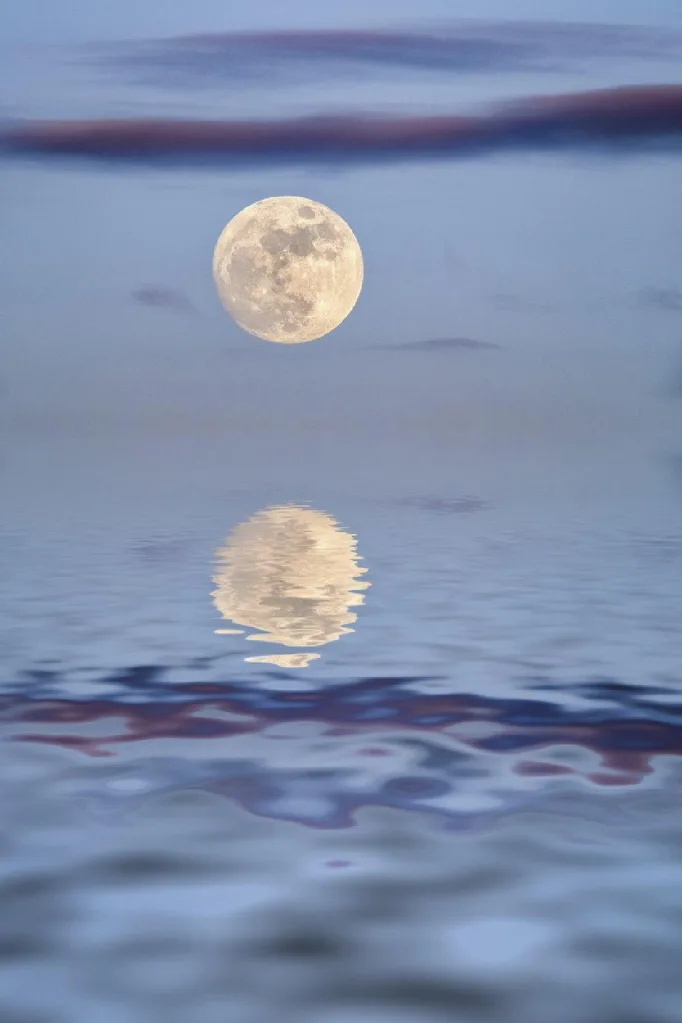
Our next micromoon will be a blue moon (Getty).
What Is The Spiritual Meaning Of The Blue Moon?
Astrologically, this Blue Moon arrives in Sagittarius: the zodiac’s philosopher, traveller, and truth-seeker. Spiritually, astrologers associate the Full Moon in Sagittarius with perspective shifts, revelation, and the urge to break beyond old limitations. Sagittarius energy is expansive and future-focused, linked to higher learning, freedom, travel, and asking bigger questions about the direction of your life.
While full moons are traditionally associated with culmination and release, Sagittarius adds momentum. This isn’t necessarily a soft or introspective moon — it’s one that pushes you outward and forward. You might feel sudden clarity after a period of confusion, the sudden urge to book a flight or the feeling that your world has become too small. It can also provide a reset as we reach the midpoint of 2026 after an emotionally intense astrological five months. Essentially, it’s time to think big.
When Is The Next Blue Moon?
According to Time and Date, the next Blue Moon will occur on May 20, 2027.
When Is The Next Full Moon?
Next month, the full moon (a “Strawberry Moon”) will rise on June 30, 2026.

Senior Writer, Fashion + Beauty
Sign up for our newsletter
Sign up for the latest news from ELLE including offers and discounts we choose to share with you
By joining, you agree to our Privacy Policy & Terms of Use
About your privacy Are Media Pty Limited collects your personal information through this site to process registrations, send out newsletters, communicate offers, discounts, competitions, or surveys, and to provide you with targeted advertising based on your online activities. Our Privacy Policy contains information on how you can access or correct your personal information, which entities we may disclose your personal information to (including overseas recipients), how to opt out of targeted advertising, and how to lodge a complaint.