
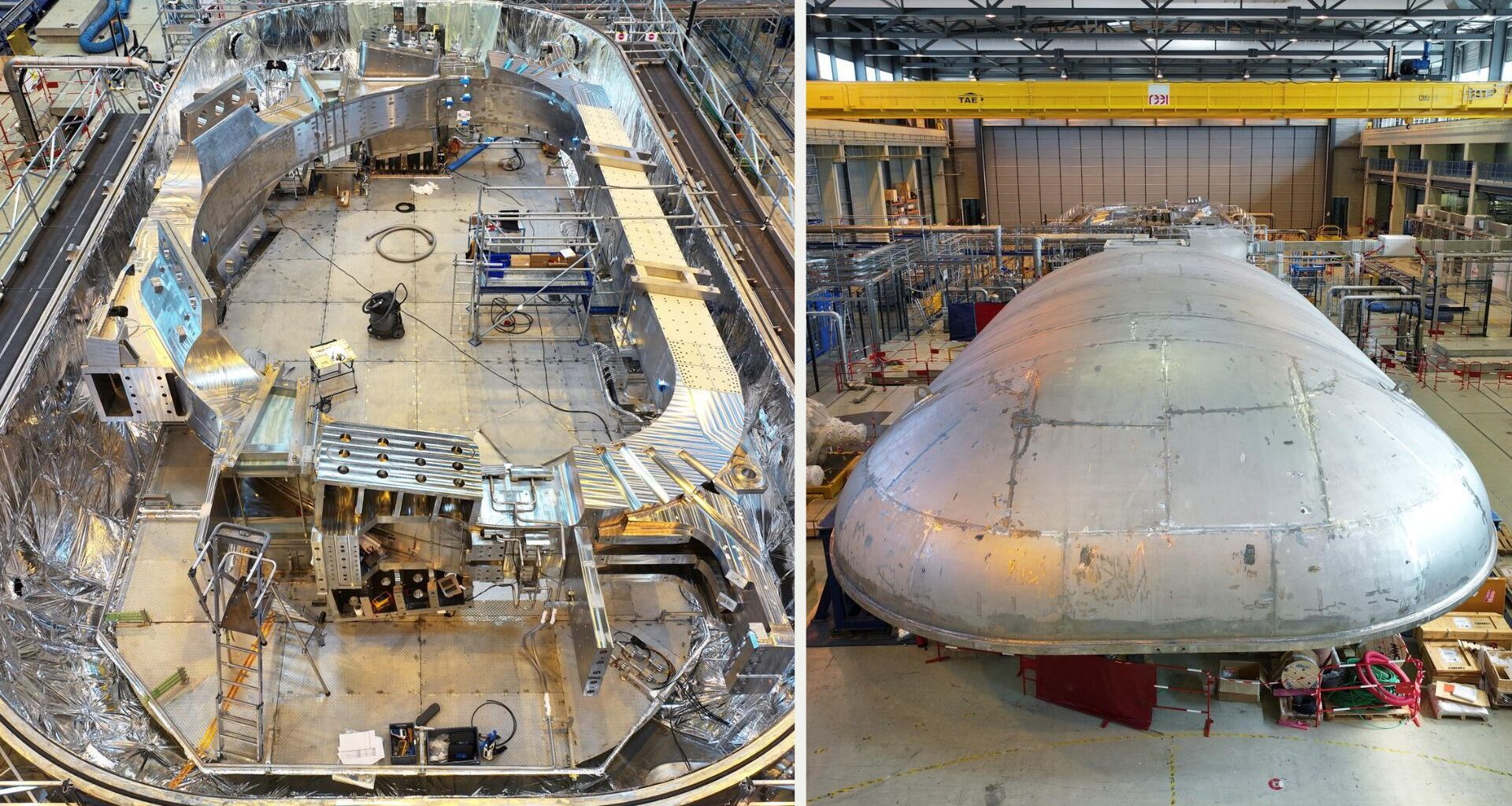
Engineers are preparing for high-current trials at ITER’s newly activated Magnet Cold Test Facility, following a 12-day cooling process that lowered a 330-ton toroidal field coil to its functioning temperature of 4 Kelvin (minus 269 degrees Celsius). This operational milestone was celebrated yesterday during a site visit by the ITER Council’s Management Advisory Committee.
This program verifies magnet performance before the parts are locked into the main reactor. Over the course of four to six months per coil, the team will subject components to full operational electrical currents, which reach 68 kiloamperes (kA) for the toroidal field units and 48 kA for the poloidal field units.
“Eighteen D-shaped toroidal field coils, six ring-shaped poloidal field coils, and the six independent modules of the central solenoid-with a combined stored magnetic energy of 51 Gigajoules (GJ)-will produce the magnetic fields that initiate, confine, shape and control the ITER plasma,” said ITER in a press release.
Generating intense magnetic fields
Constructed from niobium-tin (Nb3Sn) and niobium-titanium (Nb-Ti), these alloys require liquid helium immersion to lose their electrical resistance.
Superconducting systems are essential for industrial-scale fusion because they generate intense magnetic fields with minimal electricity compared to copper variants. However, this state relies on keeping temperatures, current levels, and magnetic forces below strict physical limits.
If these thresholds fail, the material undergoes a “quench,” reverting to a standard resistive state that releases sudden heat. Consequently, a major goal of these cold runs is verifying that the automatic safety sensors detect these thermal changes instantly.
Measuring how magnets handle stress
Running these benches alongside existing plant networks provides early data on how the central control systems, power feeds, vacuums, and cooling setups interact. This parallel testing reveals vulnerabilities prior to final plant commissioning.
Though the setup cannot mimic the exact environment of an active fusion reaction, it measures how the magnets handle stress, monitors insulation behavior, and checks the integrity of internal superconducting joints.
Managing components that weigh hundreds of tonnes demands significant logistics, including a 20-meter-long cryostat chamber, heavy electrical links, and direct lines to the facility’s primary helium cryoplant.
ITER built this testing area inside an assembly hall formerly used by Fusion for Energy for shaping large exterior coils, capitalizing on the building’s existing heavy cranes and its layout.
Lowering project risks
ITER Director-General Pietro Barabaschi noted that adapting this existing footprint allowed the organization to lower project risks logically before starting full system integration. He added that the facility will eventually serve the broader commercial fusion market by sharing technical insights.
Once ITER finishes its own scheduled runs on the initial niobium-tin (Nb3Sn) coil and subsequent manufacturer deliveries, private fusion ventures will gain access to the testing area.
“This is important for ITER as well as an example of how ITER can support the wider fusion ecosystem by creating knowledge, infrastructure, and operational experience that others can use,” concluded Barabaschi.