

 Image via Unsplash.
The most radical thing a burned-out person can do may look like nothing at all.
Sit on a bench without checking your phone, just looking at what’s happening around you, and you might feel a strange guilt brewing. Maybe you should answer that message, or check your email. Perhaps you should be striving to improve yourself, or at the very least, optimize your fun somehow.
But what if the opposite is true? What if what you should be doing is nothing at all?
The Dutch have a word for it: niksen. Literally, “nothinging.” Niksen means doing nothing without a purpose. You don’t get an achievement for it, there’s no secret productivity hack. But increasingly, science is showing that may be exactly what our modern brains need.
Everyone Is Burned Out
The world is clearly going through a work stress and exhaustion crisis. Global surveys show high workplace stress and persistent emotional strain, especially after the pandemic. Gallup’s 2026 State of the Global Workplace report found that 80% of employees worldwide aren’t engaged at work, while stress, anger and sadness are on the rise. There is also evidence that burnnout is widespread among younger workers. Around half of millennian and Gen Z workers feel burned out at work.
 The figures in the UK are similar to those in many parts of the world.
Burnout is the most extreme and chronic form of this stress. It involves mental and emotional exhaustion, fatigue, insomnia, and physical symptoms like headaches or stomach aches.
The world isn’t burned out just because we work too much, it’s burned out because we’re forgetting how to relax. The economy of self-improvement, the constant hustle, has been seemingly ingrained into us. When we’re not doing anything, we feel like we’re failing; but our brain strongly disagrees. Our brain, it turns out, likes it when our mind wanders sometimes.

A big part of the problem is that our brain doesn’t have unstructured downtime. Burnout happens not just because we work too much, but because we don’t recover. Burnout keeps the brain stuck in task mode, and your brain doesn’t like that. In fact, one particular area doesn’t like that.
×
Thank you! One more thing…
Please check your inbox and confirm your subscription.
Your Brain’s Dfault Mode Network
The Default Mode Network (DMN) is a network of interacting brain regions that activates when you’re awake but not focused on anything in particular. It is highly active during wakeful rest, daydreaming, mind-wandering, recalling personal memories, and envisioning the future.
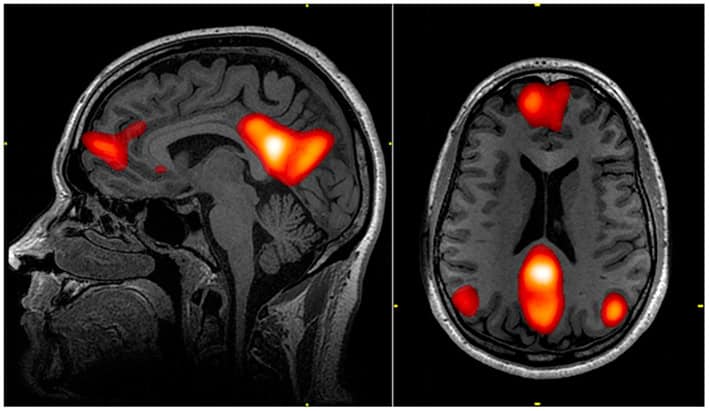 Magnetic resonance imaging of areas of the brain in the default mode network. Image credits: John Graner, Neuroimaging Department, National Intrepid Center of Excellence, Walter Reed National Military Medical Center.
But the DMN isn’t just loafing around. It’s linked to how we remember the past, imagine the future, and how we think about ourselves. The phrase “default mode” can be misleading. It sounds passive, like a laptop dimming its screen. But the brain at rest is metabolically expensive. Classic work by Marcus Raichle and colleagues helped establish that the brain’s baseline activity is high, and that focused tasks add only a modest increase compared with that already-active baseline.
The brain actually consumes a lot of energy at rest (about as much as when we think actively about something) and the DMN is a big part of that. The DMN does much of its work during those periods.
So basically, when you stop focusing on a task, the brain doesn’t shut down. It simply shifts modes.
In healthy downtime, the DMN starts supporting memory processing and your sense of meaning. But under chronic stress, the same inward-turning machinery can become hijacked by rumination — repetitive, negative thought loops. You lose your sense of meaning and get overwhelmed by negative thoughts. That might sound familiar.
That’s where niksen comes in.
Your Brain on Niksen
Niksen was popularized internationally by writer Olga Mecking, especially through her 2019 New York Times essay “The Case for Doing Nothing,” in which she encouraged readers to “stop being so busy.” Mecking then wrote a book on niksen which, despite polarizing reviews, got the concept into the public eye.
But is this actually backed by science?
 Cats, of course, are master niksers.
The term Niksen itself doesn’t really appear in science papers. It’s a cultural term rather than a scientific one. But the concepts that niksen envelops have been studied.
A 2025 PLOS ONE longitudinal study followed working-age adults in the UK across two pandemic lockdown periods. They found that people who were better able to psychologically detach from work had better wellbeing, lower anxiety, and higher life satisfaction one year later. Burnout, whatever the cause may be, is a real problem.
“Interventions to encourage workers to psychologically detach from work may help to support employee wellbeing at all times, not only in the extreme circumstances of pandemics and economic uncertainty,” the researchers concluded.
A 2024 Frontiers review argued that boredom and curiosity are closely linked as drivers of information-seeking. It found that boredom works a bit like “hunger” for stimulation, while curiosity works more like “appetite” toward specific information. Letting your mind wander (something many would consider “boring”) is your brain’s way of processing information and re-establishing itself. Another 2024 study found that “freely moving mind wandering” helps build creativity.
There are studies that show how burnout affects us, and how mind wandering can help. These (and several others with similar conclusions) are recent studies. We’re just now uncovering how useful it is to let your mind wander.
The Breakthrough Brain
The classic 2012 study often cited in niksen discussions found that people who did an undemanding task during an incubation period performed better on later creative problem-solving than people who did a demanding task, rested, or had no break.
This goes back to the same idea we mentioned before: when your mind is wandering, your brain isn’t actually switching off. It’s just working in a different way.
If you’ve ever struggled with a problem only to have the answer “magically” appear in your head after a break or sleep, you’ve probably experienced it. You didn’t think about the problem consciously, but in the background, your brain was working on it.
Cognitive scientists call this incubation, and it’s been demonstrated in a number of different studies. But it was French mathematician Henri Poincaré gave one of the most influential descriptions of creative incubation.
Poincaré, like all mathematicians, had moments when he got stuck. In one particular episode, he felt completely stumped by a problem. Then, he went on a vacation. As he was going on a bus, as he was mid-step and mid-conversation, the solution came to him. Nothing from the outside gave him clues, it was his brain that, powered by mind wandering, figured it out. Poincaré argued that unconscious work continues after deliberate effort stops, and that stepping away can let hidden combinations surface.
His observations were remarkably spot on. The mind doesn’t stop working just because we stop forcing it. This is why breakthroughs so often arrive during walks, showers, train rides, or idle moments at the window. The occasional break is not empty time.
When we step away from focused effort, the brain shifts out of performance mode and into a looser, more associative state. Instead of marching down one narrow path, attention begins to roam. Memories, images, half-formed ideas, and old observations can bump into each other in new ways. That is the quiet gift of rest: it gives the brain room to keep thinking without the pressure of having to produce an answer on command.
Why Niksen
 A cafe can be an excellent niksen environment.
This doesn’t mean boredom is always good. Chronic boredom, especially in dead-end jobs or isolated lives, can be corrosive. Nor does Niksen mean sitting in misery while anxious thoughts swarm. For people with severe anxiety, depression, trauma, or acute burnout, open-ended idleness can sometimes become rumination.
But niksen isn’t just doing nothing. It’s doing nothing on purpose — not to improve yourself, not to recharge for more work, not to squeeze some hidden productivity out of the pause. Niksen is meant to let the brain wander.
If you’re feeling overwhelmed by bad thoughts, an anchor might help; something to get you to be mindfully in the moment. You can try looking at trees or at the people around you. Doing something absent-mindedly (like knitting or doodling) can help. You can even do it when you’re doing a light workout, like running.
Niksen creates a deliberate gap between effort and recovery. It should feel effortless, like when you’re exploring things as a child.
How Do I Niksen?

The first rule of niksen is almost annoyingly simple: stop trying to do it well.
There is no posture to perfect. There’s no competition. It’s not a productivity trick disguised as rest. Stop trying to make it correct.
Then, start small. Two minutes is a good start. Look out a window. Actually look. What do you see? Take a second to think about it. Does it remind your of anything, or is there anything that’s aesthetically pleasant? Let your eyes wander without looking for something.
Niksen also works great when you sit on a bench. If you can do that in a park or by water, that’s even better. You can also do it in a cafe, taking in the smells and buzzing of the place. As long as you let your brain wander and you don’t look at your phone, you’re golden.
At first, it may feel uncomfortable. Burnout culture may try to make you feel guilty. You may panic and realize you’ve got a looming deadline or a shopping list to complete. The emails won’t write themselves.
Let it pass.
Focus on what’s around you, and listen to your senses. The whole trick is to avoid purpose.
Niksen works best in small, ordinary gaps: between emails, after lunch, before opening your laptop, while waiting for the kettle, after finishing a hard task. A good niksen moment ends without fireworks and big revelations. You’ll just have a slightly softer nervous system that’s better prepared to deal with the rest of the day.
No Silver Bullet
Niksen is an individual solution — not designed to resolve societal problems. It can’t replace fair wages, humane staffing, paid leave, predictable schedules, childcare, psychological safety at work, or managers who think mental health and burnout aren’t real.
But niksen is also a bit about rebellion. It challenges the idea that human worth depends on work output, and it works best when we treat it both as a personal practice and as a cultural critique.
The promise of niksen is not that doing nothing will help us do more and feel better. It seems like an absurd promise, and yet its roots are anchored in science. Because maybe, just maybe, it’s not individuals who are broken; it’s the machine.
And in a burned-out world, that may be the beginning of recovery.