
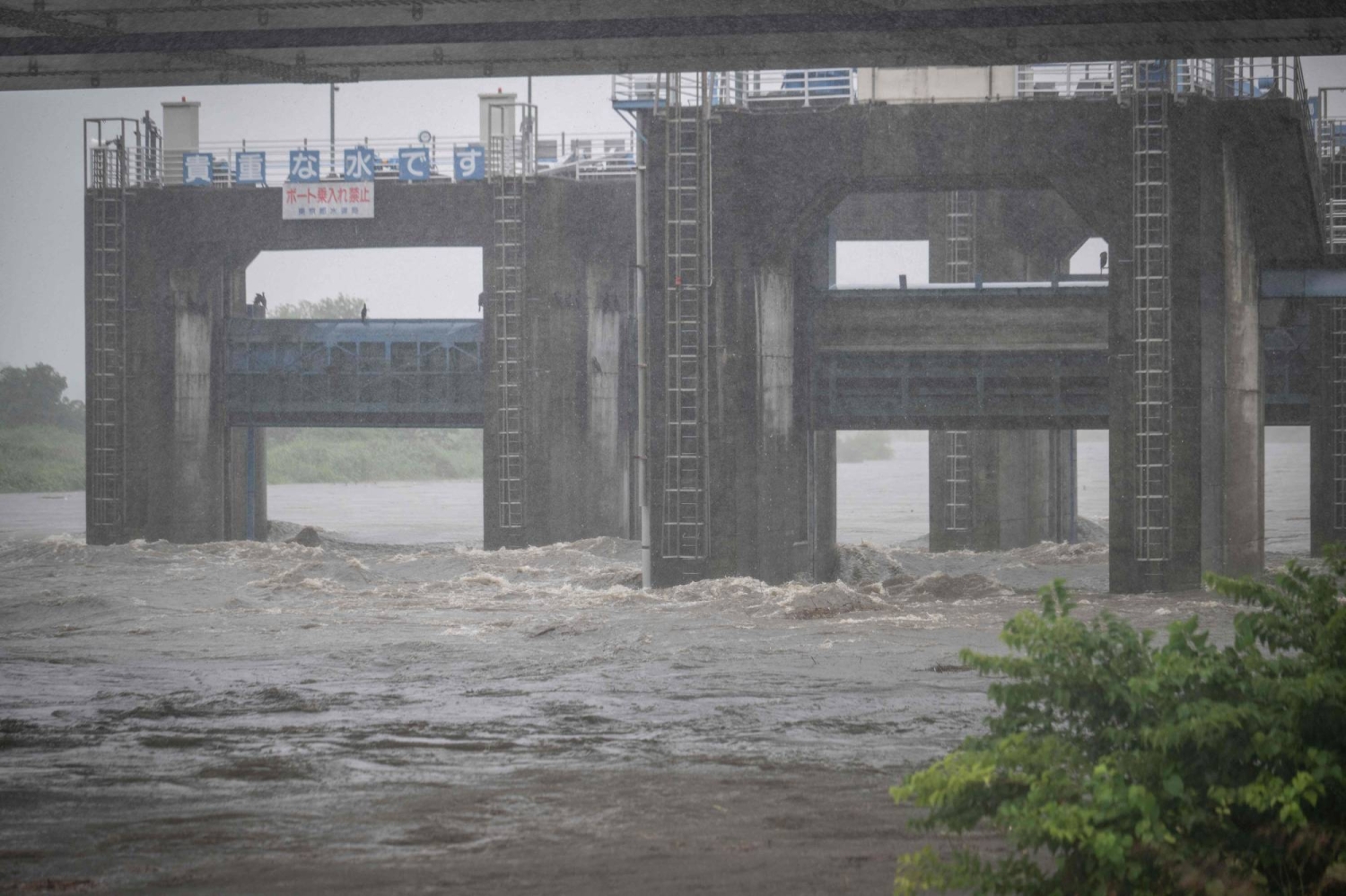
Tropical Storm Jangmi, known in Japan as taifū no. 6, lashed a broad swath of central and eastern Japan with heavy rain and strong winds on Wednesday, triggering flood alerts across the area.
As of 12 p.m., the storm was located about 60 kilometers south-southwest of Izu-Oshima, in Shizuoka Prefecture, and was moving east-northeast at 45 kilometers per hour. It had a central pressure of 985 hectopascals with wind speeds of 25 meters per second and was packing maximum sustained winds of 35 meters per second.
As of 12:30 p.m. level 4 evacuation orders were in place in Tokyo for all of Shinagawa Ward and areas near the Nogawa and Kanda rivers.
In Chiba Prefecture, the cities of Izumi, Minamiboso, Kamogawa, Katsuura, the Gyotoku district of the city of Ichikawa and the town of Otaki all had level 4 evacuation orders.
In Kanagawa prefecture, level 4 evacuation orders have been issued in some wards of Yokohama and Kawasaki, as well as the cities of Yokosuka, Miura, Fujisawa, Kamakura, Zushi and the town of Hayama.
Shortly after 9.40 a.m. in Kawasaki’s Saiwai Ward, a road intersection flooded, with some areas reaching a depth of 30 centimeters. The area around Kawasaki Station was also temporarily flooded, according to NHK. At 11 a.m., several meters of a section of national highway in Tokyo’s Ota Ward was also flooded.
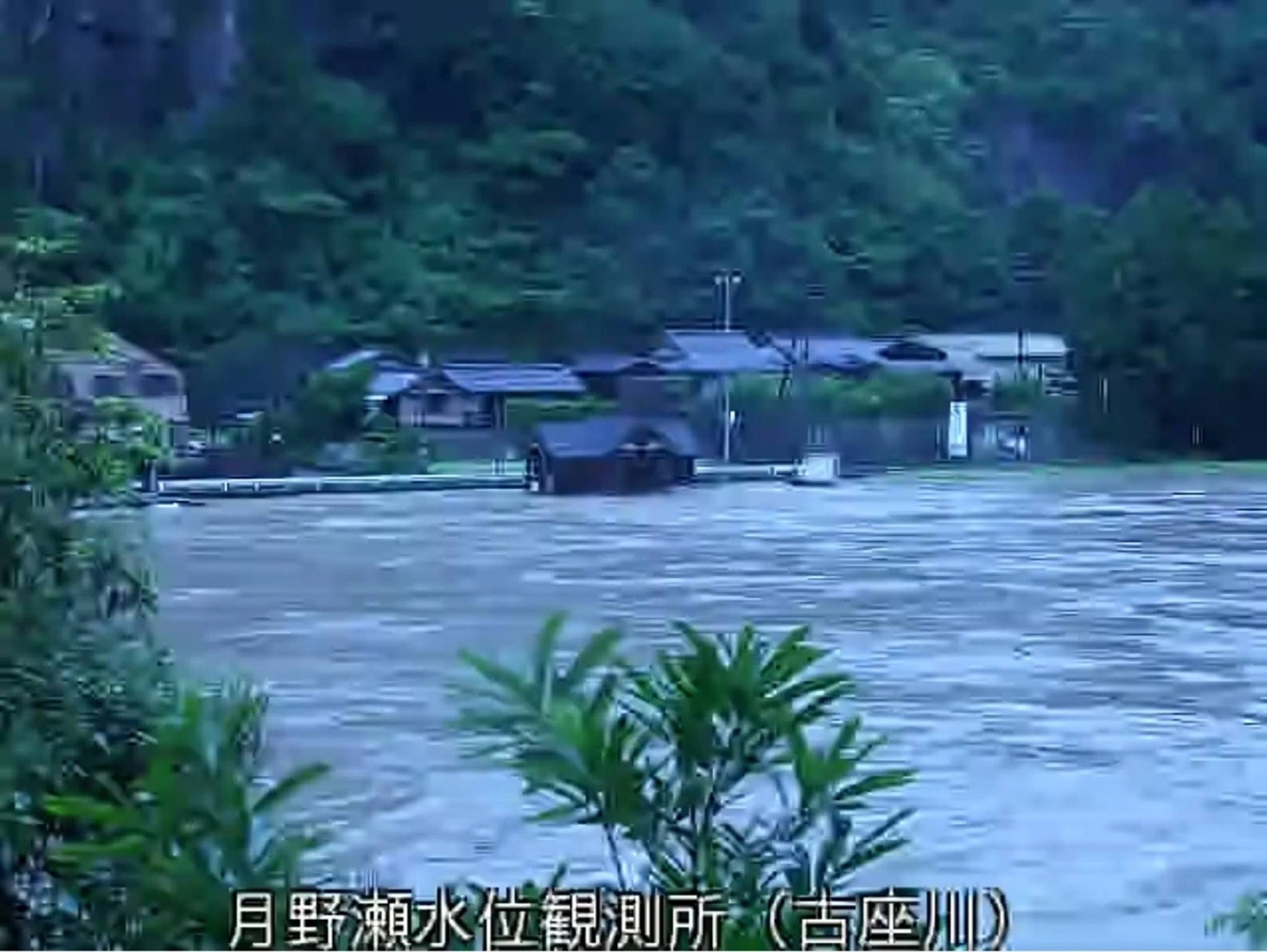
The Koza River is seen Wednesday in a screenshot from video after the Japan Meteorological Agency and Wakayama Prefecture issued a Level 5 special flood warning — the highest level. The warning was later downgraded to Level 2, but officials continued to urge residents to remain alert for rising river levels and flooding.
| WAKAYAMA PREFECTURE / VIA JIJI
Earlier Wednesday, the Meteorological Agency and Wakayama Prefecture issued a Level 5 special flood warning — the highest level — after flooding occurred along the Kozagawa River. The warning was later downgraded to Level 2, but officials continued to urge residents to remain alert for rising river levels and flooding.
The meteorological agency said very strong winds were expected Wednesday along the Pacific side of western and eastern Japan and the Tohoku region. Maximum sustained winds were forecast to reach 25 meters per second in the Kanto-Koshin, Tokai, Kinki and Shikoku regions, with gusts of up to 35 meters per second. In Tohoku, winds were expected to reach 23 meters per second, with gusts of up to 35 meters per second.
Seas were also forecast to be extremely rough, with swells along the Pacific coast. Wave heights were expected to reach 9 meters in the Kanto-Koshin and Kinki regions, 8 meters in Tokai, and 6 meters in Tohoku and Shikoku.
The agency said torrential and extremely heavy rain was expected along the Pacific side of western and eastern Japan. In the 24 hours through noon Thursday, up to 120 millimeters of rain was forecast in the Kanto-Koshin and Tohoku regions.
The agency urged people to remain on strict alert Wednesday for landslides and high waves with swells along the Pacific side of western and eastern Japan, while also warning of violent winds, flooding in low-lying areas, rising river levels and flooding. High waves were expected to remain a concern in eastern Japan and Tohoku through Thursday.
Jangmi also disrupted rail and air travel across Japan on Wednesday, with train cancellations and delays in the Tokyo metropolitan area and airlines scrapping hundreds of flights, including services to and from Haneda Airport.
According to Tokyo Electric Power Co. Holdings, as of 12:59 p.m. 9,740 homes in the Kanto-Koshin region were without power.
The agency advised residents to move indoors and secure their safety if signs of approaching cumulonimbus clouds appear.
Jangmi is also disrupting rail and air travel across Japan, with train operators warning of cancellations and delays in the Tokyo metropolitan area and airlines scrapping hundreds of flights, including services to and from Haneda Airport.
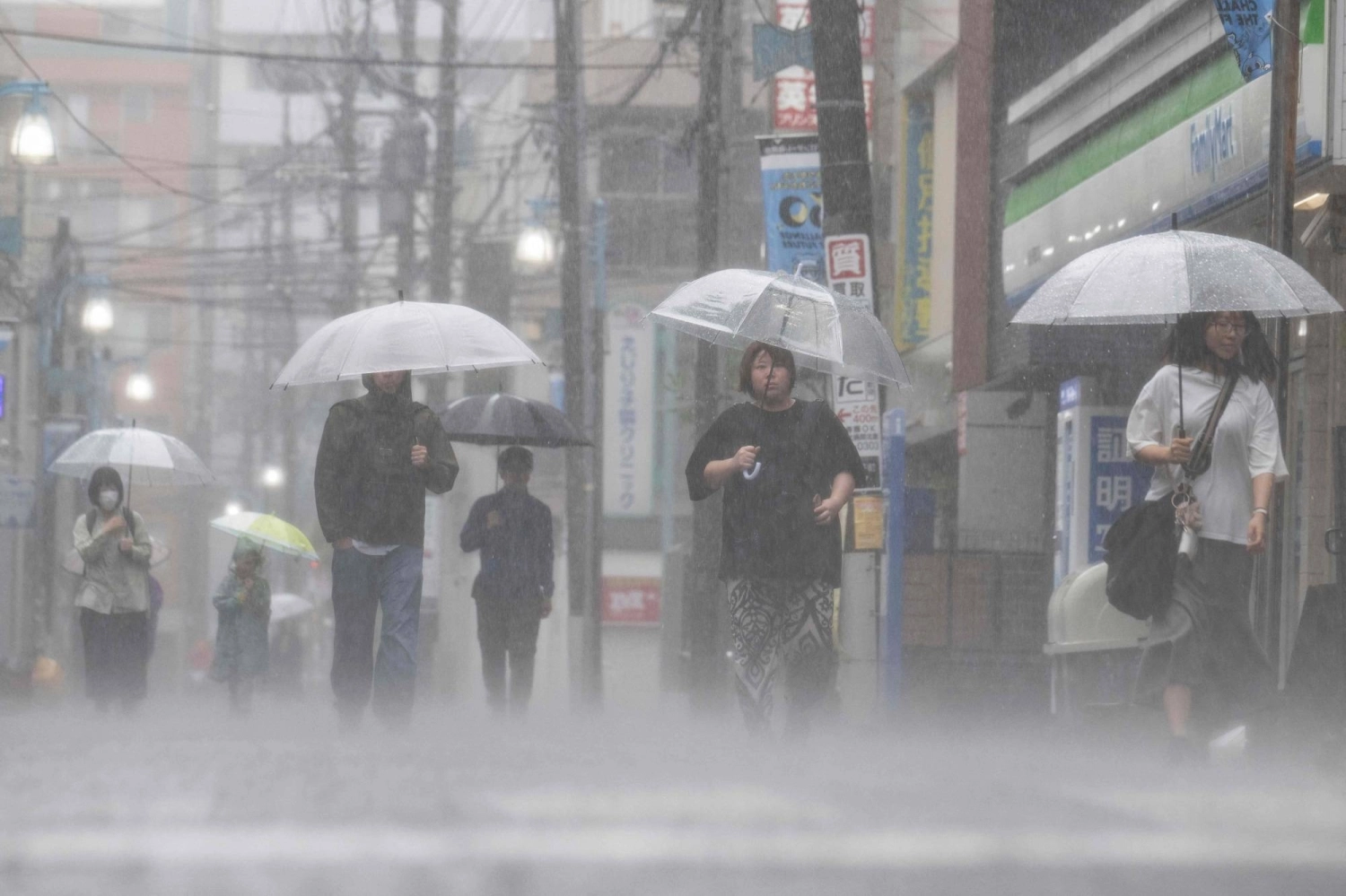
People commute in heavy rain brought by Tropical Storm Jangmi in Kawasaki on Wednesday.
| AFP-JIJI
JR East suspended several lines from the start of service. The Shonan-Shinjuku Line was halted between Shinjuku and Odawara and Zushi stations, with operations expected to resume around 4 p.m. The Chuo Line was suspended between Takao and Fujimi stations with operations expected to resume around 3 p.m., while the Ome Line was halted between Ome and Okutama stations with operations expected to resume around 8 p.m. The Tokaido Line was also suspended between Odawara and Atami stations.
Service on the Hachiko Line was suspended in both directions between Haijima and Komagawa stations from around 5:15 a.m. after tree branches became tangled in overhead wires.
Several lines were set to remain suspended for the entire day, including the Uchibo Line between Kimitsu and Awa-Kamogawa stations, the Sobu Main Line between Sakura and Choshi stations, the Kashima Line between Sawara and Kashima-Jingu stations, the Sotobo Line between Kazusa-Ichinomiya and Awa-Kamogawa stations, the Narita Line between Narita and Choshi stations, and the Kururi Line between Kisarazu and Kazusa-Kameyama stations.
Tokyo Metro and other private railway operators in the Tokyo area also warned of possible suspensions and delays from the morning.
Limited express services were heavily affected. The Narita Express, as well as Azusa and Kaiji trains linking Tokyo with Yamanashi and Nagano prefectures, were suspended from the first trains of the day with operations expected to resume around 3 p.m. All services were canceled on the Odoriko and Saphir Odoriko lines linking Tokyo and Shizuoka Prefecture; the Shiosai, Sazanami and Wakashio lines linking Tokyo and Chiba Prefecture; the Kinugawa and Spacia Nikko lines linking Tokyo and Tochigi Prefecture; and the Kusatsu/Shima line linking Tokyo and Gunma Prefecture.
Airlines also canceled a large number of flights as the typhoon affected operations. According to NHK, major domestic carriers canceled about 760 domestic flights on Wednesday, including services to and from Haneda Airport, along with more than 90 international flights.
Domestic cancellations included 292 flights by Japan Airlines, 232 by All Nippon Airways, 70 by Skymark, 37 by Solaseed Air, 32 by Peach Aviation, 31 by Jetstar Japan, 28 by Air Do, 22 by StarFlyer, five by Japan Transocean Air, four each by Fuji Dream Airlines and IBEX Airlines, and two by Spring Japan.
ANA also canceled 55 international flights, while JAL canceled 37.