
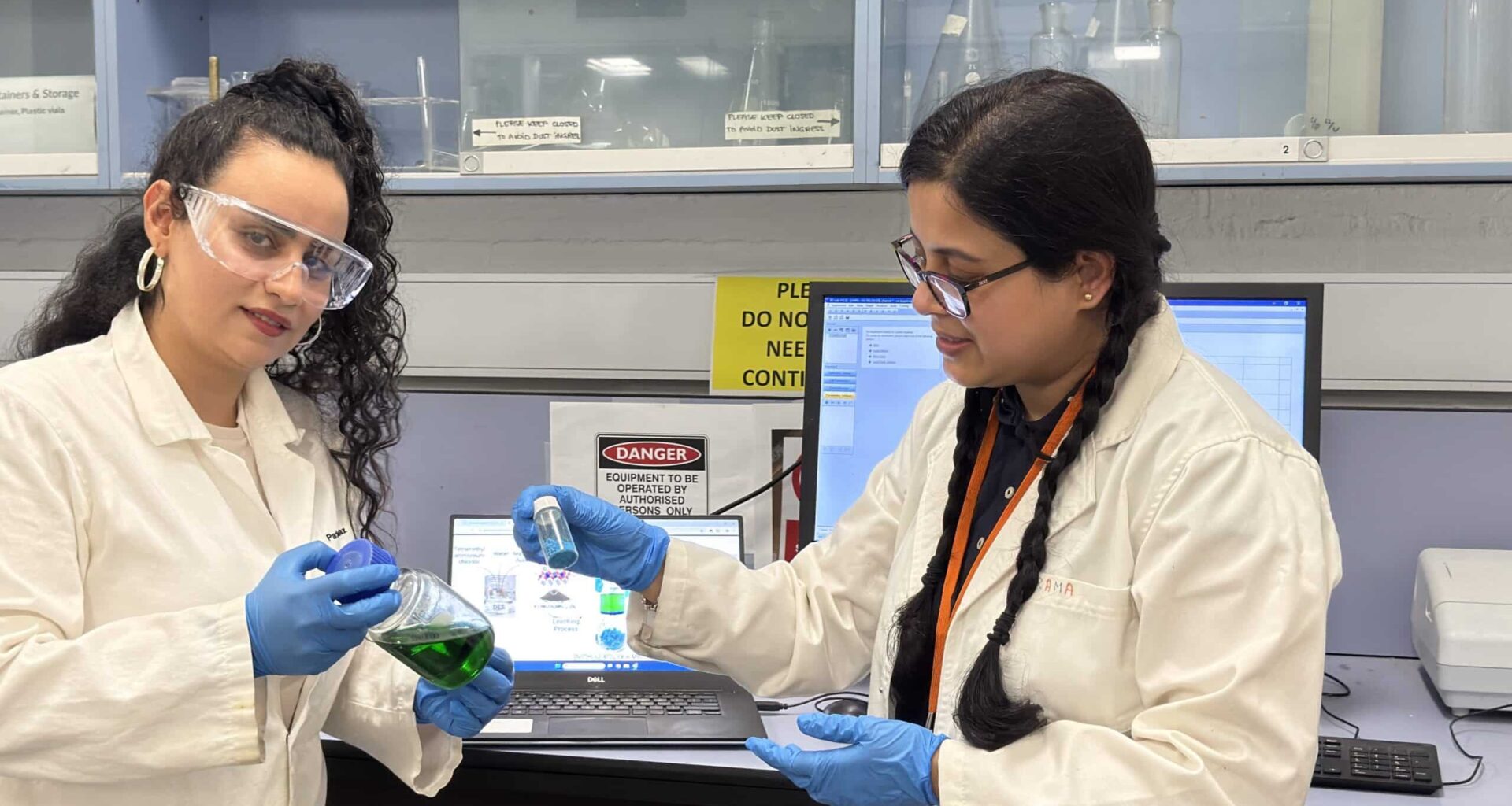
A Monash University research team has developed a new approach to the sustainable recovery of valuable metals from disposed lithium-ion batteries.
Sustainability is a cornerstone of Monash University’s many education programs.
The concept spearheads the various research projects of Dr Parama Banerjee, Senior Lecturer with the Monash Department of Chemical and Biological Engineering.
“As an organisation, Monash pledges for a sustainable future,” Parama says. “Sustainability as an idea is taught from the very first semester in various bachelors’ degrees and continues through different courses. It is also embedded in our higher research curricula.”
Parama leads a team of ‘sustainable engineers’ who research recycling and circular economy opportunities for various waste streams – from legacy wastes to solar panels.
Disposed lithium-ion batteries have been a focus of the team, but particularly for Dr Parisa Biniaz, a recent PhD graduate and Lecturer in Chemical and Biological Engineering at Monash University.
“My research focuses on recycling lithium-ion batteries,” Parisa says. “This research is critical as battery waste continues to grow across Australia, bringing both environmental risks and significant opportunities to recover valuable materials.”
According to Parisa and Parama, close to 3000 tonnes of lithium-ion batteries are produced in Australia annually. When these batteries are disposed of – typically in landfill – they can leak metal substances which pose a range of risks to the surrounding environment.
“Lithium-ion batteries contain cobalt, nickel, and manganese,” Parama says. “Some of these materials are carcinogenic. When batteries are sent to landfill, these toxins can leach into the soil and contaminate groundwater. This eventually reaches our marine environments and negatively impacts our flora and fauna.
“They also contain electrolytes which can become explosive under certain conditions.”
These environmental risks can also carry consequences for the country’s economy and the health of specific regional and cultural communities.
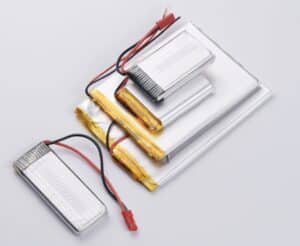 The metals left in lithium-ion batteries after disposal pose a serious risk to the surrounding environment and are quite valuable if recovered. Image: amixstudio/stock.adobe.com
“People generally dispose of these batteries in landfills in rural areas,” Parama says. “Communities within close proximity of these landfills will be more affected by the waste’s toxicity than other groups.
“Some of the metals used in lithium-ion batteries are also quite scarce and will vanish from the earth in the next 50 years due to our mining of them.
“Recovering these resources from disposed batteries is crucial. It will allow us to reuse the metals in other products, and as a result we won’t have to rely exclusively on virgin mining.”
Traditionally, two methods have been used to recover metals from spent batteries. Pyrometallurgy uses extremely high temperatures to extract metals, while hydrometallurgy relies on leaching – a process in which metals are dissolved into a liquid solvent to enable their separation and recovery at high purity.
Parisa has developed a new approach to hydrometallurgy through a novel and more sustainable solvent known as a deep eutectic solvent.
“The deep eutectic solvent is much less toxic than the harsh acids commonly used in conventional hydrometallurgy,” Parisa says.
“We can also employ it at much lower temperatures than those required in pyrometallurgical processing.
“The method that we use to apply the solvent is still leaching, but it’s easier to implement and more versatile, so it’s more sustainable.”
This versatility means the solvent can recover metals in different ways in line with industry requirements.
“The recovered metals can be recovered using a range of downstream techniques, including membrane-based separation, electrochemical separation – with each approach offering different outcomes,” Parisa says. “This all depends on how the metals will be used following their recovery. And when the metals are recovered, they are extremely pure, as if they’ve been freshly mined.”
Small-scale tests of the solvent have been successful in extracting metals from disposed lithium-ion batteries, making this a crucial breakthrough in metal recovery. The next step is scaling up for commercial viability.
“We’ve done everything in the lab with great results, but a scale-up study must be conducted,” Parama says. “This will also include finding suppliers who can provide the solvent’s ingredients in bulk quantities.
“The solvent composition is also part of Monash’s intellectual property, so distributing the solvent will require the discussion of licensing and more.”
Parisa and Parama are excited by the possibility of refining the solvent further for application to other waste types and resource recovery.
“We’re very excited to continue advancing this work and delivering meaningful impact,” Parisa says. “This is just the first phase. We expect to further optimise the solvent over time, enhance its sustainability, and improve its capacity to be reused across multiple recovery cycles.
“To us, that is always the next step. Practicality and sustainability are as important as pure innovation in any sector. That is the future of technology.”