
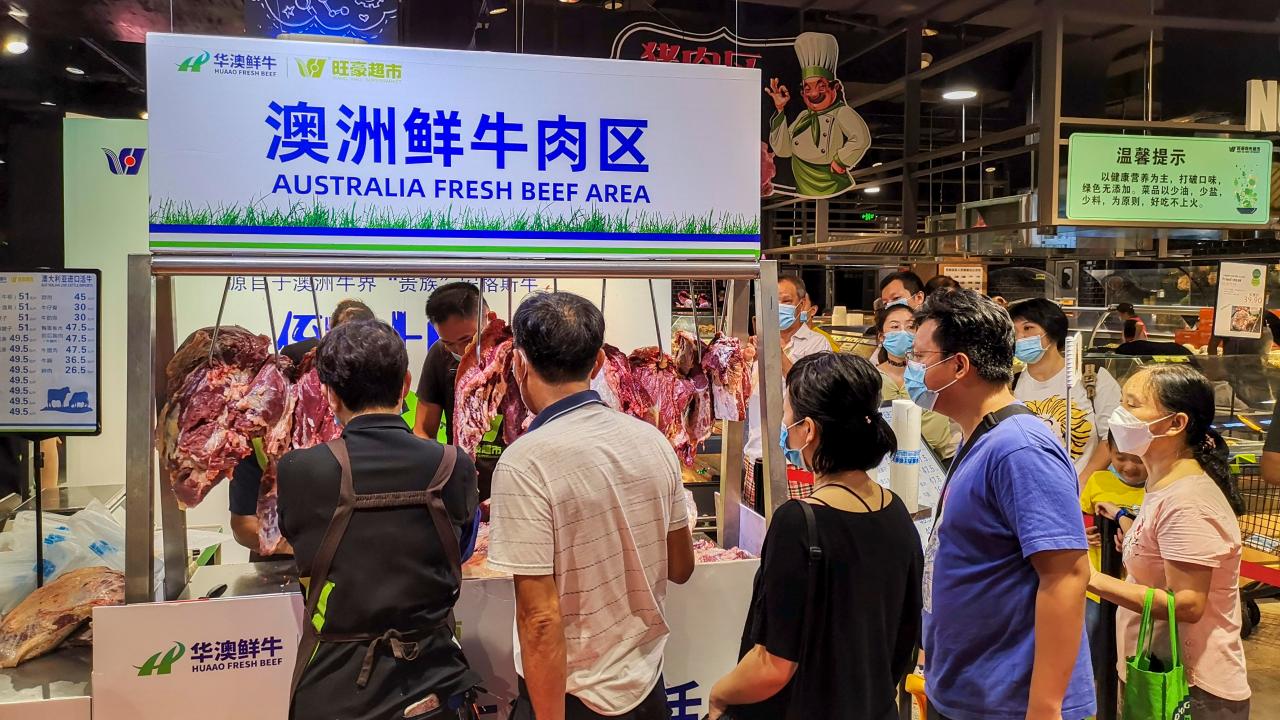
Australian beef entering China will face a 55 per cent tariff within days as the global superpower looks to protect its farmers.
Beijing has introduced quotas for tariffs on major beef exporters, such as Australia, to protect local suppliers.
The quota was set at 205,000 tonnes of beef for the whole year, about one-third lower than its total imports from 2025.
After hitting this mark, a 55 per cent tariff will be imposed on all beef imports from the nation.
Chinese state media outlet the Global Times reported that Australia was quickly approaching this quota.
“Previously, the ministry announced in March that imports of beef from Australia had reached 50 per cent of the annual quota under its safeguard measures, and reached 80 per cent in May,” it reported.
Earlier this week, China’s Ministry of Finance and Commerce revealed that Australia had reached about 90 per cent of its quota.
Australia’s efforts to lobby China to remove or increase the quota have been unsuccessful.
The quota also applies to other major beef exporters such as the United States, Brazil, Argentina and New Zealand.
It was introduced after the Trump Administration slapped tariffs on beef imports to the United States.
Meat and Livestock Australia (MLA) general manager of international markets Andrew Cox said the tariffs would likely weigh on Australian beef farmers.
“I don’t think it will totally stop, but certainly 55 per cent is a significant barrier to trade,” Mr Cox said, per the ABC.
“There’s no doubt we’ll be sending significantly less beef in the second half of the year, but I can’t give you an exact figure.
“All I know is that there’s certainly a willingness from Chinese customers to stock Australian beef, a lot of steakhouse menus, a lot of retail shelves … stock a lot of Australian beef and have done for a long time.”
If Australia was to hit the 205,000 quota by June 10 as expected, this would exceed last year’s beef exporting pace by almost two months.
It would also be about four months ahead of 2024 as Australian beef’s popularity has surged at Chinese restaurants and high-end supermarkets.
The levy comes as the United States plans to hit Australia with a 12.5 per cent tariff after determining Australia had failed to prevent the importation of goods made with forced labour.
Australia was one of 60 countries called out by the US for its alleged failure to stop importing goods made with forced labour.
The Trump administration said countries that had implemented forced-labour import bans, committed to a ban, or operated a partial prohibition, would face additional tariffs of 10 per cent.
This levy will apply to 15 countries, including Canada, Ecuador, Indonesia, Malaysia, Britain and the European Union.
The remaining 45 countries, including Australia, will face an additional 12.5 per cent tariffs under Trump’s proposal.