
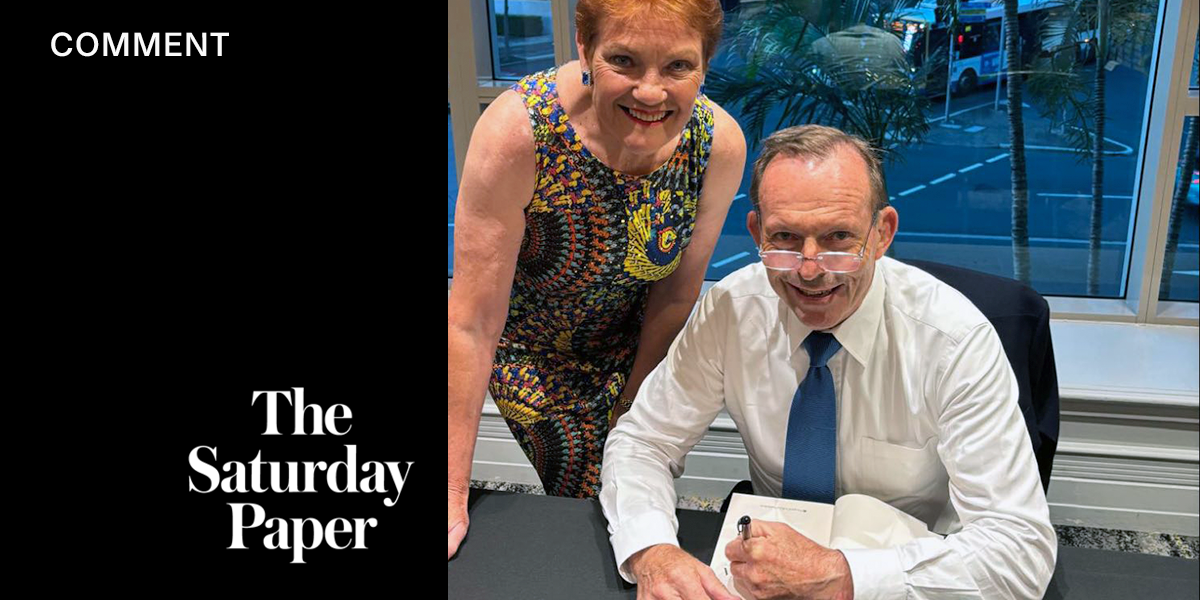
It is tempting for the major political parties to take comfort in the distance to the next federal election, drawing on the age-old wisdom that the only poll that counts is the one on election day.
Such thinking is dangerous folly, and no one in the Labor, Liberal or National parties is succumbing to it.
One opinion poll can be easily dismissed, but One Nation is up in all nine published polls since the budget – at the expense not only of the Coalition but also of the Labor government. Something real is happening out there and it is close to a major disruption of Australian post-World War II politics. It will take the result at the next election, due by May 2028, to reveal just how disruptive.
On current polling trends, One Nation will emerge as the dominant non-Labor party, with the Coalition running a distant third.
Labor could be pushed into minority or worse. This week for the first time, two polls – RedBridge Group and Sky News Pulse/YouGov – have One Nation with more support than the Labor Party, suggesting Pauline Hanson’s newfound drive to be prime minister cannot be dismissed as far-fetched.
While Liberal leader Angus Taylor emulates his mentor, Tony Abbott – employing end-of-the-world hyperbole to attack Labor’s “toxic taxes” for destroying Australia and promising to do “whatever we can to defeat the worst Labor government in our nation’s history” – it is Hanson’s party that is prospering.
Maybe this is because the vehemence of Taylor’s attack doesn’t quite square with the reality of the way in which the budget is being received. The YouGov poll echoes others that suggest a majority of voters aren’t wildly impressed, but nor are they as outraged as the opposition and elements of the mainstream media.
Fifty-six per cent of respondents believe their households will be either better off or about the same as a result of the budget measures. Forty-four per cent believe they will be worse off.
Indeed, the political design of the budget is banking on a vast majority of Australians not noticing the changes, because their concessions have been mostly grandfathered and so they will not be touched. This is why Prime Minister Anthony Albanese is very keen to have the legislation done and dusted as quickly as possible.
The elevation of Abbott – a brutally effective communicator and the sort of “media tart” that his newly elected deputy president, Alexander Downer, says the party desperately needs – sets up a risky alternative focal point to the parliamentary leader, Angus Taylor.
Albanese’s people say they always knew that reforms to essentially redistribute the tax burden in a fairer way would face blowback from powerful vested interests and their political allies. The prime minister is not for turning, essentially because the reforms are a statement of Labor conviction.
Besides, one of his closest allies says, the electoral risk of doing nothing over the next two years was greater than leaving the root causes of the housing crisis unaddressed.
Confronted with a finding in the RedBridge poll that 51 per cent of Millennial voters believe the budget is bad for them, Treasurer Jim Chalmers said in the current volatile climate – rising interest rates, the Middle East war, the scare campaign – a budget full of difficult decisions couldn’t be expected to give a “boost to any government’s primary vote”.
Labor is certainly not dismissing the rise of One Nation. Chalmers says the Coalition has “legitimised” the Hanson party by preferencing it, in contrast to the leadership shown by John Howard and Peter Costello.
He says the Liberals are being “consumed” by their rival on the right as a result. Had the Coalition parties not preferenced One Nation in the Farrer byelection, it would have been a much tighter result and possibly a win for the main independent.
Midweek, Labor’s national president, Wayne Swan, sent a fundraising email to the party’s supporters. Swan seized on an interview Pauline Hanson gave to the Sky News talk show Sunday Agenda. In light of the latest polling, he said, “the Liberals cannot form government without One Nation”. Hanson “made clear exactly what that would mean for Australia”, Swan said.
She argued workers should be easier to sack and questioned whether Australians deserve higher wages. She said Australia’s workplace laws need a complete overhaul and she has the backing of powerful interests “spending millions” to make it happen.
The interview sounded like WorkChoices on steroids.
Maybe someone advised Hanson to tone down her rhetoric, because on Tuesday, after the Fair Work Commission raised the national minimum wage by almost 6 per cent – for the first time pushing the weekly wage over $1000 – and also lifted minimum award wages by almost 5 per cent, Hanson said she didn’t “begrudge” the rises. That was two days after she questioned whether they were warranted or affordable.
The about-turn made her sound like any other politician, but so far in this latest surge of support Hanson has escaped the sort of scrutiny visited on mere mortals.
Her seeming invincibility is spooking the Liberals’ new party president, Tony Abbott. So much so, he says that his main concern is not combating One Nation but rather “our enemy”, whom he identifies as “a really bad Labor government”. Abbott told delegates at the National Council last week: “Our job is to lead a people’s revolt to be rid of the worst government in living memory.” He conveniently forgets that his own lasted just under two years and was judged bad enough for him to be sacked by his own party room.
It is his achievement of a landslide win from opposition against the badly divided Rudd–Gillard–Rudd government in 2013 that has persuaded the party to turn to him now.
Abbott was elected unopposed to the Liberals’ top organisational position, and he told delegates his return to more active politics was because he owes the Liberal Party “big time” and he regards it as his duty to “serve the party in this time of existential crisis”.
Though Abbott is famously prone to exaggeration, the polls certainly point to crisis, especially the latest three to be published – YouGov, Morgan and RedBridge. They have the Liberal primary vote around 20 per cent. Not since Robert Menzies picked up the pieces of the old United Australia Party and formed the Liberals 82 years ago has the right side of politics faced a worse predicament.
Abbott’s priority to attack Labor flies in the face of the post-budget polls that suggest targeting Albanese doesn’t help the Liberals as much as it does One Nation.
Paul Kelly in The Australian senses fear and defeatism is driving the Liberals to what he says is a “catastrophic option”: working with One Nation in the belief that a de facto alliance against Labor will save the day.
Kelly says this is a “surrender pact” to Hanson. Unless the Liberals can lift their primary vote, it will be their preferences electing One Nation candidates, “thereby cutting the throats” of the Liberals.
The elevation of Abbott – a brutally effective communicator and the sort of “media tart” that his newly elected deputy president, Alexander Downer, says the party desperately needs – sets up a risky alternative focal point to the parliamentary leader, Angus Taylor.
Speaking in parliament, Albanese said the Liberals have now turned themselves into a “cover band” of Tony Abbott, “a cheaper version”. Albanese quipped at Taylor that Abbott did “seven interviews” on Monday, “because he knows that this bloke ain’t up to the job”.
Abbott’s agenda is unapologetically hard right. He nominated Labor’s trade union ties, “obsession” with cutting greenhouse gases and its “ambivalence about the country itself” as issues to target in a campaign.
There is deep unhappiness among the remnant of Liberal moderates in the parliamentary ranks. They do not see climate denialism and revisiting the culture wars as a winning prescription in metropolitan seats.
There is even talk of turning to shadow treasurer Tim Wilson to lead the party, with a challenge after the Victorian state election in November. Under this scenario, only a miracle can save Taylor.
He does, however, have the backing of Abbott and there is a precedent of the party president publicly intervening in the parliamentary party’s leadership. Tony Staley did it in 1994, supporting the dumping of John Hewson in favour of Alexander Downer.
Staley as president also outplayed the parliamentary party in attacking the business dealings of then prime minister Paul Keating.
Abbott is well aware of all this. He told ABC Radio he didn’t think “there has ever been a party president who’s taken a vow of silence” and he added he was “certainly not going to start”.
By contrast, putative future Liberal leader Andrew Hastie, who has fallen out with Abbott, has no qualms about targeting Hanson. On ABC TV he attacked her poor attendance record at Senate estimates, where she was absent 88 per cent of the time.
Hanson and her chief of staff, James Ashby, have promised to campaign hard against the former army commander in his seat of Canning. He doubts her commitment or stamina to become prime minister.
“Let’s see it,” he says. “Let’s see her turn up for the battlers rather than having birthday cake with billionaires.”
The rumblings of a political earthquake are unmistakeable.