
As Liverpool announced their decision to part ways with Arne Slot on Saturday, there was a sense of regret at how things fell apart for the manager who delivered them a record-equalling 20th league title just 12 months ago.
Performances clearly trailed off under the Dutchman last season, picking up 24 fewer points than they managed in a seamless debut campaign, and losing three times the amount of Premier League games. For many, those results alone were justification enough for his dismissal.
But there was a deeper concern surrounding Slot’s style of football, which was much more measured than that of his predecessor Jurgen Klopp. In an era of the English top flight where players are sprinting more than ever before, and aggressive, hyper-athletic sides press man-for-man, clubs who prioritise controlled possession and technical ability in midfield risk looking blunt and easily containable in attack.
The club’s official statement, underlining the need for a “change in direction” and a “different approach”, hinted as much. Liverpool want to evolve and become a more assertive, fast-attacking side once more.
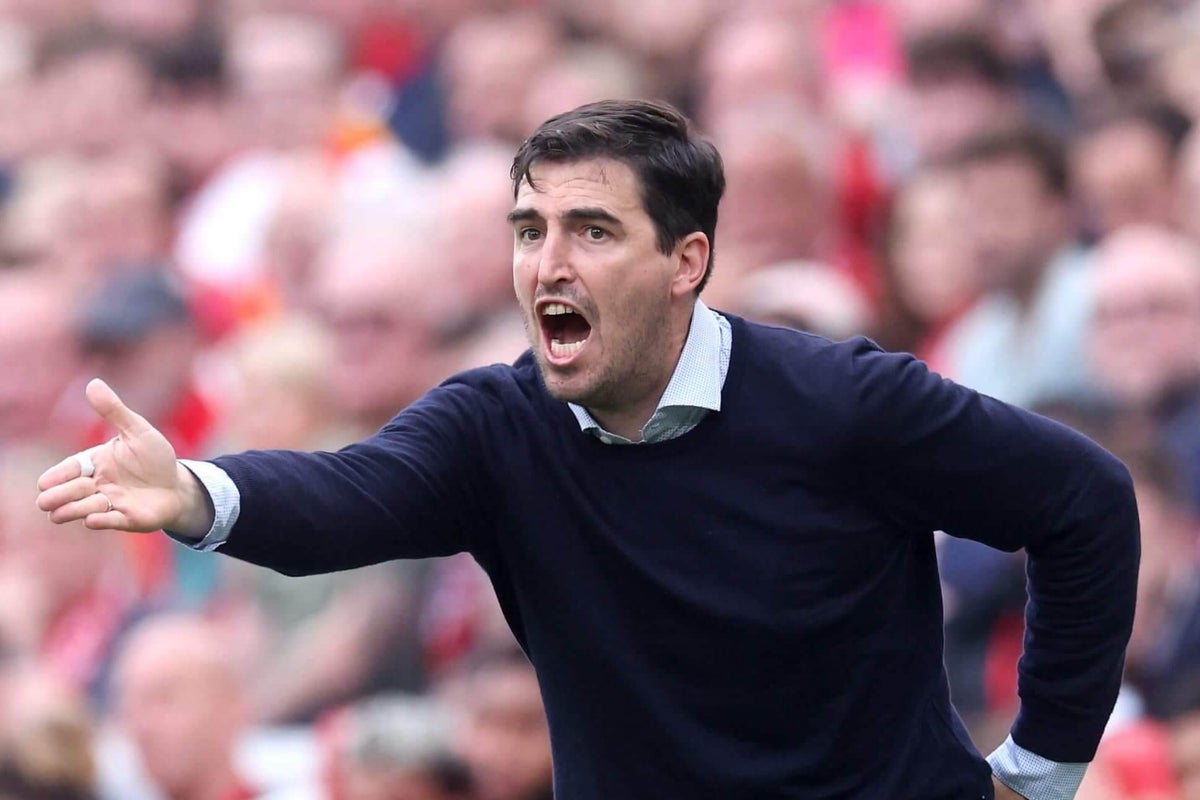
In that respect, Andoni Iraola is an understandable choice to take over. The 43-year-old transformed Bournemouth into one of Europe’s most front-footed teams during his three seasons in charge, encouraging an adventurous off-the-ball approach that looked to smother the opposition high up the pitch.
They defended tirelessly and attacked with purpose, scoring the joint-most goals from Opta-defined fast breaks (nine) last season.
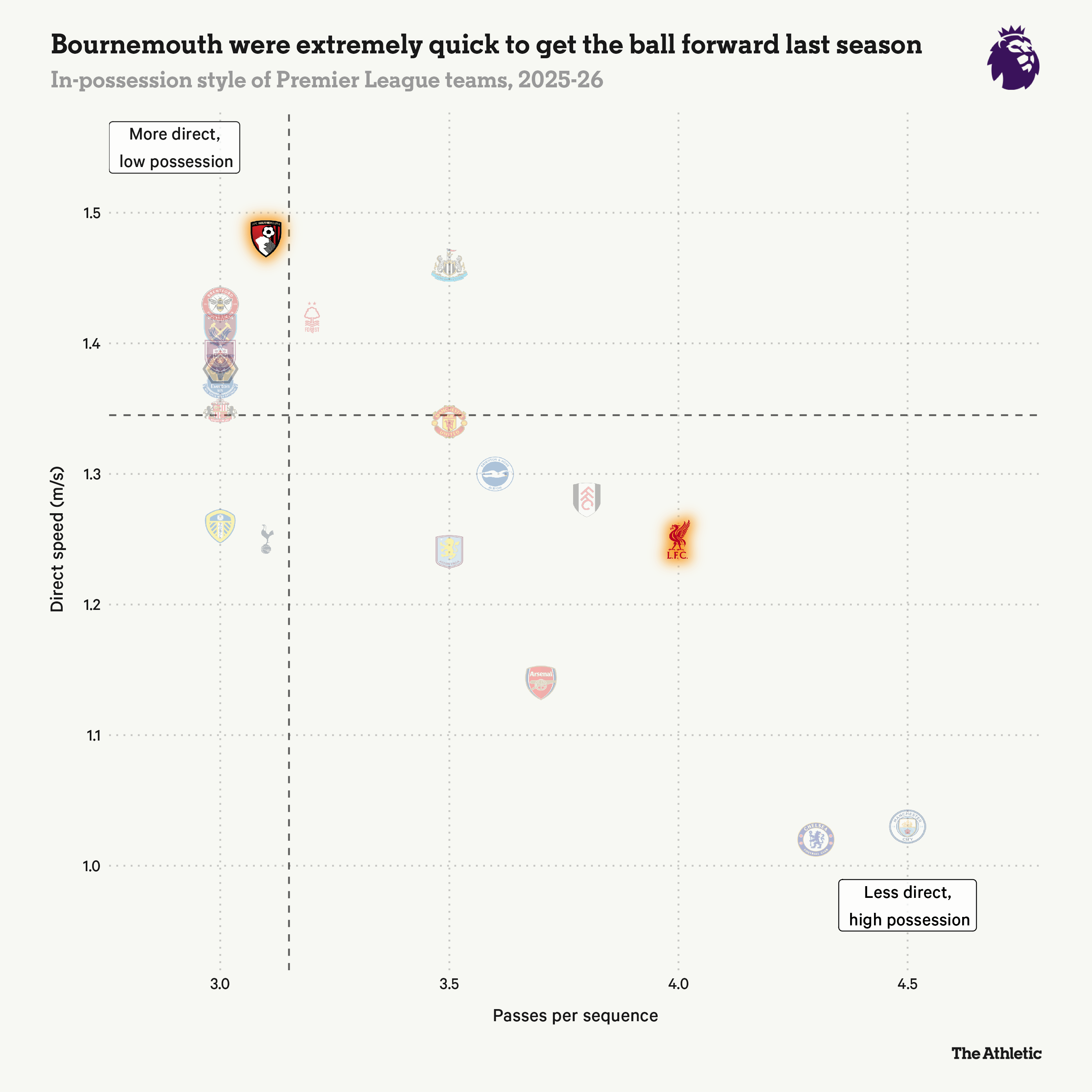
As we can see from the visualisation below, Iraola’s Bournemouth spearheaded the shift towards direct football last season, moving the ball towards goal quickly and with few passes along the way. Liverpool, on the other hand, struggled to exact the necessary control to consistently win games with a more patient approach.
Naturally, questions arise as to how Iraola can scale up his tactical approach to a club where pressure is far greater and expectations are different. At Bournemouth, he aimed to disrupt and challenge elite opposition without the ball. He will not be able to instil that underdog mentality at one of the biggest clubs in the world.
But there is also the question of Liverpool adapting to him, and whether a squad of players who pressed with irregularity last season can be whipped into shape. Iraola’s system requires collective buy-in and athletic commitment, and will be picked apart should one link in the pressing chain show any signs of weakness.
Are Liverpool’s squad up for the challenge? The Athletic digs into the data to find out.
Clearly, attacking at speed and embracing the chaos of end-to-end football takes a physical toll. For his system to function, Iraola requires players in peak condition who can carry the ball forward and win most of their defensive duels.
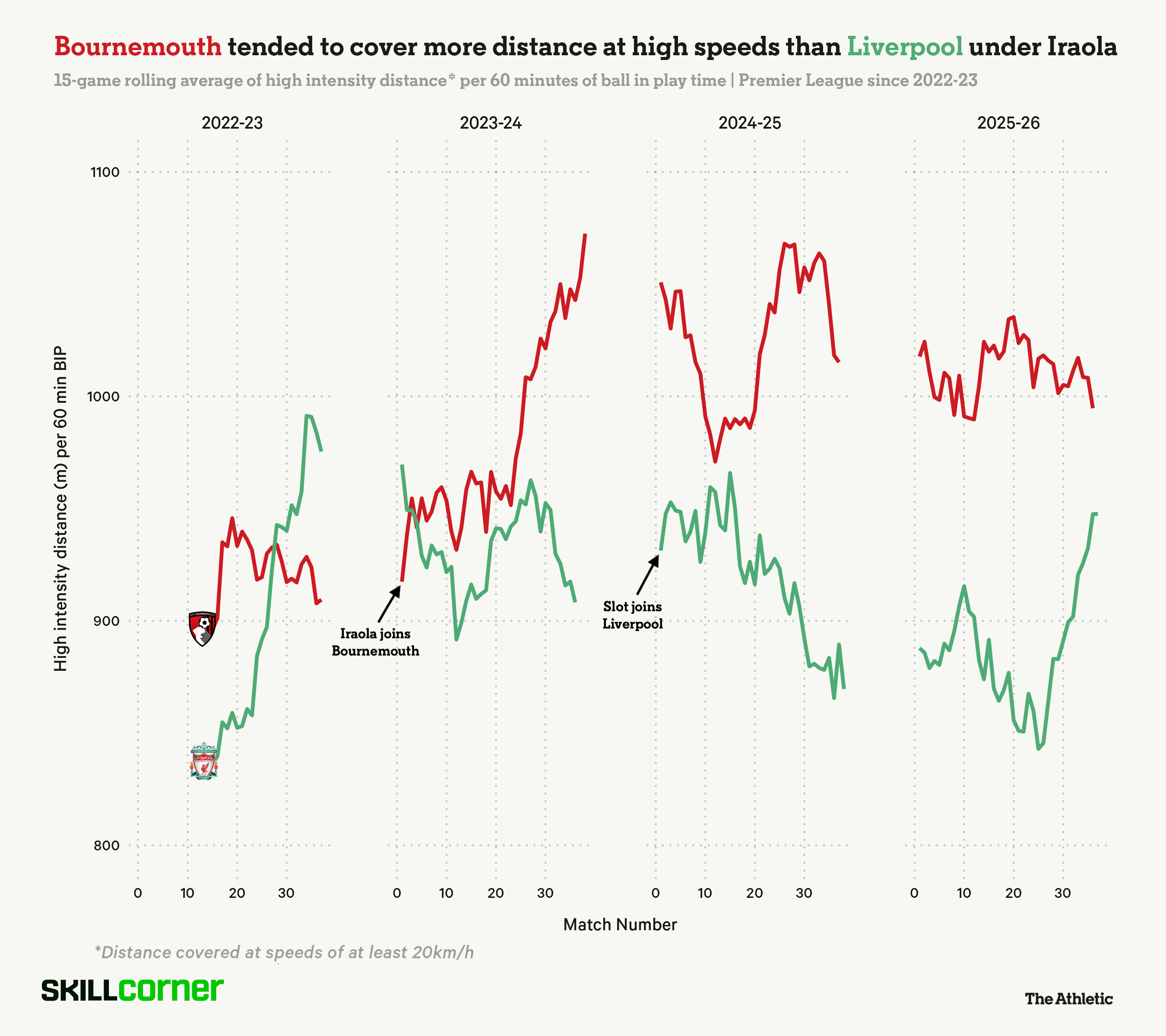
No team across Europe’s top five leagues covered more distance at a high intensity (20km/h or more) than Bournemouth last season for every 60 minutes the ball was in play. As we can see from the visualisation below, those figures shot up after Iraola’s arrival, while Liverpool have generally covered much less distance at high speeds since Slot joined the club.
Iraola will almost certainly look to the transfer market this summer to address any athletic weak spots that he perceives in the squad. He has a strong relationship with Liverpool sporting director Richard Hughes, with whom he worked closely at Bournemouth to identify undervalued players who would be able to cope with the extra physical load.
That synergy between the manager’s philosophy and recruitment brought results, as the likes of Antoine Semenyo, Milos Kerkez and Dean Huijsen all arrived for cut-price fees and left for millions more. Transfer profit is less of a consideration at Liverpool, which should allow the pair to target market-leading players at the top of their game.
Iraola has also proven that he can identify traits within his own players and put them to use elsewhere.
The case of Ryan Christie at Bournemouth is the prime example, as he transformed the Scotsman into a defensive midfielder despite his long career prior on the wing, honing in on his sense of anticipation and ability to sustain sprinting bursts throughout a game. Since Christie played his first match from a deeper midfield role against Newcastle in 2023, no player has averaged more than his 7.5 defensive recoveries per game.
With the increased player quality at Liverpool, we cannot rule out Iraola working with players such as Dominik Szoboszlai or Curtis Jones to help plug any gaps; midfielders who are versatile and can be moulded to unfamiliar positions in the new system.
Another important thing to establish is who does most of the hard-running for an Iraola side.
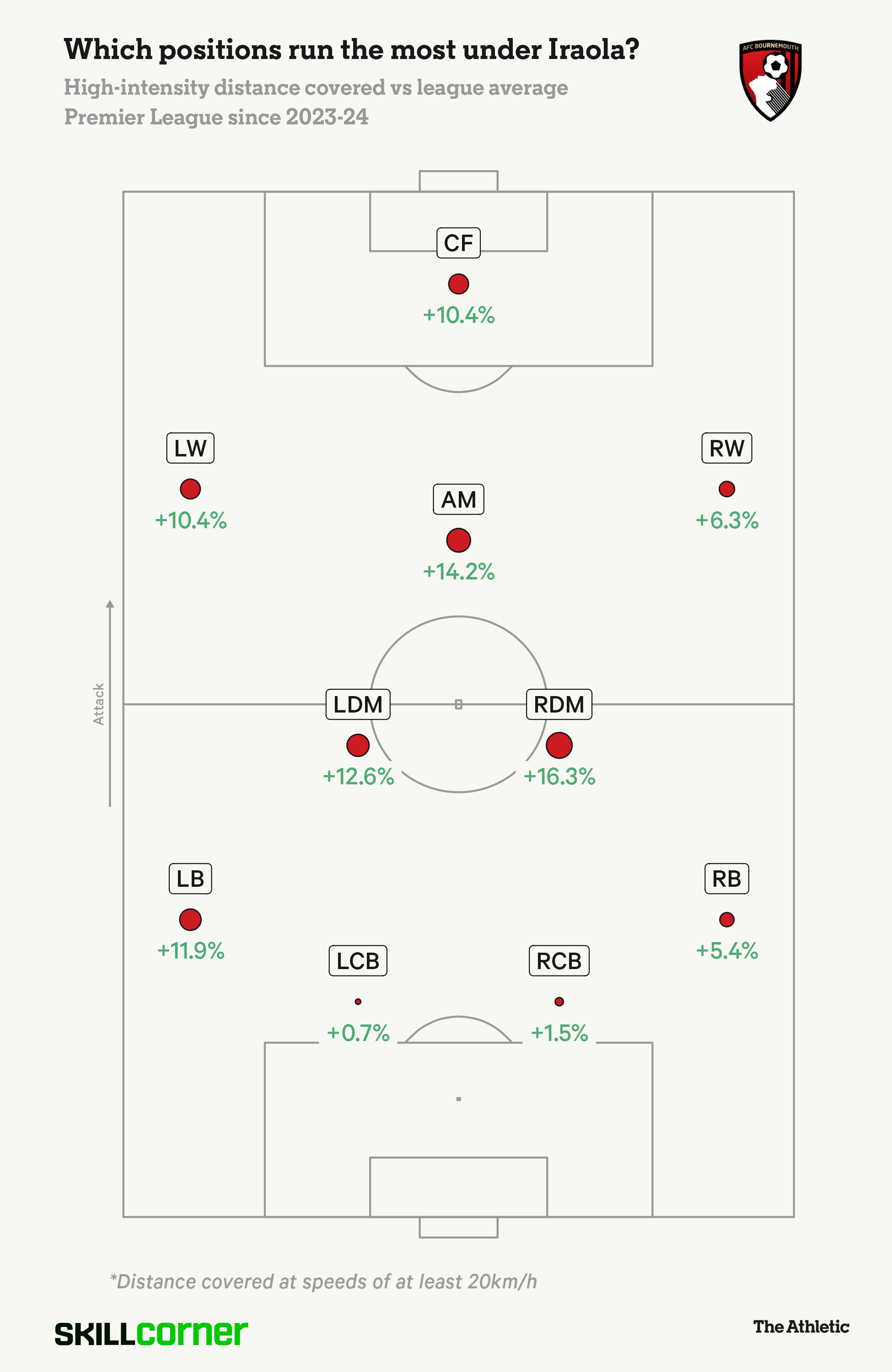
The visualisation below looks across the manager’s three-year spell at Bournemouth, and compares the high-intensity distance covered by each of his players with the league average across that same period.
As we can see, every player in his preferred 4-2-3-1 system covered more ground at high speed than their positional peers, but it was the holding midfielders, the left-sided attackers and the front two who really put in the extra work.
At Liverpool, Kerkez has already worked with Iraola, and is clearly capable of making the step up.
Bournemouth’s central defenders did not tend to sprint much more than the average Premier League centre-back, but they are expected to step up and follow runners into midfield in support of team-mates in the press further ahead. It is something that the outgoing Ibrahma Konate is comfortable with, but less so Virgil Van Dijk — a player who prefers to drop and defend space, rather than charging up the pitch to engage with opposition strikers.
Maybe there are internal solutions in the form of young defenders Jeremy Jacquet and Giovanni Leoni. But it feels safe to say that Iraola will be in the market for an aggressive centre-back, one who relishes last-ditch defending and can spread the play with an expansive passing range, much like Marcos Senesi at his previous club.
Right-back will also be another area where reinforcements are required. Jeremie Frimpong has not proven an effective ball-winner so far in the Premier League despite his blistering pace, while Conor Bradley has struggled with a knee injury since the start of 2026, even if he is better suited to an end-to-end full-back role.
Bournemouth were not characterised by defensive solidity throughout Iraola’s tenure — they actually conceded one goal more than Liverpool in the league last season. But if he is to instil a more transitional playing style at Anfield, he will need to be able to rely on a combative, fired-up back four.
Moving forward into midfield, and we can see that both holding roles are likely to demand plenty of commitment. Szoboszlai seems made for the role, shouldering much of the responsibility when it came to hunting down the ball for Liverpool last season.
More than just fitness, Iraola’s midfielders are tasked with spotting opportunities to jump into challenges. Bournemouth would frequently switch from zonal defensive structures to man-to-man marking when a single player — whether Christie, Alex Scott, Tyler Adams or the similarly tenacious Lewis Cook — snapped into gear and chased the ball. Picking the correct moments to do so is a crucial aspect of the manager’s style.
It would not be a surprise to see Iraola explore his options in the transfer market, but he could also look to work with Alexis Mac Allister and Ryan Gravenberch to hone their anticipatory skills. Further ahead, Florian Wirtz is another player who largely struggled to adapt to the physicality of the Premier League in his debut season, but clearly possesses the energy and desire to hassle and harry up the pitch.
Off-ball movement is equally important for Iraola’s midfielders. In order to make the most of opportunities to counter, they must be prepared to join the attack quickly, and to return to position should it break down.
As we can see from the pizza charts below, Bournemouth players tended to offer support runs much more often — keeping up with attacks behind the ball carrier — while they also looked to attack the box (Cross receiver, 89) and look to overlap out wide.
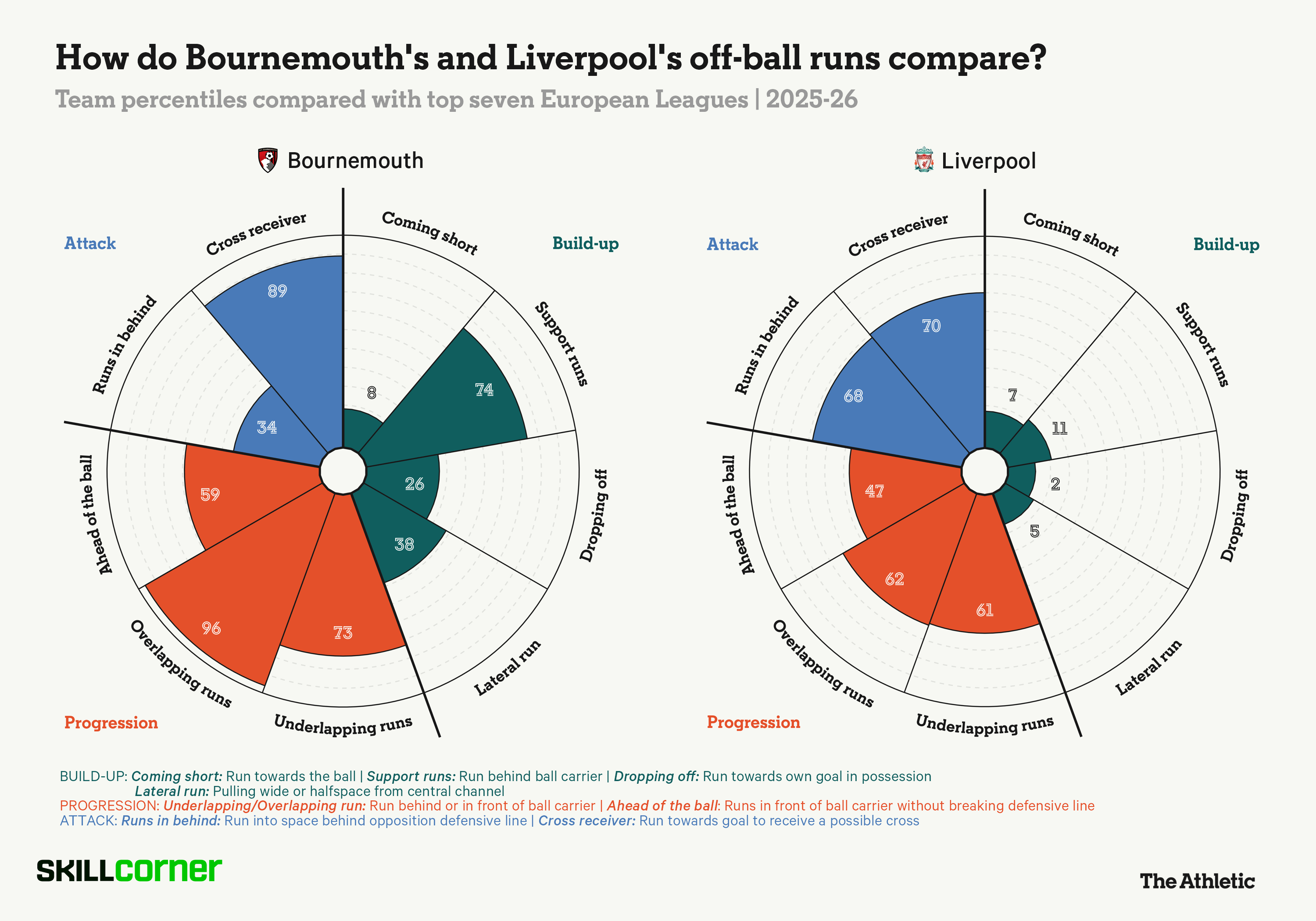
Up top, Liverpool face the unenviable task of replacing Mohamed Salah this summer. With Iraola now at the helm, they will surely target pacy wide players who can stamp their authority on quick attacks, who will also not shy away from any defensive work.
They are in contact with RB Leipzig over a possible deal for Yan Diomande, an electrifying winger who looks to fit that bill. Rio Ngumoha, still only 17, could be another to grow into the role.
At centre-forward, Hugo Ekitike was devastating on the counter for Eintracht Frankfurt, and showed flashes of his ability to impact the game at speed at Liverpool before a disastrous Achilles injury derailed his season and will keep him out until well into next term. Alexander Isak holds similar potential, but has also been impacted by a lengthy injury.
Given Liverpool’s success in previous years playing hard-hitting transitional football, fans should be quick to get on board. But there are issues to iron out with the squad, and tactical ideas to instil, that suggest it could take time for the best of Iraola to appear.