
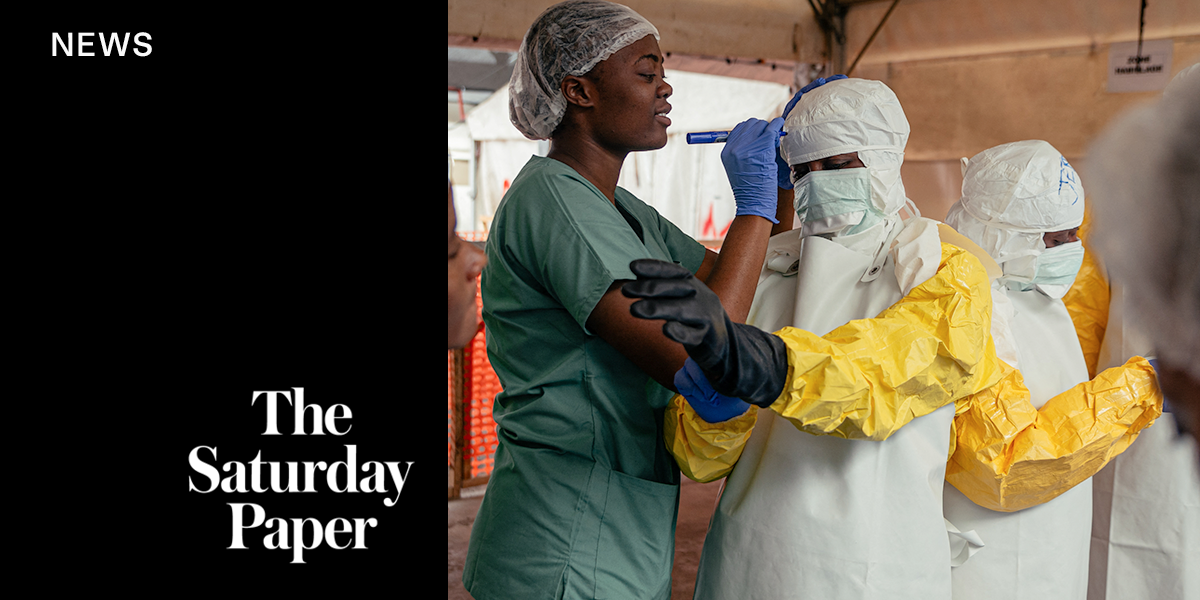
An outbreak of the rare Bundibugyo strain of Ebola is proving difficult to control in the Ituri province of the Democratic Republic of Congo, a region beset by conflict and insecurity. The virus has reached epidemic proportions, with 321 confirmed cases, and has spread to Uganda and possibly other countries further afield.
As we know from the experience of Covid-19, travel and trade mean that epidemics anywhere can threaten the whole world. Australia’s first case of the H5N1 bird flu was a child who had caught the infection overseas. Similarly, we now see the hantavirus outbreak on the cruise ship Hondius spreading to countries around the world. The severity of their impact depends on how well these Ebola and hantavirus outbreaks can be contained.
The most obvious responses are vaccines and drugs. Though these were developed for Zaire Ebola in response to the 2014 West African epidemic – the largest and worst in history, with about 28,000 cases – there is no commercially available drug or vaccine for Bundibugyo Ebola. The World Health Organization (WHO) is sponsoring clinical trials of an experimental vaccine and treatments. No vaccines are as yet approved for hantavirus.
An epidemic – loosely defined as a widespread outbreak that may affect a whole country – can be controlled, however, with non-pharmaceutical measures. Time and time again we see amnesia about the principles of such measures, which span air quality, disinfection, personal protective equipment, isolation of infected patients and quarantine of their contacts.
The recent epidemic of the Andes strain of hantavirus – which can spread from person to person – on board the Hondius highlights lessons from the Diamond Princess and Ruby Princess outbreaks of Covid-19. Cruise ships can experience explosive outbreaks, with indoor air quality a key factor in the spread of infection.
WHO’s initial recommendation was for passengers to stay in their rooms or wear a surgical mask when leaving their cabins. Later, this was changed to recommend the higher level of protection offered by a respirator, such as an N95 or P2 mask. Nevertheless, ventilation and air quality were not addressed.
The current diphtheria epidemic in the Northern Territory – which is the worst in more than 35 years – highlights the vulnerability of First Nations communities to infectious diseases, in part due to low vaccination rates.
A complicating factor in the case of the Hondius is that the captain announced to passengers that the initial death was from natural causes, not infection. As a result, passengers condoled with the widow, who later also died of hantavirus. A total of 13 cases and three deaths have occurred to date in multiple countries where passengers and crew were repatriated.
There are lessons for the current Ebola epidemic from that of 2014, when a few hundred cases in March spiralled to almost 28,000 by July the following year. For the first six months, there was no concrete action to control the spread, despite a flood of international responders in the era of USAID funding. That September, however, modelling showed that expanding the capacity of hospitals to isolate infected patients could control the epidemic. Until then, Ebola patients were unable to get a hospital bed and were freely infecting others. This prompted international responders to build tent hospitals to isolate and treat more patients, which flattened the curve. Considerable efforts were also made to trace contacts and quarantine them, which is also critical, as it prevents onward transmission.
The use of personal protective equipment (PPE) was a flashpoint in 2014, with the WHO and US Centers for Disease Control and Prevention (CDC) recommending surgical masks for health workers. The CDC switched to respirators after two nurses in the United States became infected wearing surgical masks. The WHO advocates lower-level PPE for Ebola, with even their latest guidelines stating, “Paradoxically, wearing excessive PPE can increase a person’s risk of infection.”
In 2014, my colleagues and I published a paper that was the first to openly challenge the CDC and WHO guidelines. We argued that the precautionary principle – that reasonable steps to reduce risk should be taken in the absence of scientific certainty – should be used to protect the occupational safety of health workers treating patients with Ebola, given the high fatality rate and lack of available treatments or vaccines. Aside from the rights of health workers to be safe at work, if your health workforce is disabled or killed by infection, your ability to control an epidemic is drastically reduced. This broken record is played during every serious epidemic or pandemic, from SARS in 2003, to pandemic influenza in 2009, Ebola in 2014, Covid-19 in 2020 and now Ebola again.
By the time Covid-19 hit Australia in 2020, we had used much of our PPE stockpile in the bushfires of the preceding summer, and sent some of our remaining supplies to China to help deal with what was then an epidemic. As a result, we had severe shortages – stockpiles are typically only a few weeks’ supply, but pandemics go on for much longer.
Australia is well prepared for the current threats, however, with a new Centre for Disease Control and quarantine facilities built for the pandemic. Passengers repatriated from the Hondius have been transported there. There are no travel restrictions around the Ebola epidemic as yet, but it is still far smaller than the one in 2014, when visas from the affected countries were temporarily cancelled. Major cities in Australia have specialised medical facilities for patient transport and treatment, which would be used to safely treat an Ebola case in Australia.
That said, not all communities are equally insulated. The current diphtheria epidemic in the Northern Territory – which is the worst in more than 35 years – highlights the vulnerability of First Nations communities to infectious diseases, in part due to low vaccination rates.
One area of weakness for all countries is the risk of failing to diagnose a serious infection in the hospital emergency department. There are many examples of such failures, including the delay in diagnosing Ebola in the US and Nigeria during the 2014 epidemic, and one of MERS-coronavirus in South Korea in 2015, which led to 186 confirmed cases and 38 deaths.
Staff in ERs are busy and stressed and have no routine tools for situational awareness of high-consequence epidemics that could arrive at their door. Febrile patients are often sent back to the waiting room, perhaps for hours, where they can infect others and cause outbreaks.
An electronic decision support system for triage staff can help to improve awareness and prompt early isolation of patients with potentially serious infections. For example, if a triage nurse records a fever, they can be prompted to ask about travel. If the patient has travelled, the country would be logged and the triage nurse would receive a list of outbreaks in the relevant country. This can help prevent major hospital outbreaks.
Another global challenge is that misinformation has exploded since the Covid-19 pandemic, resulting in distrust of medicine, falling vaccination rates and resurgence of vaccine-preventable infectious diseases throughout the world. A trending topic in 2026 was that the Pfizer Covid vaccine caused hantavirus. Governments are left scrambling to keep track of trending misinformation in real time. The impact of health misinformation and disinformation needs urgent solutions.
Perhaps the most confronting issue for health authorities now is that the old era of global cooperation has ended. Until this Trump administration, America had carried much of global health, via USAID and as the single largest nation-state donor to WHO. USAID also helped to subsidise global health research in Australia. When this funding came to a sudden end last year, our own dependence on the US was exposed.
Global health is an industry, with many parties flocking to epidemics and pandemics and many careers built in the field. The proliferation of non-government organisations has contracted after the cessation of USAID funding, and 18 to 20 per cent of WHO’s funding has been lost as a result of the US withdrawal. Moreover, the US pullback was followed by that of Argentina and murmurs from other countries along the same lines.
It is time to re-evaluate the old model of global health and look to new ones that can build sustainable sovereign capacity in low-income countries and encourage all countries to invest in their own health security, while building global cooperation.
Raina MacIntyre is the founder and director of EPIWATCH, an AI early-warning system for global epidemics with real-time tools to monitor vaccine misinformation and community sentiment. She currently receives research funding from the National Health and Medical Research Council.