
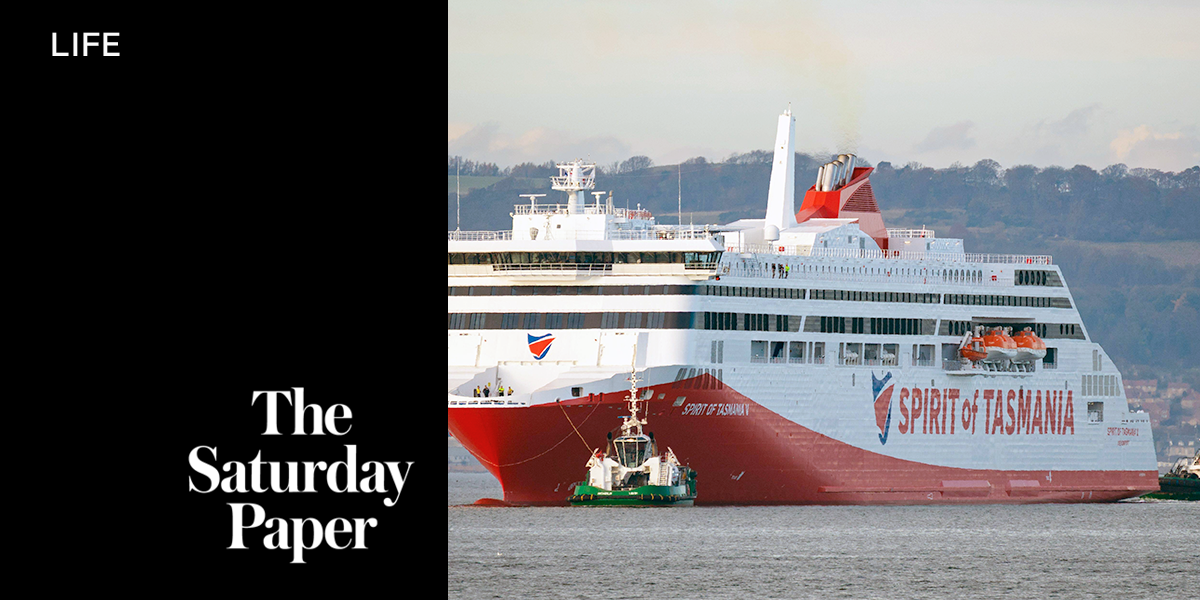
Chris Twite can’t believe his luck. Three years into his job as Dark Mofo’s artistic director, his long-held dream of programming an all-out art exhibition in a mighty big ship has come true. That it’s arrived courtesy of a monumental Tasmanian government stuff-up is something he’d rather not dwell on.
He is, as always, upbeat, wearing his trademark yellow-tinted glasses, and a bomber jacket against the chill. “What do you reckon of our ship? Pretty good, I reckon!” he says excitedly as we walk through the bowels of the new Spirit of Tasmania V. It’s a huge open space, with a lattice of steel beams and snaking pipes on the ceiling, vast ramps, towering steel walls and bright yellow lines marking the lanes where cars, trucks and caravans will eventually go when the ferry starts its Bass Strait run late this year, well behind schedule. Built in Finland, the 212-metre-long ship was completed last June, and has been languishing in various ports ever since. For the past month, it has been docked at Station Pier, Port Melbourne.
When Twite and his team discovered the delayed Spirit of Tasmania V would be in Hobart for a final fit-out around the time of this year’s Dark Mofo winter festival, they sprang into action and emailed the state-owned operator, TT-Line, asking whether the ship could be used.
“And everyone was like, let’s definitely try to make this happen, we can work in and around each other,” Twite says. “Everyone is so excited to see it come together.”
He is in Melbourne to check on the progress of the art infrastructure being installed across two of the ship’s vehicle decks – levels 3 and 5. The rest of the ship will be off limits. Workers in high-vis are busy putting the finishing touches to giant video screens at the ship’s bow and stern, setting up rigging that will support text-based light works, and laying down a “field” where menacing robot dogs, built by Argentinian and Japanese duo Lolo & Sosaku, will run amok in atmospheric light and fog.
Though the artworks are yet to be installed, it’s not hard to imagine the impact they’ll have in this immense industrial space. There’ll be booming soundscapes, dazzling lights, disorienting darkness and a thrilling sense of danger, all accentuated in the cavernous insides of this 48,000-tonne ship.
Twite has programmed six large-scale works that reflect anxieties and horrors of our times: from war to racial violence, artificial intelligence and the deluge of online imagery. The works range in mood from Brazilian artist Berna Reale’s quietly sinister video, Palomo, in which the artist, who is muzzled, rides a horse that is painted blood-red. They clip-clop through the streets of the Brazilian port city of Belém as locals watch with palpable unease. At the other end of the sound scale is the loud, techno-driven montage of American artist Arthur Jafa’s APEX, a tsunami of images detailing Black culture and resistance.
Other works include Guatemalan artist Regina José Galindo’s video La Sombra, in which the artist is relentlessly pursued by a military tank; and illuminated text works by Melbourne-based artist Chunxiao Qu that appear to float in space, with one reading: “There is nothing left to pray for”.
With no obvious path leading from one artwork to another, audiences can explore at their own whim.
“And I love that you’ll go past things like this,” Twite says, as we wander past bolted steel panels, numbered bays and a wall padded with fire-retardant material that looks as cushiony as a mattress and acts as an improvised acoustic buffer. “You’ll hear the machinery of the boat as well … Can you believe we’re doing this?”
“This is the world’s biggest floating gallery. I’ll never do this again.”
The morning we meet is dull and drizzly, and the colossal ship, with its feature red and white paintwork, adds a splash of colour to the gloom. Its sister ship, the Spirit of Tasmania IV, is docked around the curve of the bay, at Nelson Pier, Williamstown – an even stranger sight but not as bizarre as the previous lodgings in the port district of Leith, Edinburgh, where it stayed for more than a year, much to the amusement of locals. Spirit V followed it there and stayed for almost as long. Not so amusing was the reported cost of berthing the ships in Scotland: $47,000 a week, funded by Tasmanian taxpayers, and a further $380,000 a month for crew.
The two new ferries, bigger and better than the currently operating Spirit I and II, were touted as “game changers” for Tasmania’s tourism industry. Instead, they’ve become emblematic of an epic blunder, as the state government forgot to build a berth large enough to accommodate the ferries in Devonport. That farcical oversight cost Liberal backbencher Michael Ferguson his role as deputy premier and minister for infrastructure and transport – though he has not denied speculation that he will vie for a federal Senate seat in 2028.
The Dark Mofo team’s proposal provided TT-Line the opportunity for some positive news at last. The fiasco plunged the beleaguered operator into debt, requiring a $506 million government bailout. The company ignored my questions about the costs of storing the ships in Melbourne and wouldn’t confirm whether the new ferries would be fully operational by October 31.
When I suggest that Dark Mofo solved a problem for the Tasmanian government, Twite is diplomatic: “We solved the problem for ourselves.” The government is providing $21.6 million for the festival over three years to 2027, adding to the $30 million-plus that David Walsh – as the owner of the gallery, Mona, that spawned the festival – has forked out since its inaugural run in 2013.
The “problem” for Twite this year was the absence of a site large enough to accommodate Dark Park, the festival’s free, sprawling, public art offering. In years past, it has covered the appealingly scrappy grounds of Macquarie Point, but now earthworks are about to start there for Hobart’s AFL stadium – another Tasmanian government project mired in controversy.
“The great part about Dark Park over the years has been wandering and discovering works over large areas, and so we’ll be able to replicate that this time within the ship … it’s so vast, each one of the pavilions is 180 metres. This will end up being one of the bigger Dark Parks, which is crazy,” he says. “We can have 1600 people on the boat at any one time.”
Dark Park will extend across the Port of Hobart this year, with artworks also installed in the huge waterfront warehouse MAC 02.
“This has been one of the most complex events TasPorts has ever supported,” says the state-owned company’s interim chief executive, Allan Gray, via email. “Opening a regulated port berth to the public is the maritime equivalent of running a festival on the tarmac at Sydney International Airport. The same level of security regulation applies, and for the same reasons.”
This will be a hard act to follow, with Macquarie Point indefinitely out of bounds, and the ferries, with luck, fully operational next year. “It weighs very heavy on my mind, what we’re going to do next year,” Twite says.
“The great thing about the art program is it’s taken many different forms over the years,” he adds. “We have some ideas; we’re working through them … but it will mean a lot of sleepless nights while we try to find spaces.”
For now, he’s relishing the chance of a lifetime.
“This is the world’s biggest floating gallery,” Twite says. “I’ll never do this again.”
Dark Mofo runs in Hobart from June 11-22.