
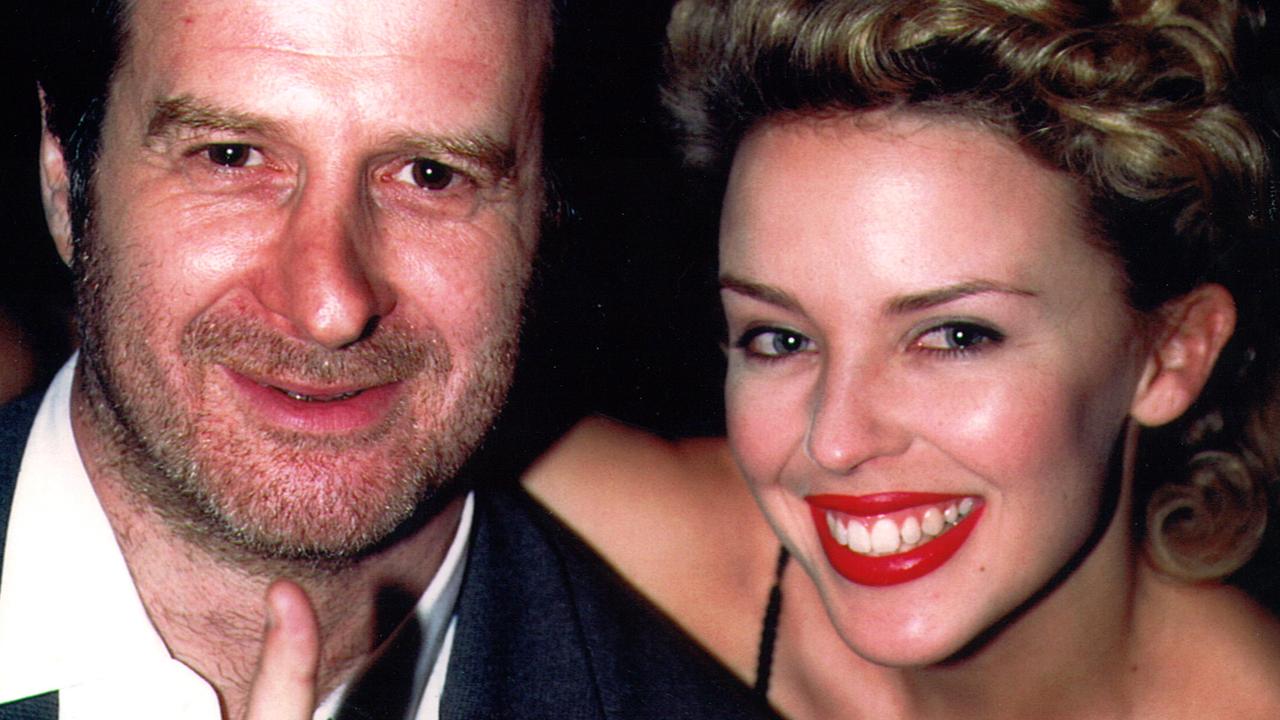
Key Melbourne figures who helped shape Kylie Minogue’s global success story are devastated and upset about being omitted from the hit Netflix documentary on the pop superstar.
The three-part doco studies Minogue’s trajectory from soap star to pop princess, but largely overlooks the Melbourne chapter and important local music industry figures who helped launched her career, and continued with unwavering support.
Since the doco’s release, social media, fan forums and Reddit threads have lit up with outrage over late music boss Michael Gudinski, Minogue’s former manager Terry Blamey, and record label executive Amanda Pelman, being erased from Kylie history.
None are featured in the documentary.
Mushroom Records legend Gudinski got fleeting video grab in the doco, despite signing Minogue to his label in 1987 after Kylie’s demo of The Loco-Motion found its way to Pelman.
Gudinski became Minogue’s biggest champion, as a label boss and concert promoter.
Blamey managed Minogue from 1987 to 2013, and oversaw her career from homegrown act to global pop force, Grammy winner, and performer with full artistic control.
However, industry figures say the absence of Blamey, Pelman, Gudinski, and another late music executive, Gary Ashley, in the Kylie doco has left some feeling upset and unappreciated.
“Terry is devastated,” a source close to Blamey told Sunday Confidential.
“He is really hurt. Wouldn’t you be if you were written out of history? He was like a father figure to Kylie. For 26 years, it was just them, especially in the early days.
“You have to ask the question, and it’s a fair question, ‘Where was the man who helped make Kylie a global superstar? She had the talent, but it took strategy. That’s what Terry had, and that’s what Terry did.
“He told her to invest her money in property, and he strategised Kylie’s career and made her a brand. Beyond the music and shows, he did deals for the perfume, the sheets, the linen, the this, the that.”
In 2012, Blamey won the Peter Grant Award, the ultimate accolade for a music manager, for his outstanding contribution to the worldwide music industry.
“I mean, give the man some f—ing credit,” the source said.
Another former record label boss told Sunday Confidential: “Everybody is talking about who is, and isn’t, in the documentary. It’s grossly unfair. Terry drove Kylie’s career for 25 f—ing years, and so did Gudinski. But who am I to say? The (doco) producers are telling their version of the story.”
Paul Cashmere, chief executive of music site noise11, told Sunday Confidential: “Kylie is a Melbourne legend. Her story starts here. But the Kylie documentary alleges the whole thing began in England.
“By not mentioning the facts, and people who played an important part in the Kylie story, the history get distorted and rewritten. That’s the danger we’re in.”
Minogue first performed The Loco-Motion during a charity event for the Fitzroy Football Club, at Melbourne’s Dallas Brooks Hall, in 1987.
The performance prompted TV producer Greg Petherick to organise a studio recording.
Pelman wrote in her memoir, Four Weddings And An Encore: “I thrive on the thrill of discovery. Kylie’s voice was effervescent.. I knew Mushroom could make this work.”
The Loco-Motion was Kylie’s first hit, and ruled the top of the Australian singles chart for seven weeks.
However, the Kylie doco claimed Minogue’s first hit was I Should Be So Lucky, written by pop craftsmen Mike Stock, Matt Aitken and Peter Waterman.
Minogue attended Michael Gudinski’s funeral service in 2021.
“Legend. Legacy. Love,” she wrote on social media at the time. “One of a kind and forever family to me. I’ll always love you, Big G. Irreplaceable and unforgettable.”