
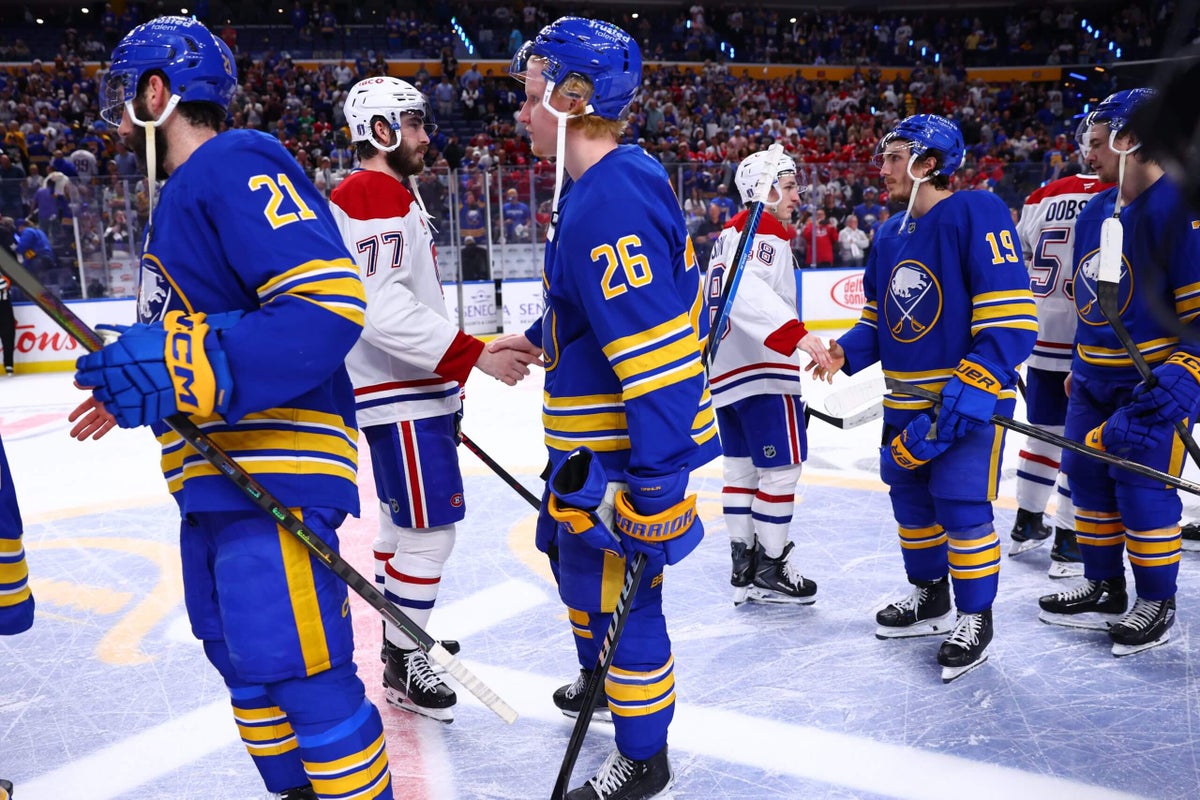
Not long after defenseman Jaccob Slavin won his first Lady Byng Trophy in 2021, a fellow Carolina Hurricanes player approached him to say congratulations — and also to offer a lighthearted chirp.
“It’s kind of embarrassing, right?” said the teammate, whom Slavin declined to name. “You’re a defenseman. You’re supposed to be rough and tough and cross-check people.”
Handed out every NHL season since 1925, the Lady Byng — in its physical form, a two-handled silver cup atop a wooden base — goes to the player “adjudged to have exhibited the best type of sportsmanship and gentlemanly conduct combined with a high standard of playing ability,” according to the league.
This subjective criteria for the award, voted on by the Professional Hockey Writers Association, has contributed to a stigma surrounding the Lady Byng for decades. The result is perhaps the most peculiar trophy in professional sports: one that not every player wants to win.
In 2003, after publicly declaring that he didn’t even want the award in the first place, then-Toronto Maple Leafs winger Alexander Mogilny skipped the ceremony when he was named the winner. The next year, candidates Brad Richards and Martin St. Louis, both with the Tampa Bay Lightning, argued over who desired it less until assistant coach Craig Ramsay told Richards to stop, explaining that they were enjoying the privilege of playing in the NHL and should be honored to receive any trophy whatsoever. After the scolding, according to a syndicated Sporting News article, Richards — who ultimately won — and St. Louis decided they “really wanted it.”
Frank Boucher, who spent most of his Hall-of-Fame career with the New York Rangers in the 1920s and ‘30s, won the Lady Byng a record seven times. Montreal’s Cole Caufield, meanwhile, was announced as the 2025-26 recipient on Friday after a 51-goal season. With no foolproof method to measure gentlemanly conduct, voters from the Professional Hockey Writers Association tend to prefer players with low penalty minutes yet high offensive production. Caufield, for example, committed only seven minor penalties in the year.
To many, though, playing a physical, scrum-filled game like hockey while displaying gentlemanly conduct feels like an antithetical concept. In hockey, clean play — especially if it reflects a hesitance to battle for pucks or positioning in hard areas of the ice, like around the net or in the corners — can be equated with softness: the opposite of what any player strives to be.
Former NHLer Mike Foligno, owner of 2,047 career penalty minutes, told his sons, now-Minnesota Wild forwards Marcus and Nick, that the Lady Byng was the only award they weren’t allowed to win as hockey players. Sure enough, neither has finished above 43rd in award voting in 34 combined seasons of NHL experience: Nick received one second-place vote in 2015, the only time either brother has appeared on a ballot.
“Marcus and I have to play a certain brand to be impactful,” Nick Foligno said. “These other guys are so good they can play (sportsmanlike) and be impactful.”
He called the ability to do both impressive. And, with a smile, Nick added, “Maybe we’re a little jealous at the end of the day, too.”
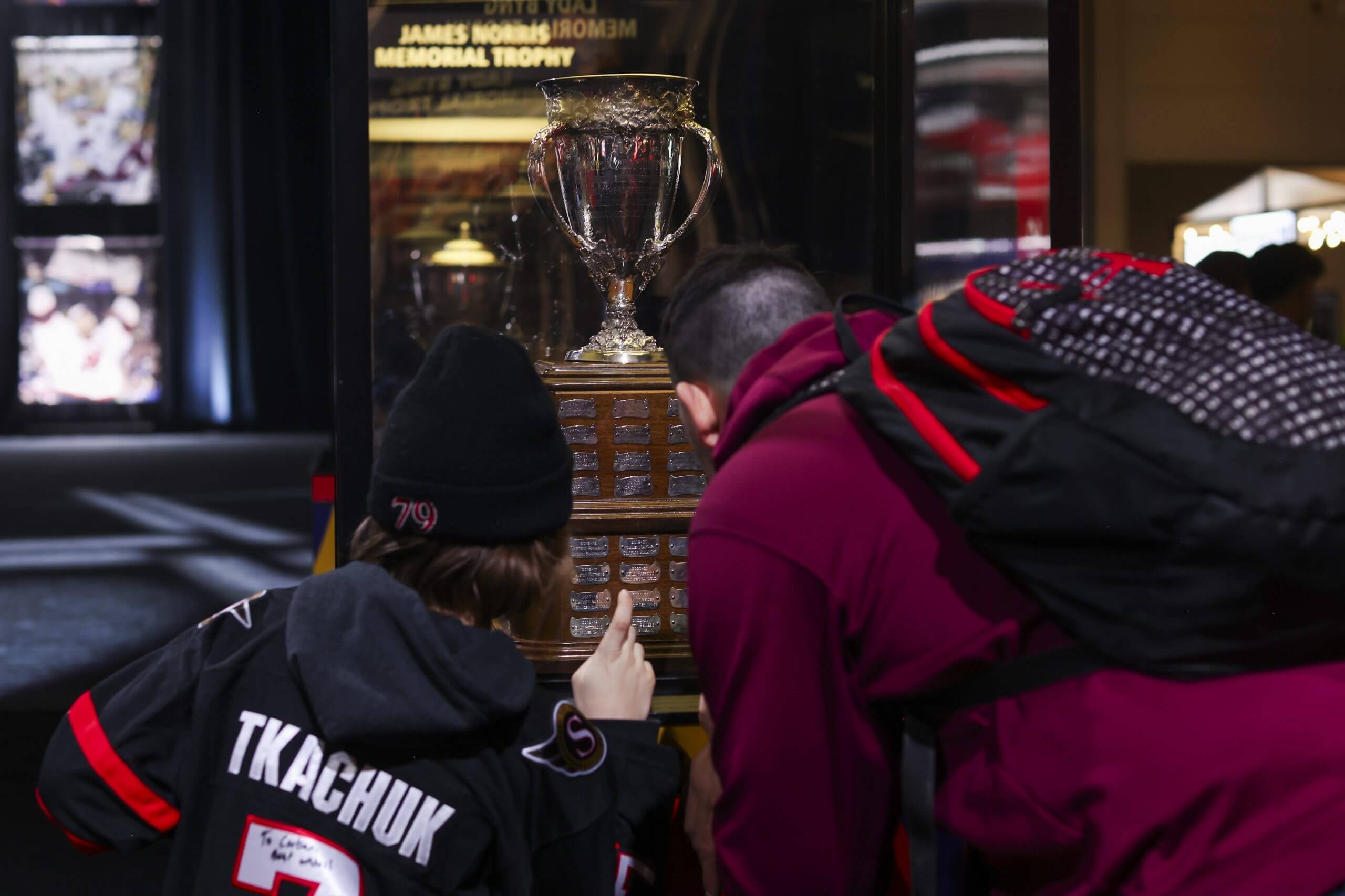
The Lady Byng Trophy, seen here during NHL All-Star week in Feb. 2024, has been around for more than a century. (Carlos Osorio / NHLI via Getty Images)
Were it not for the British monarchy, the Lady Byng Trophy would not exist. In 1921, King George V appointed Julian Byng as Governor-General of Canada. Upon moving to the country, Byng and his wife, Evelyn — thereafter known as Lady Byng — became hockey fans. Frank Boucher recalled meeting her multiple times with his brothers, including Hall of Famer George Boucher, at the Government House in their hometown of Ottawa.
“George, the tough guy in the Boucher family, thought she was simply wonderful,” Boucher wrote in his memoir, “When the Rangers Were Young,” recounting how Lady Byng would have her gardener cut flowers for the Bouchers to take home after every visit.
In 1925, seeking to put her stamp on the sport, Lady Byng wrote a letter to then-NHL president Frank Calder in which she expressed a desire to “eliminate the needless rough play that at present is a threat to the national game,” according to newspaper reports at the time. Her solution? The creation of a “challenge cup,” she wrote Calder, to be awarded to “the man on any team in the National Hockey League who, while being thoroughly effective, is also a thoroughly clean player.”
With the Lady’s offer arriving too late in the 1925 NHL season for a proper vote, Calder wound up hand-picking the inaugural winner: the Ottawa Senators’ Frank Nighbor. The next year, the same national panel of sportswriters and editors that voted on the Hart Trophy for league MVP began casting Lady Byng ballots, too, with Nighbor winning again.
After Boucher won seven times in eight seasons between 1927 and 1935, Lady Byng — then back in England — agreed to donate a new trophy so Boucher could keep the original, which was later destroyed in a house fire. But the trophy’s core idea of rewarding clean play continued to play a major role in determining recipients for decades to come, as evidenced by comments from two-time winner Stan Mikita in 1970.
“In the early years, I never really thought about the Lady Byng award,” Mikita said, as quoted in the Fort Lauderdale News. “But now, whenever I have a chance to dodge a penalty, I do. But every once in a while, you have a chance to step into somebody and automatically the thought hits you, ‘There goes the old trophy’.”
Of the 51 Byng winners eligible for Hall of Fame induction, 35 have been elected — including Boucher and Mikita. Others, such as the Colorado Avalanche’s Nathan MacKinnon and Anze Kopitar, are bound to join them when their candidacy is voted upon. For longtime hockey writer Eric Duhatschek, who worked for The Athletic before retiring in 2024, lower-profile awards such as the Lady Byng and Selke Trophy — given to the best defensive forward — serve as good ways to recognize elite players who fall just short of Hart consideration.
“When I started voting, it was almost automatic that Wayne Gretzky was going to win the Hart,” said Duhatschek, who was recognized by the Hall of Fame in 2001 as an Elmer Ferguson Memorial Award winner for hockey journalism. “So you want to be able to honor other players of that generation that are never going to win the Hart because Gretzky just won the scoring title by 80 points again.”
Ron Francis, for example, ranks fifth all-time in points but saw his prime overlap with the careers of Gretzky, Joe Sakic, Mario Lemieux, Mark Messier and Steve Yzerman. Francis never came particularly close to winning a Hart Trophy, but took home the Lady Byng three times: a fitting resume addition for a Hall of Fame player.
Of the individual NHL awards, only the Hart (first handed out in 1924) is older than the Lady Byng. But to many, the latter lacks the same gravitas of newer trophies, such as the Vezina (best goalie) and Norris (top defenseman). For writers voting on the award, it can also be close to impossible to decide on a worthy winner. Sportsmanship and gentlemanly conduct, after all, can be hard to gauge watching on TV or from a press box — about as far as any seat from the chirps and scrums at ice level.
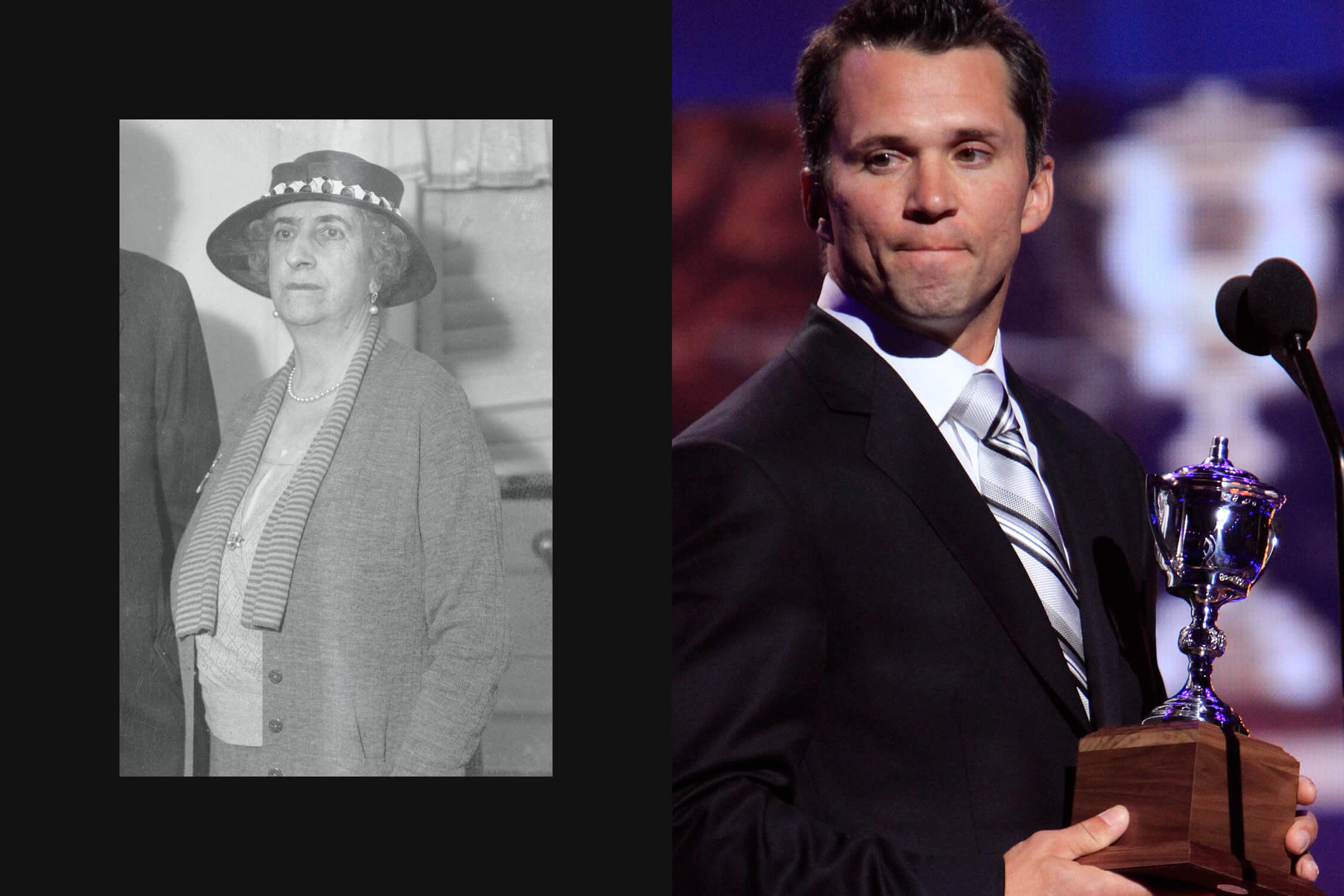
Decades after Lady Byng, left, created her eponymous award, St. Louis went through a perspective shift on its meaning as a three-time winner. (Bettmann Archive / Getty Images; Jacob Andrzejczak / Getty Images for NHL)
Penalty minutes are perhaps a useful tool for evaluating gentlemanly conduct, but not all infractions are created equal. As the Hurricanes’ Slavin pointed out, NHL players can receive minor penalties for roughing incidents that almost become fights, just as they can for accidentally flipping a puck over the glass, as Slavin did for his only penalty during his Lady Byng-winning season of 2020-21.
Yet penalty minutes are one of the only metrics available to voters. It’s why many writers struggle to feel confident when casting their Byng ballots, especially compared to other league awards.
“(The Lady Byng) is always the toughest one for me,” says Associated Press writer Stephen Whyno, the PHWA’s president. “We’re not on the ice, in between the benches.”
“We can count stats and we can use analytics to fill in the blanks if we don’t know the stats for other awards, but for this award it’s nebulous,” ESPN’s Greg Wyshynski adds.
Wyshynski has long advocated for NHL on-ice officials voting on the award, as they work in the thick of the action and overhear interactions writers cannot. Retired referee Dave Jackson, now a rules analyst at ESPN, believes officials would have an interest in offering input, even if just by anonymously sharing insight with PHWA members and not submitting official ballots. (PHWA ballots are made public for the Hart, Selke, Calder and Lady Byng trophies and the All-Star and All-Rookie teams, but votes from other bodies — general managers for the Vezina Trophy, for example — are not.)
Over the years, Jackson has never found himself upset upon seeing the names of the Lady Byng finalists. He has, though, felt other players deserved to be included in the conversation for the “best type of sportsmanship and gentlemanly conduct,” even if they were highly penalized players. He put Shane Doan, who never finished higher than 26th in Byng voting and had 1,353 career penalty minutes, in that category.
“There are guys that take a lot of penalty minutes that are some of the greatest guys ever,” Jackson said. “They’re never disrespectful to the officials. You can always seek them out. … But because of their penalty minutes, sometimes they never get consideration.”
Slavin defines gentlemanly conduct as “carrying yourself in a way that you respect the game, you respect the people and you’re playing the game in an honest way.” St. Louis, now behind the bench as coach of the Montreal Canadiens, says it’s competing hard while staying within the rules.
Whyno, who believes the PHWA membership “does a great job figuring this part of it out,” spitballed the idea of some sort of committee voting on the award. It could include a group of hockey writers — who Slavin and Jackson both noted have perspective on how candidates carry themselves in open dressing rooms — as well as on-ice referees and linesmen; between-the-bench TV reporters; and perhaps even a collection of players and coaches.
“I wish it were more (of) an anecdotal award than a stats award,” Whyno said.
Even with the current voting format, no recent winner has felt out of place on the overall list of decorated Byng recipients. That sense is important to maintain: For St. Louis, who received the Byng three times after finishing third behind Richards in 2004, winning was exciting because of those who came before him.
“When you look at the list of players that won that trophy, it’s pretty impressive,” he said.
Slavin appreciated the honor, too. Now a two-time winner, the Carolina defenseman received acclaim for his strong defensive play, often against other teams’ top competition, and took only five combined minor penalties in 133 games during his two Byng seasons. A proud Christian, Slavin cited his faith as one reason why an award based in part on character holds meaning to him.
That doesn’t mean he prominently displays the miniature Lady Byng trophies that each winner receives. His first name is misspelled on the one he received for his 2020-21 season — only one C — and he said he keeps both in his closet.
“For right now,” he said, “they’re good dust collectors.”