
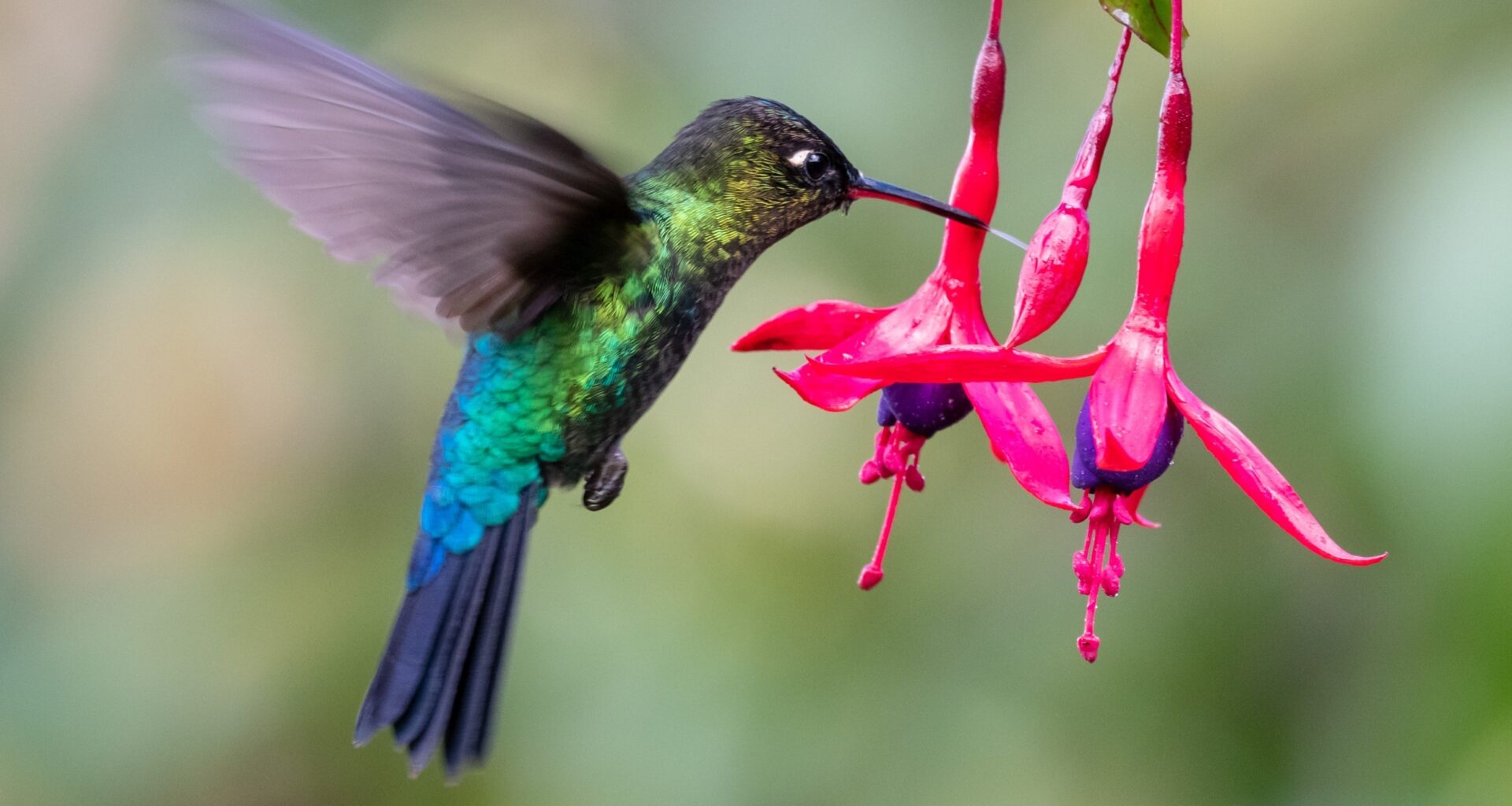
Say you’ve got two couriers carrying the same pollen from one flower to the next.
The first is careful to a fault. She scoops up every grain of pollen, tucks it neatly against her body, and hauls most of it home.

The second hardly knows the package is there. He buries his face in a flower for a sip of nectar, gets dusted with pollen by accident, and zips off to the next one, scattering grains as he goes.
Now guess which courier actually delivers more pollen where it needs to go.
A new study from plant scientists at the University of California, Santa Cruz (UCSC) finds that the sloppy courier, the hummingbird, is the better pollinator.
This one quirk might solve a mystery botanists have chewed on for decades.
Why mountain flowers changed
As you move higher up tropical mountains in Central and South America, the flowers start to change.
Lower down, many flowers are wide and fragrant, which makes them attractive to bees. Higher up, they become narrow, colorful tubes that are better suited for hummingbirds.
For years, scientists believed this happened because bees could not cope with the cold, wet conditions of mountain cloud forests. They thought plants had to depend more on hummingbirds at higher elevations.
But when researchers from UC Santa Cruz studied flowers in Costa Rica, they found that bees were still there. Even in the cool, misty cloud forests, bees continued visiting flowers.
Bees never disappeared
This showed that the shift toward hummingbird pollination was not simply because bees disappeared.
“Bees were still there and visiting flowers, even in the cloud forest,” said senior author Kathleen Kay, professor of ecology and evolutionary biology at UC Santa Cruz.
“What changed was that hummingbirds became even more important – not because bees disappeared, but because hummingbirds were both efficient and more active at higher elevations.”
Quality beats quantity
So if the bees never left, why do mountain flowers keep switching to birds? It comes down to a distinction we all understand: showing up isn’t the same as getting the job done.
The team zeroed in on two close cousins, a lowland ginger pollinated by bees and a mountain ginger pollinated by a hummingbird called the green hermit.
They rigged up motion-triggered cameras and filmed the flowers for hundreds of hours, then sat down at a microscope and counted, grain by grain, how much pollen each visitor left behind.
Better pollination beats frequent visits
The bees won on sheer hustle, dropping by about seven times a day to the hummingbird’s two. But every time the bird stopped in, it delivered nearly twice the pollen.
The hummingbird pulls ahead with room to spare. The bee’s busy schedule just couldn’t beat the bird’s heavy haul.
A bee gathers pollen on purpose, as food for its young, so most of what it picks up is destined for the nest, not another flower.
A hummingbird couldn’t care less about pollen. It’s after nectar, and the pollen is just dust it can’t be bothered to wipe off.
“Unlike bees, which groom pollen from their bodies to feed their offspring, hummingbirds are focused on nectar and end up transporting more pollen from flower to flower,” Kay said.
Because the bird never tidies up, it carries those grains farther and shares them with far more flowers.
A flower reinvents itself
Switching pollinators doesn’t tweak a flower. It rebuilds it.
The bee model is big and pale, with a wide lip that doubles as a landing pad, painted lines that guide the insect in, and a scent that says come hither.
The hummingbird model tosses nearly all of that out. It gets smaller and curvier, loses its perfume, and becomes a tube shaped for a hovering beak that doesn’t need a place to land.
Pollinator shifts create species
That redesign does more than change how a flower looks. Once a plant goes all in on hummingbirds, it stops trading pollen with its bee-loving relatives, and given enough time, the two become separate species.
Study lead author Pedro Juarez is a Costa Rican biologist who is currently at Lund University in Sweden.
“Pollination shifts can help generate new species because flowers adapted to different pollinators may become reproductively isolated from one another,” said Juarez.
“These evolutionary transitions have occurred many times in flowering plants and help explain the remarkable diversity of flowers.”
A small advantage matters
What stands out is how little it took to change the course of evolution. Bees never disappeared, and no major environmental upheaval was required.
A small advantage in pollination efficiency was enough to push an entire lineage of flowers in a new direction.
In nature, it seems, a small advantage can snowball into something big.
A lot of the watching fell to undergraduates who spent long, humid days filming flowers in the forest. One of them, Kathryn Gerhardt, finished her degree in 2023.
“Though the field work was the most exciting part, it was also rewarding to extract usable data from camera traps and see the paper published,” said Gerhardt.
The study is published in the journal New Phytologist.
—–
Like what you read? Subscribe to our newsletter for engaging articles, exclusive content, and the latest updates.
Check us out on EarthSnap, a free app brought to you by Eric Ralls and Earth.com.
—–