
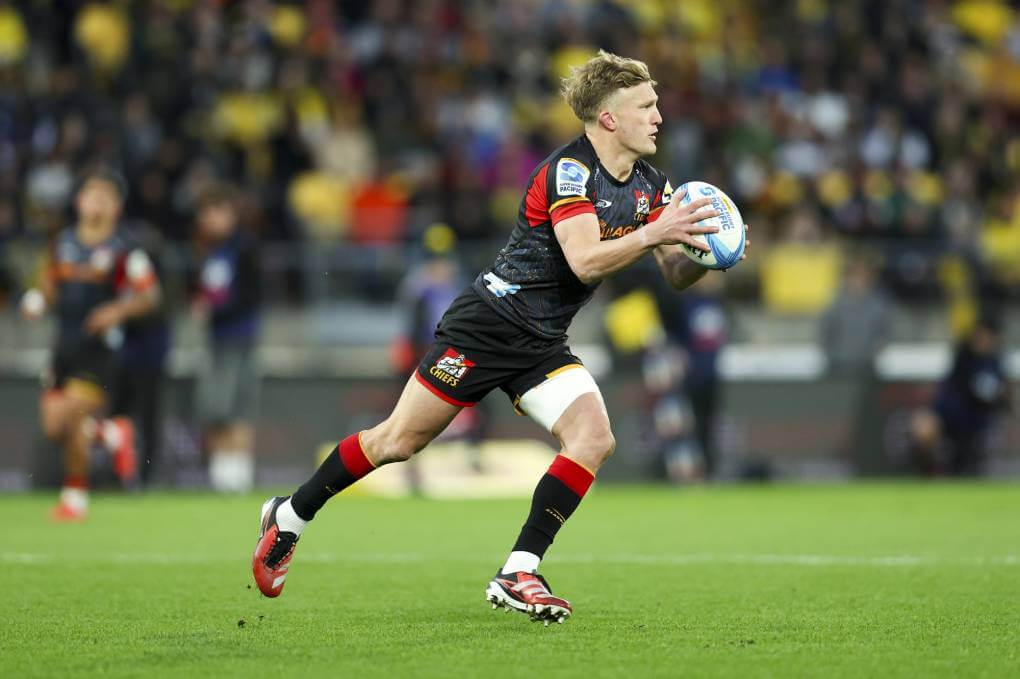
Happy Monday, G&GRs! Well, the 2026 Super Rugby Pacific is done and dusted for the Australian teams. As was widely predicted, our teams only lasted one more round. But what was interesting was that all teams lost by 20 points or more. Proving that the top teams are really a quantum above the others. So let’s dive in and analyse the three matches, Brisneyland style. Go and pour a cup of liquid gold☕ and get that into you while we dissect the SRP.

Super Rugby Pacific 2026 – Qualifying Finals
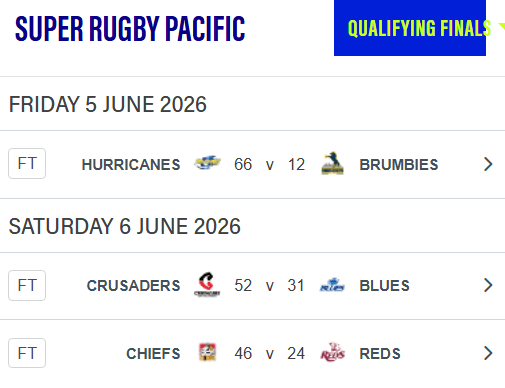
Hurricanes 66 defeated ACT Brumbies 12
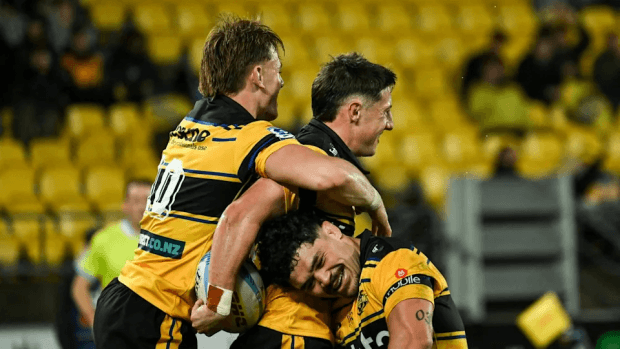
The Brumbies arrived in Wellington carrying the hopes of Australian rugby. They left carrying a 54-point hiding and another entry in the ever-growing catalogue of Kiwi finals trauma. The Hurricanes absolutely dismantled the Brumbies 66-12 on Friday night, delivering the biggest finals defeat ever suffered by an Australian side in Super Rugby and extending the nation’s miserable record in New Zealand playoff matches.
For all the talk during the week about history, momentum and the Brumbies’ surprisingly decent recent record across the Tasman, none of it mattered once the Hurricanes got rolling. The top seeds were faster, sharper, more physical and frankly looked like they were playing a different sport for large stretches of the evening. The match was effectively over before most Australian viewers had settled into their couches.
After surviving some early pressure on their own line, the Hurricanes turned a Brumbies handling error into a long-range try and never looked back. Five first-half tries followed as Wellington’s men raced to a staggering 31-0 lead before eventually taking a 38-7 advantage into the sheds. The Brumbies had spoken during the week about staying in the fight early. Instead, they found themselves chasing shadows.
Ruben Love was outstanding, pulling the strings with authority and looking every bit a future All Blacks playmaker. Outside him, Jordie Barrett was a constant threat while halfback Cam Roigard sliced through the Brumbies’ defence repeatedly, helping himself to a double. The Hurricanes’ right edge was particularly brutal. Every time the Brumbies looked like they might build some momentum, the hosts found another gear and exposed defensive disconnects with ruthless efficiency.
By the second half, it had become an exercise in damage limitation. Unfortunately for the visitors, the Hurricanes weren’t interested in showing mercy. Ngane Punivai crossed three times after the break as the scoreline ballooned, while Love finished with a near-perfect night from the tee, slotting nine conversions and a penalty in a clinical display.
For the Brumbies, it was a sobering end to a season that promised far more. They began 2026 looking like genuine contenders but gradually lost momentum throughout the campaign, eventually limping into the playoffs in sixth position. Their attack never really clicked in Wellington. Ryan Lonergan battled hard behind a pack that struggled to generate front-foot ball, while too many passes found fingertips instead of hands. The handling errors mounted, the confidence evaporated, and the Hurricanes happily capitalised.
There was at least one positive from an Australian perspective. Tom Wright produced several flashes of class, beating defenders and creating opportunities whenever he touched the ball. With the Wallabies Tests looming, Joe Schmidt will have liked what he saw from his fullback, even if the scoreboard was ugly reading. As for Australian rugby, the wait continues.
The Brumbies had won four of their previous six matches in New Zealand and had beaten the Hurricanes in each of their last three finals encounters. If any Australian side was going to finally break the playoff hoodoo on Kiwi soil, it felt like this group had a chance. Instead, the Hurricanes delivered a reminder of the gulf that can still exist when New Zealand’s best teams hit finals mode.
Three Things We Learned
Finals footy in New Zealand remains rugby’s hardest assignment – Every year, we convince ourselves things have changed. Every year, a Kiwi side reminds us otherwise. The Brumbies were experienced, well-coached and battle-hardened, yet they were blown off the park inside 30 minutes. Winning a Super Rugby final in New Zealand remains the ultimate challenge for Australian franchises.
Ruben Love’s All Blacks credentials are growing rapidly – Love controlled the game beautifully. His kicking, passing and game management were all first-class, and he constantly put the Brumbies under pressure. With New Zealand’s playmaking stocks being closely watched, performances like this won’t go unnoticed by the selectors.
Larkham has to go back to the drawing board – Season 2026 has seen some serious wheel wobbling with the Puppy Killers. Unlike the previous seasons, the Ponies had some rally head-scratching moments, and some serious un-Brumby-like games. Something isn’t quite sitting right within the Brumby camp, and Larkham has the off-season to work out what it was.
Crusaders 52 defeated the Auckland Blues 31
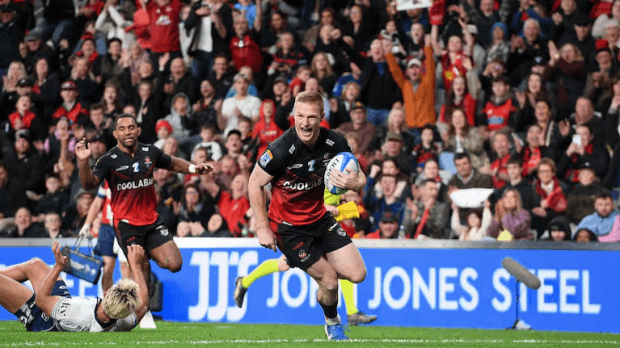
Crusaders turn Christchurch into a fortress as Blues self-destruct in qualifying final – Well, that escalated quickly. The Blues arrived in Christchurch hoping to spoil the Crusaders’ party and keep their title defence alive. Instead, they spent more than an hour trying to survive with fourteen men as the Crusaders piled on seven tries in a comprehensive 52-31 qualifying final victory at One NZ Stadium.
For Australian rugby fans hoping someone, anyone, could make life difficult for the perennial red-and-black menace, it was another reminder that finals footy in Christchurch remains one of the toughest assignments in world rugby. To their credit, the Blues started like a team determined to silence the home crowd. A clever lineout variation opened space in midfield, AJ Lam sliced through the defence and drew the last defender before putting Sam Nock over for the opening try.
The Crusaders weren’t interested in reading that script. A powerful break from Chay Fihaki put the hosts on the front foot before Sevu Reece crossed to level the scores. What followed was a typically brutal finals arm wrestle, with both sides trading territory and physicality. Then came the moment that changed everything.
In the 18th minute, Blues No.8 Malachi Wrampling launched into Leicester Fainga’anuku with a tackle that made every viewer immediately start looking for the bunker graphic. Contact with the head was clear, mitigation was minimal, and after a brief review, 🧀 quickly became 🍷. The Blues suddenly had more than sixty minutes to play a man short against the Crusaders in Christchurch. Good luck with that.
To their credit, the visitors refused to fold immediately. Johnny McNicholl crossed for the Crusaders, only for Anton Segner to respond and keep the Blues within touching distance. Unfortunately for the Aucklanders, the effort required to stay in the contest eventually became too much. David Havili crashed over to spark a late first-half avalanche. Fihaki joined the party soon after, before Taha Kemara added another as the Crusaders turned a competitive contest into a scoreboard headache. By halftime, the lead had blown out to 33-14, and the result already felt inevitable.
The second half became an exercise in damage limitation. McNicholl completed his hat-trick with two more tries as the Crusaders repeatedly found space out wide. Every time the Blues threatened a comeback through Xavi Taele or Peyton Spencer, the home side simply shifted up another gear. A late rolling maul try pushed the Crusaders beyond the half-century mark, because apparently winning comfortably wasn’t enough.
The final score of 52-31 reflected both the quality of the Crusaders and the impossible challenge facing a Blues side that spent most of the night down a man. The victory keeps Rob Penney’s side unbeaten at their shiny new home and maintains the remarkable aura Christchurch continues to hold over Super Rugby finals.
Now comes the waiting game. If the Chiefs account for the Queensland Reds, we’ll get a Hamilton rematch of last year’s Grand Final. If the Reds can do Australian rugby a favour and upset the Chiefs, the Crusaders will be back in Christchurch next week, hosting Queensland. As for the Blues, they’re reduced to becoming temporary Chiefs supporters. A Hamilton victory keeps their season alive and sends them to Wellington. A Reds upset, however, would bring the curtain down on their title defence.
Three Things We Learned
Red cards and Christchurch are a terrible combination – Playing the Crusaders in Christchurch is difficult enough with fifteen men. Trying it with fourteen for more than an hour is basically rugby’s version of voluntarily wrestling a crocodile. The Blues fought hard, but once Wrampling saw red, the mountain became Everest.
The Crusaders are peaking at exactly the right time. For much of the season, the Crusaders looked good. In recent weeks, they’ve looked dangerous. Against the Blues, they looked like genuine title favourites. Their attack was clinical, their set piece was dominant, and they punished mistakes without mercy.
Saders do what Saders Do – Every year we watch the Dark ones get off to a slow start. Every year, we wonder if this is going to be the year they finally fall over. Then they start getting their 💩 in one sock. Then the Saders do what the saders do. They peak at exactly the right time and come home with a wet sail.
The Chiefs 46 defeated the Queensland Reds 24
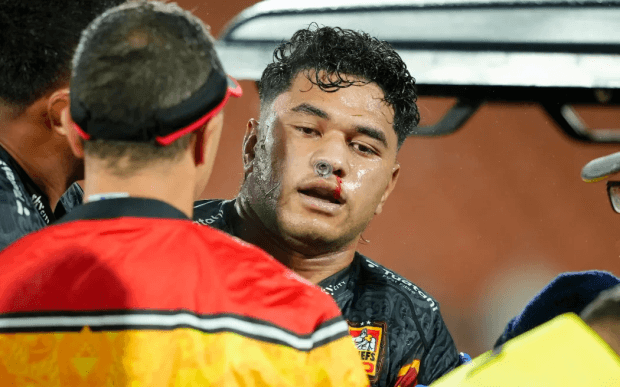
The Queensland Reds’ season is over, and with it goes Australia’s latest attempt to break the seemingly unbreakable Super Rugby finals curse across the ditch. Despite a brave effort in Hamilton, the Reds were eventually overpowered 46-24 by the Chiefs on Saturday night, extending the miserable record of Australian teams in New Zealand finals to 0-from-22. If you were looking for signs that the hoodoo might finally be ending, they were there for about 50 minutes. Then Damian McKenzie happened.
For a side playing its final match under Les Kiss before he heads off to take over the Wallabies, there was plenty to like. Unfortunately, there was also plenty of Damian McKenzie, and that’s usually a problem.
The Reds came out with intent and weren’t remotely overawed by the occasion. Fraser McReight, celebrating his 100th Super Rugby appearance, was a menace around the breakdown all night, while Tate McDermott continued his remarkable comeback from a serious hamstring injury. Given he’d only played a handful of matches this season, the halfback looked sharp and dangerous whenever Queensland generated quick ball.
Filipo Daugunu was arguably the Reds’ most threatening back, carrying hard and repeatedly bending the defensive line. The frustrating part was that he probably didn’t see enough of the football. The first half was a genuine contest. The Reds matched the Chiefs physically and stayed firmly in the fight despite the home side finding opportunities out wide through winger Kyran Taumoefolau, who crossed twice before the break.
When former Chiefs prop Aidan Ross crashed over late in the half against his old side, it looked like Queensland might head to the sheds with momentum. Instead, Taumoefolau’s second try on the stroke of halftime gave the hosts a narrow 22-17 advantage and shifted the mood inside FMG Stadium.
The game’s most concerning moment arrived in the 17th minute when Chiefs number eight Wallace Sititi suffered a nasty head knock that left players from both teams visibly concerned. Reds lock Lukhan Salakaia-Loto was initially shown a yellow card for the incident, but after review, the officials determined that the major injury occurred through a separate head clash involving Chiefs prop Sione Ahio, meaning the sanction was not upgraded to red. Sititi was eventually taken from the field and later transported to the hospital for further assessment. (From all Australian Rugby supporters, we hope that Wallace gets the care he needs and gets well soon. No one wants to see things like that).
Unfortunately for Queensland, the second half started in the worst possible fashion. McKenzie, returning after missing last week with a concussion, spotted the Reds napping and took a quick tap penalty to score under the posts barely a minute after the restart. It was the sort of play that drives opposition coaches insane and highlights why the Chiefs’ playmaker remains one of the most dangerous footballers in the competition. From there, the Chiefs gradually tightened the screws.
McKenzie added a second try midway through the half and was at the centre of almost everything dangerous the home side produced. Every time the Reds looked capable of building pressure, the Chiefs found another gear. Matt Faessler gave Queensland a brief glimmer of hope when the replacement hooker barged over, but any thoughts of a comeback disappeared shortly afterwards. McKenzie produced a ridiculous backhand flick that somehow stuck, sending fullback Isaac Hutchinson away to score and effectively end the contest.
The scoreline ultimately blew out more than the performance deserved. For large stretches, the Reds were competitive and matched one of the tournament favourites. But final football is about moments, and the Chiefs won nearly all of them. Their reward is a semi-final showdown with the Crusaders in Hamilton next week, while the Reds head into an off-season that should still be viewed as progress under Kiss.
The season didn’t end the way Queensland supporters wanted, but there were enough signs throughout 2026 to suggest the Reds are moving in the right direction. Unfortunately, on Saturday night, they ran into a Chiefs side with Damian McKenzie pulling the strings, and that’s a difficult problem for any team to solve.
Three Things We Learned
Fraser McReight is ready for a massive Wallabies season – If there were any lingering doubts about McReight’s standing among the world’s best opensides, they should be gone. In his 100th Super Rugby match, he was relentless at the breakdown and consistently disrupted Chiefs possession. Les Kiss may be leaving Queensland, but Joe Schmidt’s successor will be delighted knowing McReight is entering his prime.
The Reds aren’t far away—but they’re not there yet – The final score says 22 points. The performance says something different. Queensland matched the Chiefs physically and remained in the contest deep into the second half. The problem was execution in key moments. The best New Zealand sides punish every lapse, and the Reds still have work to do before they can consistently win those moments in finals football.
Damian McKenzie remains the competition’s ultimate game-breaker – The Chiefs weren’t perfect, but McKenzie didn’t need them to be. His quick-tap try completely changed the complexion of the second half, while his second try and outrageous assist for Hutchinson showcased his ability to create something from nothing. When finals matches tighten up, having a player capable of producing moments like that is often the difference between surviving and advancing.
The 2026 Semi-Finals
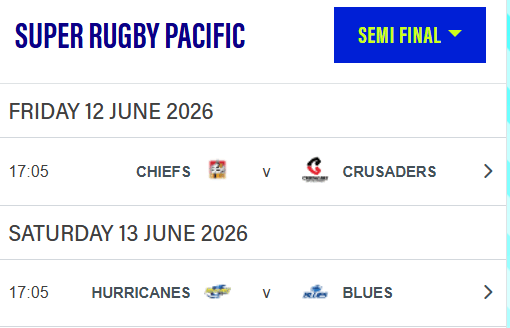
The smoke has barely cleared from a brutal qualifying finals weekend, but the shape of the semi-finals is already becoming frighteningly clear. The Hurricanes and Chiefs have reminded everyone why they finished first and second on the ladder, dismantling the Brumbies and Reds respectively with the sort of ruthless efficiency Australian fans have spent three decades learning to fear. The Crusaders have also booked their place after seeing off the Blues, setting up what many will argue is the de facto grand final a week early when they travel north to Hamilton to face the Chiefs. On current form, it’s hard to split them. The Chiefs possess the competition’s most potent attacking weapon in Damian McKenzie, but the Crusaders have that irritating habit of treating finals rugby like a family business.
The more intriguing question surrounds the fourth semi-finalist. Thanks to the “lucky loser” system, the Blues survive despite their qualifying final defeat and now earn the privilege of travelling to Wellington to face a Hurricanes side that just hung 66 points on the Brumbies. Logic says the Hurricanes should account for the Aucklanders comfortably, particularly given the form of Cam Roigard, Jordie Barrett and a forward pack that has been steamrolling opponents all season. But finals rugby has never been particularly interested in logic. The Blues remain loaded with All Blacks experience and have spent most of the last two seasons proving they are at their most dangerous when everyone has written them off. If there is a semi-final upset brewing, it’s probably there. If not, we may well be headed towards the heavyweight showdown everyone suspected was coming months ago: Hurricanes versus Chiefs for the right to lift the trophy. But then again, there are those damn pesky Saders doing what they do!
Wallaby Selection and Training Squad

Joe Schmidt is expected to name a provisional train-on squad of around 36 players toward the end of this coming week, or the beginning of the next. This initial squad will bring together Super Rugby players in Sydney to begin preparations for the highly anticipated July Test window. Following the squad assembly, the team will commence preparations for a demanding mid-year schedule before Schmidt hands the head coaching reins to Les Kiss.
In the last few rounds of SRP and the finals matches, a number of players stuck their hands up, and a number had performances I am sure they wish they could take back. Here is Brisney’s view of the Wallabies stocks moving forwards. I will not cover individual players, as we have Hoss’s great reveal of the GAGR player poll coming up soon.
Front Row
All in all, this is where I see our biggest weaknesses lie. Our depths in the piggy and hooker ranks aren’t that great. We have some solid players, but by the time we hit the bench, we are struggling.
Second Row
Our depth in the locking department is not that bad. Between the Force, Ponies and Reds, we have some very decent tall timber. As well as some decent reserves that can cover both the second row and the back row.
Back Row
For whatever reason, Australia seems to grow back rowers like my garden grows weeds. They are everywhere, strong and pesky little buggers. Our challenge with our current crop is that we have more great players in the back row than we have spaces available. But going into the 2027 RWC, we will need two full squads, so we should be covered there.
Scrum Half
Whilst at the beginning of the season we looked OK in the 9’s stocks, the year hasn’t panned out so well. The incumbent has had an atrocious season and should not be allowed anywhere near the gold jersey. And our best form 9 has only just started back from injury. We have had a couple of players really step up, and a few youngsters emerge that highlight our future stocks of 9’s should be pretty healthy.
Fly Half
Next to front rowers, here is our biggest weakness. Our mainstays are not that dynamic and are generally struggling for form. Our key fly-half returning from injury has had a few good games back, indicating a trend in the right direction, but really hasn’t had enough game time to demonstrate this fully. The combinations with our scrum halves here will be interesting to see which way the selection decisions go.
Centres
Our centres are a bit hit and miss. We have a decent one overseas returning from injury. According to the Stan crew, we have a dead cert who hasn’t really played a decent SRP game this season. Then there are a couple of guys who have had pretty handy SRP seasons, but there is a big difference between SRP and the Test arena.
Fairies
We have plenty of these. Personally, I am hoping that we pick our wings and full-backs based on form. But alas, I am sure there will be some funny buggers going on here. But rest assured, we have enough decent wings and fullbacks to cover two squads.
Overall, we are looking ok. Front row and fly-half are our concerns. Can’t wait till Hoss publishes the GAGR Vox Pol. Let me know your thoughts. Anyway, enough of my gibbering crap. Over to you, GAGRs! Have it!