
 Save
Save
You have reached your maximum number of saved items.
Remove items from your saved list to add more.
AAA
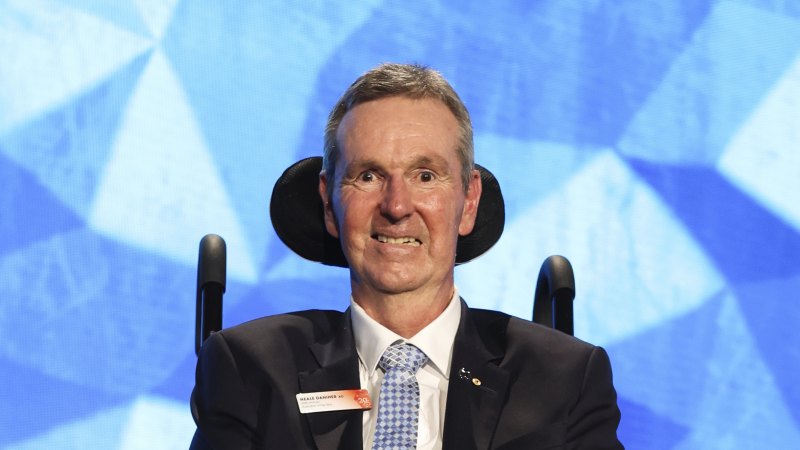
Neale Daniher’s life was writ large, first in footy and then through circumstances no one would wish upon another. In 2013, Daniher was diagnosed with motor neurone disease. A year later he founded FightMND. It has raised more than $150 million for research and support.
A large factor in its fundraising is the Big Freeze at the MCG. It is the biggest fundraiser in Australia for MND. On Monday, almost 90,000 people turned the ground into a sea of blue beanies. Digital beanies for each seat sold out.
It is a testament to Daniher, his family and FightMND that Australians have joined in the battle in the numbers they have and in giving money to the cause – whether it be a few dollars or the extraordinary gift of $40 million that Queensland couple Quentin and Kylie Birt made on Monday.
Before the game, FightMND’s lead researcher, Bec Sheean, reflected to fans at Federation Square on Daniher’s legacy. “I remember telling people I was working on MND in the early days, and most people had absolutely no idea what it was. Today, everyone in Melbourne knows what MND is, and it’s because of Neale, and it’s because of the Big Freeze.”
Last January, the federal government disclosed it was investing $40 million over four years – through FightMND – to establish the Neale Daniher National MND Clinical Network, which will accelerate research, expand clinical trials and seek to improve outcomes for people with the disease. The Victorian government on Monday pledged $500,000, taking its financial backing for FightMND to $4.6 million in the past 11 years.
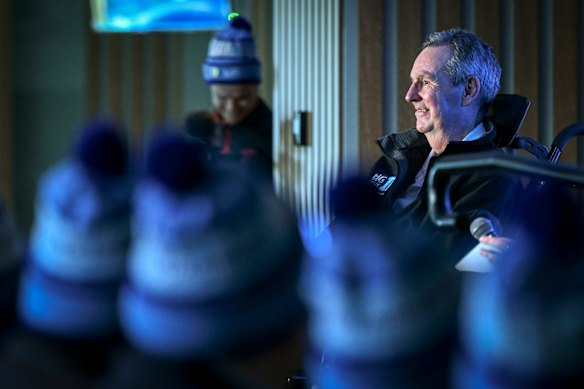 Neale Daniher, pictured addressing Melbourne players ahead of the King’s Birthday clash against Collingwood last year, will be honoured at a state funeral today. Eddie Jim
These are both welcome contributions, but state MND associations rely primarily on public donations. Governments need to step up further to tackle this devastating disease, just as Neale Daniher did and others will continue to do in his honour.
More broadly, investment in science is crucial. The Australian Academy of Science will launch on Wednesday a campaign seeking to halt the decline in money for science, an area in which funding in research and development has gone backwards. It is now 1.69 per cent of GDP, compared with the OECD average of 2.72 per cent.
“From creating Wi-Fi and sunscreen to developing the cochlear implant and the cervical cancer vaccine, Australia is known for its cutting-edge innovation, research and development,” Academy president Professor Sam Berkovic said. “However, the reality is that it spends a third of what its global peers do when it comes to backing scientists, researchers and doctors.”
Today the flags are lowered to honour and mourn Neale Daniher. The state funeral at the MCG begins at 1pm. Daniher died last month, aged 65. For the last 13 years of his life he had fought “The Beast”, his term for MND. Even though there is no cure, Daniher took up the fight with a superhuman strength of will to vanquish The Beast and to help others who were afflicted.
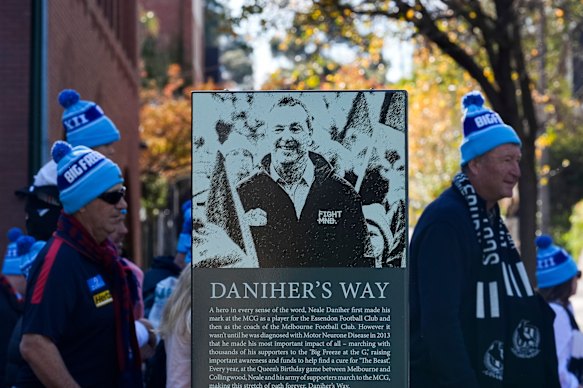 Spectators pass a sign in honour of Daniher during the Walk to the G ahead of Monday’s game.Getty Images
He once said, “There’s always opportunity, and my opportunity was to fight MND. And that’s allowed me to prevail. It’s allowed me to find purpose, to transcend, what’s happening to me.”
According to MND Australia (which has awarded $2 million towards MND research projects starting this year), each day in this country two people are diagnosed with the disease. On average, two people die each day from it. About 2780 people are believed to battling it at any one time.
Although the risk of MND increases as you age, it is not confined to the elderly, as the case of rugby league player Jai Arrow has shown. The 30-year-old revealed last month that he had been diagnosed with MND. He tossed the coin for the start of Monday’s match. “I’ve got a fight on my hands,” he said, “I’m ready to fight.”
Thirteen years ago, Daniher, on being diagnosed, was ready to fight. His work led to his being named Victorian of the year in 2019 and Australian of the year in 2025. FightMND is now one of the world’s largest independent funders of MND research.
Though the flags are lowered this day, his light shines on.
Get a weekly wrap of views that will challenge, champion and inform your own. Sign up for our Opinion newsletter.
Save
You have reached your maximum number of saved items.
Remove items from your saved list to add more.
 The Age’s View – Since The Age was first published in 1854, the editorial team has believed it important to express a considered view on the issues of the day for readers, always putting the public interest first.From our partners