
Multiple times in the past month, MotoGP has got lucky.
That’s undeniable; what’s also the truth is that crossing your fingers should be nobody’s idea of a sustainable strategy, especially on matters of safety that can have serious consequences.
Every MotoGP qualifying, practice and race LIVE and ad-break free from lights out to the chequered flag. New to Kayo? Start Your Free Trial Today >

Which is why, after three first-corner crashes across the past three rounds in Catalunya, Italy and Hungary that have left multiple riders battered and bruised – and fortunately with nothing more than broken bones and time spent sitting on the sidelines – MotoGP’s rider corps are getting restless.
Start devices – launch devices, holeshot devices, call them what you will – are being banned in MotoGP as part of the 850cc engine regulation revolution set for next season. But with 14 rounds remaining in this season – and 28 race starts when you include sprints – there’s one easy fix that can help make a sport that can never truly be safe somewhat safer.
Outlaw them now.
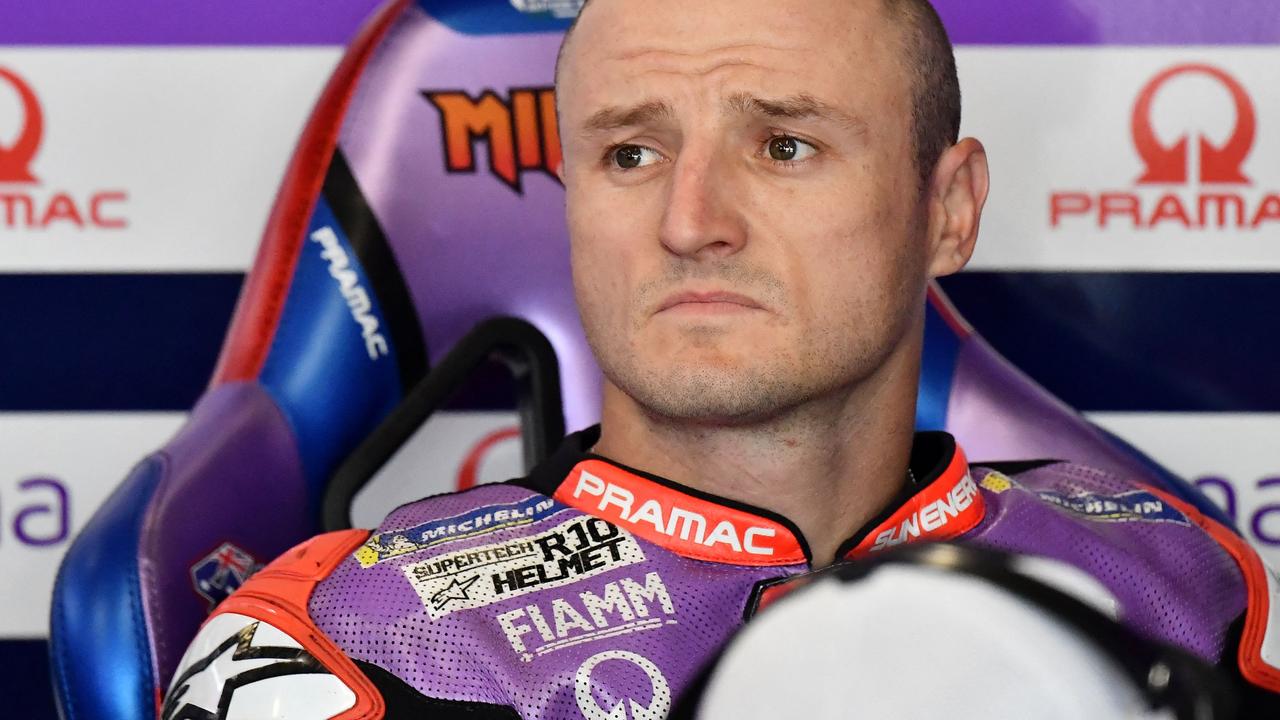
Just ask Jack Miller.
“Take them off,” Miller forthrightly said after last weekend’s Hungarian Grand Prix, when an out of control Jorge Martin – clearly struggling to get his Aprilia’s start device disengaged in the short run to Balaton Park’s first corner – speared into championship-leading teammate Marco Bezzecchi, Bezzecchi’s bike then taking out Ducati riders Fermin Aldeguer and Fabio Di Giannantonio, and Aprilia stablemate Raul Fernandez.
MORE MOTOGP NEWS
TALKING PTS: Aprilia fumble gift for champ, Aussie rides luck luck
AUSSIE’S MOTOGP CHANCE? Tech3 boss ‘open’ to 2027 rookie,
Marquez reaches 100 win milestone! | 00:43
Fortunately, no riders involved in the incident were seriously injured, and Di Giannantonio remounted his crashed Ducati and continued in the race.
But to Miller, that’s not the point.
“I’ve been quite vocal about the ride-height device,” he added, his exasperation evident.
“We’re all arriving [at the first corner] at the same time, grab abnormal amounts of brake first to get the rear [of the bike] to recover, and second to unlock the front [suspension].
“The reason why everything is even more chaotic at turn one because of the ride-height device is because everybody has it. Nobody has a clear advantage any more.”
‘WE RISK TOO MUCH’: RIDERS CRITICAL AFTER ANOTHER SCARY SHUNT
Start, or holeshot, devices in MotoGP aren’t new – Ducati was using the earliest version of theirs as far back as 2018. But as the grid caught on to their advantages and caught up with the Italian manufacturer’s innovation, they’ve become an essential part of what makes a MotoGP monster go from a standing start to full speed as rapidly as they do.
Martin wipes out 5 riders in mass crash! | 00:53
PIT TALK PODCAST: Renita, Michael and Matt catch up with Haas F1 reserve driver Jack Doohan, chat to Broc Feeney about his Supercars season, and wrap up last weekend’s racing with F1 at Monaco and MotoGP in Hungary. Listen to Pit Talk now
How do they work? With 300-plus horsepower from a 1000cc engine capable – as we saw at the recent Italian Grand Prix – of pushing a MotoGP machine to 368.6km/h as Aprilia’s Bezzecchi and Martin both managed at Mugello, keeping the front wheel down when all that torque is transferred to the rear tyre off a standing start requires more than a subtle right wrist.
As the riders prepare for the start of the race, they activate a setting that manually lowers the bike’s suspension, minimising the propensity of the bike to wheelie and allowing for more effective torque transfer through the rear wheel. The ‘device’, as riders refer to it, should be disengaged when a rider brakes for the first corner, returning the machine to its normal, racing, clearance from the ground.
Marquez overcomes Q2 crash to win sprint | 00:56
The key words, and the caveats? “Should be”, and certain circuits where the first corner – think Le Mans in France, Silverstone in England and Phillip Island in Australia – isn’t a braking area where a rider will actually brake hard enough to guarantee the device isn’t disengaged.
Back in May 2024, a key component of the regulations set out for 2027 onwards, once you’d read past the change from 1000cc machines to 850cc bikes, was that such devices would be outlawed.
Back then, MotoGP’s sprint race era – where half-distance races on the Saturday of every race weekend came in from 2023 – was already in full swing. From 22 starts per year, riders were now doing double that. More starts equals more jeopardy, potentially more accidents, and the higher propensity of riders being injured or compromised.
At the French Grand Prix in May this year – where the first corner at Le Mans is a flat-out right sweeper that leads up to a chicane where start devices become disengaged – the standard Friday safety commission meeting suggested a ban on holeshot devices at the aforementioned tracks for the remainder of this season before the devices go for good next year.
While a proposal was submitted to remove them, the lack of unanimous agreement among MotoGP’s five manufacturers meant the status quo was retained.
A MotoGP bike entering a fast first corner with an engaged holeshot device will be lower and not turn or handle as well; add 22 riders hurtling towards the same first braking point in a pack, and the potential for chaos is magnified.
MORE MOTOGP NEWS
RACE REPORT Marquez takes magical 100th win as Aprilia teammates collide
ROULSTONE RETURNS Aussie gets world championship lifeline as Moto2 stand-in
One round after Le Mans in Barcelona, the sprint start at the longest run to the first corner of any track on the calendar – 595 metres – saw Brad Binder (KTM) and Joan Mir (Honda) crash out. In the restarted Sunday Grand Prix, Honda’s Johann Zarco crashed and had his left knee wedged between the rear seat unit and rear tyre of Francesco Bagnaia’s crashed Ducati. The Frenchman has been sidelined since, and requires surgery before a timetable can be established for his return.
Two rounds after that came Martin’s incident last Sunday at Balaton Park, where the 2024 world champion lost control of his Aprilia well before the tightening Turn 1 right-hander that riders have been critical of since the track first came onto the calendar last year.
Five riders went down after Martin’s botched first corner in Hungary last Sunday. (Photo by Ferenc ISZA / AFP)Source: AFP
While there was a percentage of rider error in all three accidents across the past three rounds, the way the bikes start in modern-day MotoGP is, to at least some degree, a factor.
To be fair to Martin, his first-corner gaffe was out of character for a rider who, this season, has used the scorching starts of his Aprilia RS-GP as a way to mitigate his generally poor qualifying performances.
The Spaniard was MotoGP’s one-lap king for much of his time at Ducati, but after an injury-ravaged title defence in 2024, has become a qualifying question-mark, trailing teammate Bezzecchi 7-1 in their head-to-head qualifying battles this year.
On average, Martin’s average starting position this year – 6.8 – ranks him sixth (behind Marc Marquez, Di Giannantonio, Bezzecchi, Pedro Acosta and Alex Marquez). So how is he just 20 points behind Bezzecchi – less than one Grand Prix win – and second in the standings?
Rapid starts have become his new calling card, nowhere more so than Le Mans where he did the sprint and Grand Prix double despite qualifying in just eighth place. While he was apologetic about his role in last Sunday’s first-corner skittles, he’s won more from starts than he’s lost in 2026.
Bezzecchi, Aldeguer, Fernandez and – despite remounting and at least salvaging some points out of his Hungarian Grand Prix with 12th place – Di Giannantonio would have privately accepted Martin’s public apology but, equally, had different viewpoints.
Di Giannantonio’s post-Balaton Park debrief was, understandably for a rider who won the same Catalan Grand Prix after it was red-flagged for the horrendous Zarco first-corner crash, raw and heartfelt.
“Whatever happened with Jorge, we need to avoid it,” he said.
“I think – talking also about myself – we risk too much every time. We are not risking just to crash or lose the front [for ourselves], we are risking to put the lives of other riders in danger.
“It’s crazy that I have to pray before the race … not to do a good race, but to be safe after the first corner. I think this is completely crazy.
“I just want to race; I want to fight hard for my place, but I want to come back home. I think we are experiencing in the last years, crazy things on the starts. I always say – and it has to be the same to me if I do these things – it’s completely unacceptable.”
Di Giannantonio’s post-Hungary press debrief was raw and emotional after being taken out at the first corner. (Photo by Mirco Lazzari gp/Getty Images)Source: Getty Images
When it was put to Di Giannantonio that one of the considerations after Catalunya being discussed by the series was to increase the space between the riders on the grid or even adopt rows of two riders rather than three, he was open to change.
“We are really close [together] at the first corner and if a rider risks a lot, the reward is really high at the moment,” he said.
“If we arrive with much more distance between us, then you risk a lot for just two places. Maybe it isn’t worth it, maybe you don’t do it.
“There are tracks that are more critical than others, where we arrive with a lot of speed or whatever, but I think we are the best riders in the world, we can handle the situation.
“But if we can’t do it by ourselves, some more space, or starting closer to the first corner or whatever, for sure helps.”
BAN COULD COME SOONER RATHER THAN LATER
For factory Ducati teammates Bagnaia and Marc Marquez, the first-corner crashes are more a consequence of the number of race starts and competitiveness of the MotoGP field in 2026 relative to the past.
“There will always be risks, but it’s true that 44 starts with these bikes isn’t the best way to limit them,” Marquez mused.
“It’s good for the show, but the riders, the ones putting on the show, are taking bigger risks.”
Bagnaia concurred.
“I don’t think [adding space between rows] is a solution, or even putting just two riders in [each row],” he said.
“For me, removing the rear and front device will not make big changes. We are doing more crashes because we are starting much more, and we have more races.
“And if you consider 2011, 2012, 2014, six bikes were fast, all the others were slow. It’s difficult to compare.”
Miller continued to push for a ban to the devices even after he raced to a season-best eighth in Hungary following the first-corner crash that eliminated five rivals. (Photo by FERENC ISZA / AFP)Source: AFP
Bagnaia has a point, but MotoGP isn’t going back to an era any time soon where you could confidently pick the winner from one of a handful of bikes, nor is the sport likely to bin off sprint races on the grounds of safety overriding entertainment or their ability to produce content.
Which leaves the devices, and their imminent demise at the end of 2026 whether we have no or numerous first-corner crashes the rest of the year.
Paddock speculation bubbled in Balaton that a ban could come into place after the mid-season break following the German Grand Prix in July, which comes on the heels of the next two rounds at Brno in Czechia and Assen in the Netherlands.
Surely not coincidentally, the track immediately following the Sachsenring is Silverstone, one of the two more problematic circuits along with Phillip Island the rest of the season.
Banning the devices outright wouldn’t eliminate crashes, but could help to reduce them. MotoGP has acknowledged it needs to change given the 2027 regulations that were set out two years ago, so why wait?
“We’re making an unnatural manoeuvre, especially here in Balaton where Turn 1 was quite slippery with the new asphalt,” Miller said after Hungary, where he finished a season-best eighth after taking profit from five riders who’d qualified ahead of him all eliminated at the first turn.
“You weren’t even really able, without locking the front, to really get enough [load] transfer to unlock the devices.
“Take off the front device, it makes everybody’s life easier and everybody is in the same boat. We’re all in the same boat at the moment, except that boat is going about 30km/h faster …”.