
“If (player) could only _____ a little bit, then the (team) would really have something.”
— Ancient baseball proverb
What if Hard Throwing Pitcher could throw strikes, even at a slightly below-average rate instead of well below average? He’d get Cy Young votes, if not the actual award. If Superlative Defensive Catcher could hit .280, my goodness, he’d be worth a nine-figure contract extension. On and on it goes, throughout the roster and defensive spectrum. If a bench player could hit righties just fine instead of only hitting lefties. If only a slow player were fast, or if a clankmitt could field. If only this DH with a 1.000 OPS also had an ERA under 1.00.
You get the idea. It’s easy to dream, hard to actualize. We are all eternally “the ability to play violin” away from the New York Philharmonic, and it isn’t too different for toolsy baseball players.
Except some of those dreams can actually come true. If Kevin Pillar could hit even just a little bit, he’d have a 13-year major-league career. If Randy Rodríguez could throw strikes, he’d be a dominant closer. If Casey Schmitt could stop swinging at everything and start swinging at only most of the things, he’d be an everyday player. It’s a fine line between magical thinking and player development.
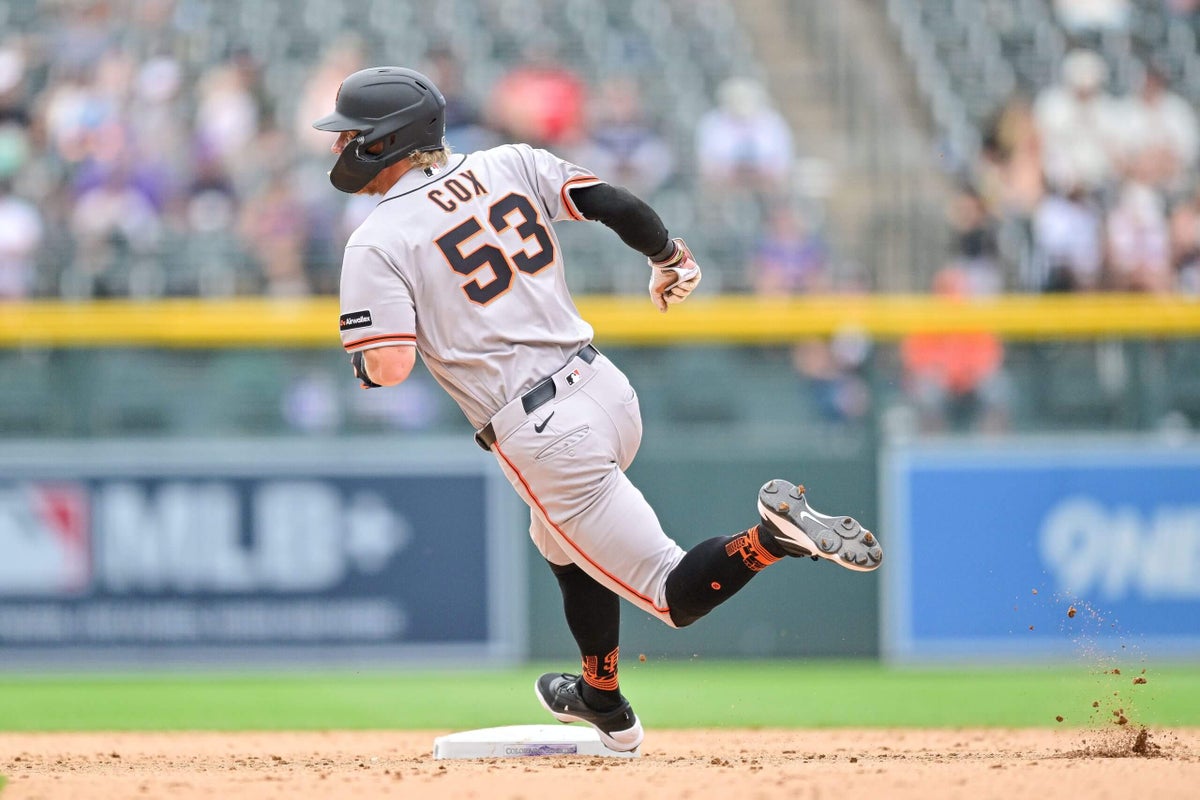
This brings us to Jonah Cox, the latest San Francisco Giants position-player prospect to make the majors. While he’s made a few plays, we haven’t yet had an opportunity to see him blaze across the vast expanses of the Oracle Park outfield. He’s scored a couple of runs, but we’ve seen his speed only briefly:
They tell us that Cox is the best center fielder in the system. It’s very easy to believe. They tell us that he’s already one of the fastest players in baseball. He’ll need a few more trips around the bases to show up on Baseball Savant’s running leaderboards, but that’s easy to believe, too. Let’s take what they say at their word, and that Cox is going to be an ultra-fast, slick-fielding center fielder.
One reason you might believe this is that the Giants added Cox to the 40-man roster months before they needed to, promoting him all the way up from Double A. They wouldn’t have done it if he weren’t off to a hilariously hot start for the Richmond Flying Squirrels (.400/.453/.644, six homers, five triples and 27 stolen bases in 44 games), but the certainty about his defense and speed being major-league quality got him to the majors ahead of schedule.
It’s easier to add a prospect before his time if he’s the archetype of a player a team knows it will always need. A prospect who is a strong defensive catcher, for example. A pitcher with the ability to both start and relieve. A speedy, defensively capable center fielder. It’s much trickier to add prospects who do a couple things well, but really need to hit to stay in the majors. If they don’t hit in the majors right away, it becomes much easier to justify designating them for assignment. (This is why Wade Meckler is rocking a .911 OPS for the Los Angeles Angels right now, not the Giants.)
You should get used to Cox, then. He’ll be around for a while. The Giants will always, always, always have a need for at least one guy who can make Oracle Park seem small, and it’s remarkable how many seasons they’ve tried to play without one of them. The Giants have tried a handful of players who had potential as “tweeners,” like Brett Wisely, with an ability to play center field and the middle infield. But what they really needed was a true center fielder, not a variety of tweeners to saturate the 40-man roster and become redundant. (This is why Tyler Fitzgerald is sporting a .998 OPS for the Oklahoma City Comets right now, not the River Cats.)
Cox has three minor-league options. He can be sent down this season. The Giants can send him down next season. They’ll be able to send him down in 2028. In each of those seasons, they’ll need a center fielder with speed, even in a reserve role or as an injury replacement. They’ve signed their guy, so to speak. There wasn’t a press conference with an oversized check or anything, but the Giants committed to an outfielder for a little bit, and they were happy to do so.
The spectrum of possibilities for Cox is fascinating, and each scenario deserves a look. We’ll start with the downer, which is the possibility that he can’t hit enough to stay on the roster. The bar is really, really low for a speedy, Gold Glove-caliber center fielder, so we’re talking historical levels of fecklessness. Blake Perkins is pretty close to a perfect comparison for Cox, in that the Milwaukee Brewers added him to their 40-man roster when he was closer to a prospect’s age, and they’ve kept him on there for four seasons now, even as his offensive numbers have gotten worse. He has a career OPS+ of 75, and it’s currently 9.
Perkins isn’t in danger of getting designated for assignment, I’m guessing, and the Brewers are still happy to have him. He’s been worth positive WAR for them in every one of his four major-league seasons, and he has a positive WAR right now. His OPS+, again, is 9.
In other words, that’s the kind of offense that Cox can provide and still keep his job. If he’s giving the Giants a .650 OPS, he’ll have a spot on the roster. You can probably go lower than that, considering the park effects of Oracle Park. (Again, all of this assumes that Cox fields as well as advertised. This is a very big assumption! If the defensive stats are weird or indifferent toward him, or if something prevents him from being the fielder he’s expected to be, this calculus changes dramatically.)
To lose one’s job as a top-tier defensive center fielder, a player has to fall into a hole that’s so deep, so vast, that they never return. Teams spent years hoping that Jackie Bradley Jr. could hit even just a little bit. Eventually, the dream stopped enticing them. That’s how bad Cox would have to be as a hitter for the Giants to designate him for assignment over the next several years.
Move up the spectrum a little, and you start to get into happier scenarios. If Cox can come close to being a league-average hitter, then he has a chance to become a WARmonger, a defensive stalwart who sneaks into the WAR leaderboards, where he’s surrounded by players who make All-Star teams and sell jerseys. The Giants enjoyed a version of this player in Pillar, albeit briefly, and there always seems to be one or two going in every season, for every generation of ballplayers. Kevin Kiermaier had a nice, long run as the king, and it’s why he’s the fourth-most valuable Tampa Bay Rays player of all time, even though he hit only .246/.304/.402 (95 OPS+) for them.
A hitter with Cox’s reputed skills who can be a little bit better than the league average? That’s a championship player, the kind of player who pushes a good team into a situation where they might actually win it all. If that reads like hyperbole, consider Andrés Torres and the 2010 Giants. They don’t win without him, and they don’t come that close. A true two-way center fielder can absolutely be the difference between second place and a championship. It’s what the Giants were hoping for when they signed Harrison Bader, and it’s why they were willing to give him a two-year contract. It’s also why it’s too early to call the contract a bust, even as he’s in a walking boot. (If he helps next year, all is forgiven. This is known as “The Zito Clause.”)
A hitter with Cox’s skills who can be a lot better than the league average, and keep doing it for years? That’s what’s known as “a Hall of Famer.” If he does it only for a short time, it’s called “a perennial All-Star.” This is why Cox’s stats in Richmond gave you cartoon-wolf eyes. You wish they wouldn’t. It hurts when they do that. But .400 with triples and homers in a cold, wet hitter’s nightmare? Awoooga. There they go again.
Sustaining that kind of success, even at a much reduced level, in the majors is the wildest and most unlikely of all scenarios, but you get one more sentence to dream. It’s more likely that Cox can be the Giants’ Blake Perkins, at the very least, putting up positive defensive numbers and sketchy offensive numbers, while never pushing his way into a full-time job. Anything more than that — even for a season — would be a big, big deal. It would mean he’s become the kind of player that teams fight over. The kind of player teams build around.
Those possibilities are far-fetched and premature, but with almost all of them, Cox sticks around for a while. I can’t tell you where a rookie corner outfielder like Victor Bericoto will be in three years, because that’s up to his bat. Unless there’s a trade, though, I can tell you where Cox will be: the same place he is right now. The only real question between now and then is how much playing time his bat will command. The Giants can afford to be patient with him. They were going to need someone just like him anyway.