
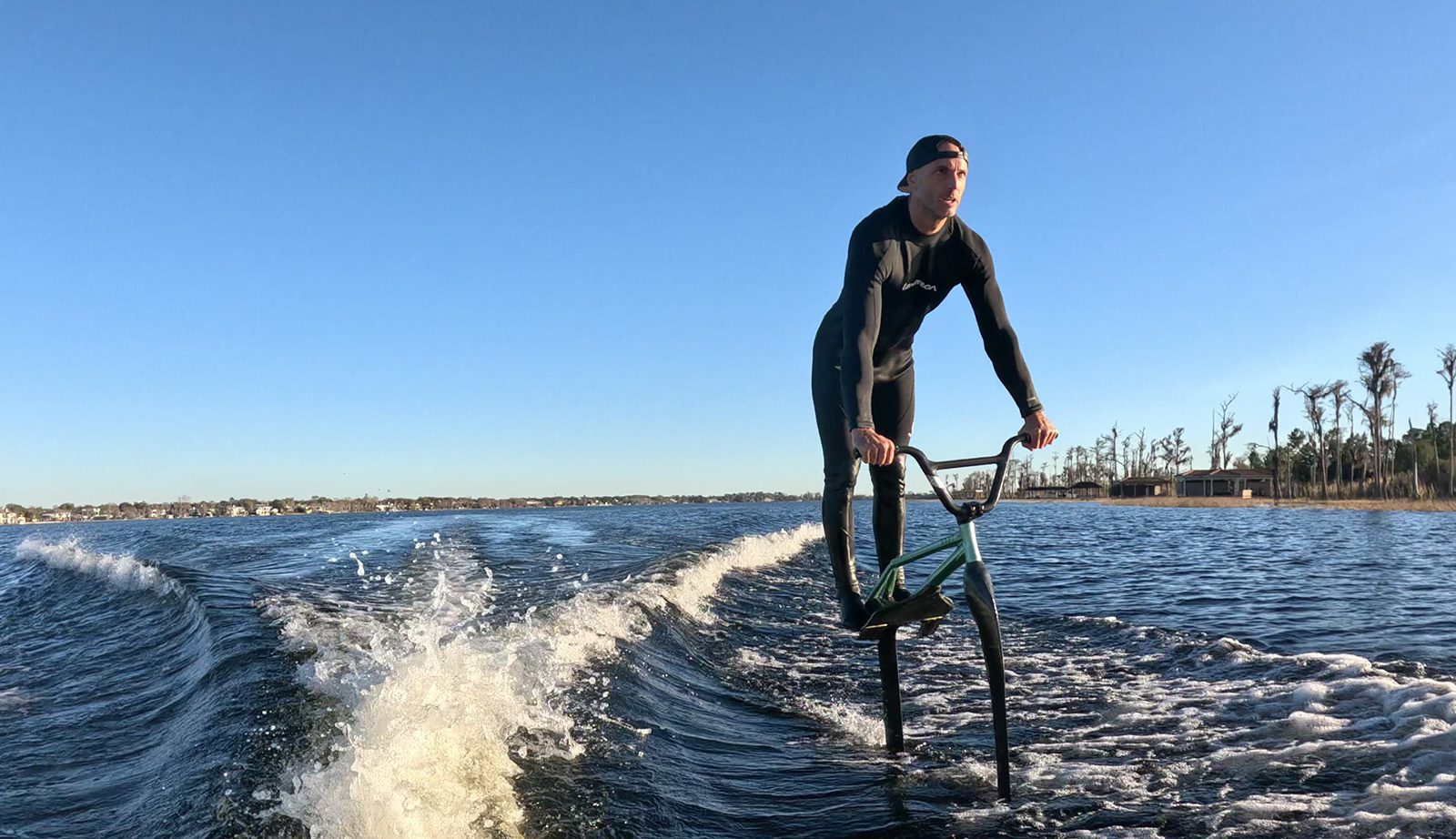
Most people look at waves and see waves. Marc Willers sees jumps.
“I would look at mountain ranges and I’d see jumps. I’d look at waves and I’d see jumps,” says the former two-time Olympic BMX racer.
For those of us that are obsessed with bicycles, we get it. That obsession led him to build SUBI, a hydrofoil bike that rides above the water on a foil. And it works. When on flatwater it looks exhausting, but it works. Willers recently launched a Kickstarter campaign to bring SUBI into production after years of building prototypes in his workshop in Knoxville. The project has nearly reached its funding goal.
From BMX tracks to boat wakes
Willers grew up racing BMX and eventually represented New Zealand at two Olympic Games. The final(ish) rendition of SUBI didn’t happen instantly. His first attempt was about a decade ago.
“I made my first one, I think it was 2016-ish. I put a bike on a surfboard,” he says.
It didn’t work. The breakthrough came when he saw the exploding popularity if foilboarding.
“I saw hydrofoiling pop up and then that just got my mind spinning on how I could make that work under a bike.”
Since then, Willers has been steadily refining the concept. He’s now on his fourth frame design and roughly his fifth rudder system.
Not your average water bike
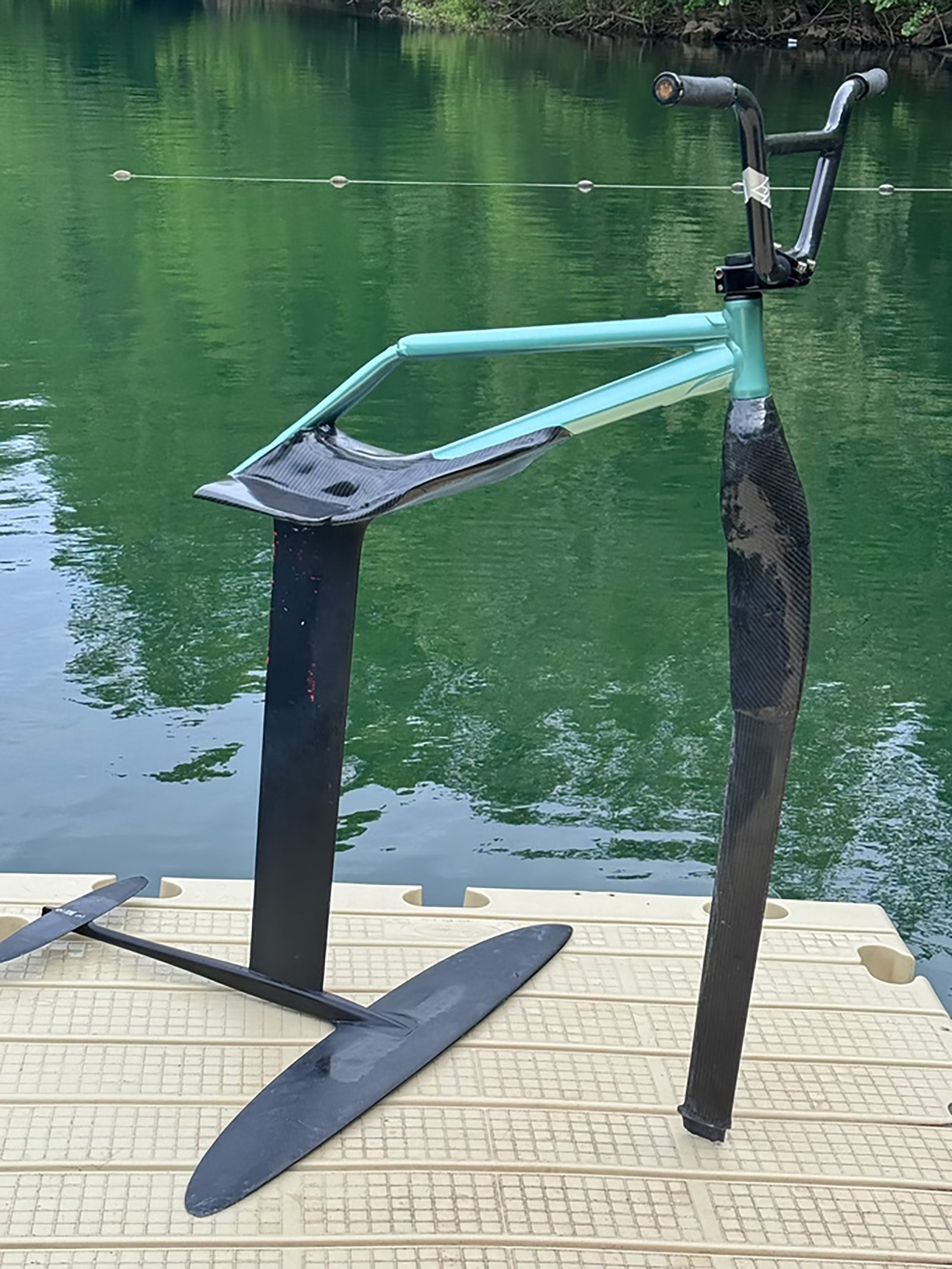
If you’ve seen water bikes before, you know SUBI is something different. Traditional water bikes are generally built for cruising around lakes at a brutally slow and awkward pace. Willers wanted something that behaved more like a BMX bike.
“Any water bike on the market does little more than float,” he says. “It’s basically a stationary bike on water.”
SUBI uses a hydrofoil mounted beneath the rider. As speed increases, the foil lifts the bike above the water’s surface. Riders steer using handlebars connected to a rudder system mounted at the front. He can start off a dock, ride behind a jetski or wakeboard boat. You can ride it on a wave or pump it on flatwater.
He hasn’t landed the backflip yet. But he’s close.
Like riding a pump track on water
One of the biggest challenges with hydrofoiling is the learning curve. Anyone who has tried a foil board knows the first few sessions involve more swimming than riding. Willers believes handlebars help shorten that learning process. Compared to traditional foiling, he says SUBI feels more intuitive.
“Once you’ve got that first 10 to 15 seconds on water and it starts processing in your brain,” he explains, “you just imagine the pump track is in front of you and you’re making your own jumps as you go.”
Then comes the comparison that every mountain biker will immediately understand.
“Once it clicks, this is just riding a pump track on the water.”
But why?
The obvious question is why. And here’s the answer.
“It is as freeing as you could imagine,” he explains. “There’s no impact. No vibration. There’s nothing. I compare it to the moment you leave the ground on a bike and do a jump. The moment you’re in the air, that’s what riding the bike feels like. You’re permanently in midair and never coming down from the jumps. And you can just just carve around and back and forth.”
Sounds seriously fun.
A new category?
Willers doesn’t believe everyone is going to sell their mountain bike and buy a hydrofoil bike. He sees SUBI carving its own niche. He imagines them strapped to wake boats, sitting at cottages and showing up at resorts looking for the next interesting thing to rent.
The Kickstarter campaign describes SUBI as a new category of riding entirely. Maybe that’s ambitious. Maybe it isn’t.
So when does the electric version come out?
“Long term, I think there’s room for it,” he says. “But you’re also looking at least double the price and weight. So keeping it as pure and raw as possible has been the goal so far.”
If this is the N+1 you’ve been looking for, support Willer’s Kickstarter and get your SUBI as early as fall 2026.