
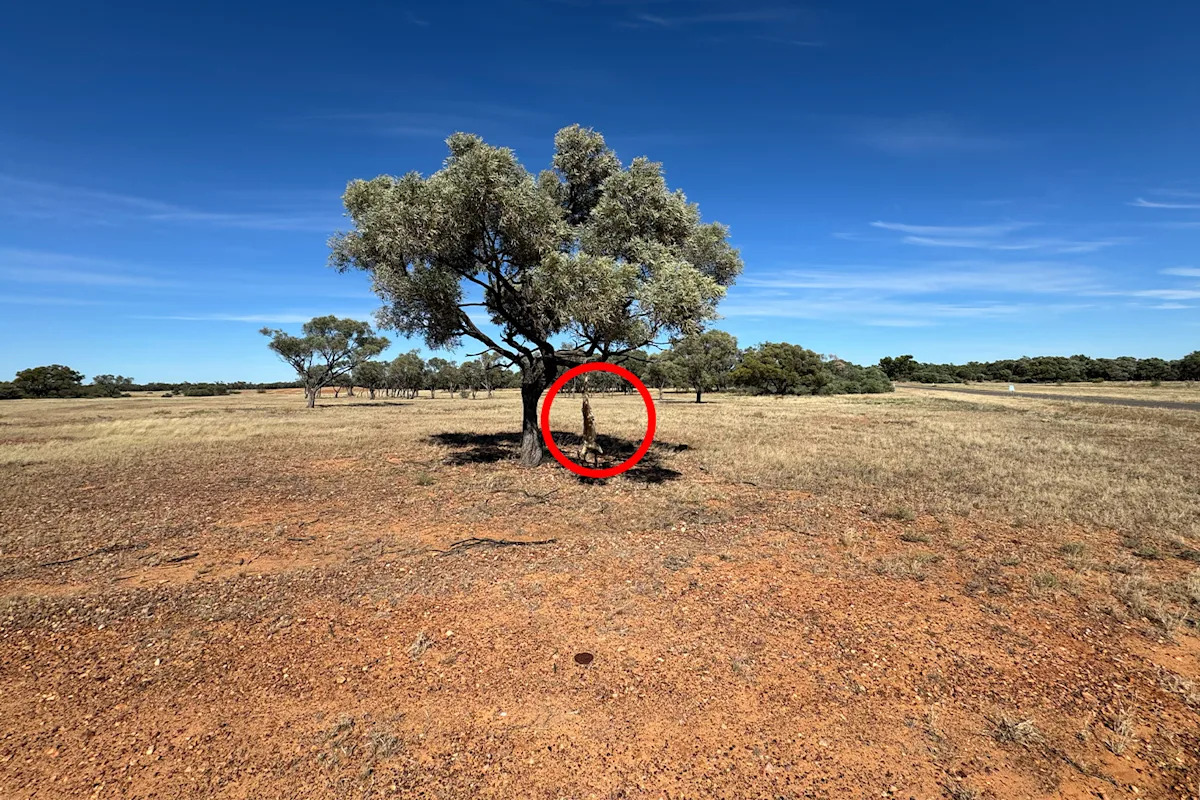
Tourists heading into an outback Queensland town were “shocked” to spot a grisly warning sign under a gnarled old tree by a roadside.
Peter Valentine, an associate professor at James Cook University, was among a group of travellers driving into Winton after a bird-watching trip, when he stopped his car in horror.
“We were completely shocked by it,” he told Yahoo News.
“We were not far outside of town, and there’s this strung-up carcass on the side of the road.”
What they had spotted was the lifeless body of a dingo hanging by one leg from a tree, a possible warning to other landholders about the predator’s presence in the area.
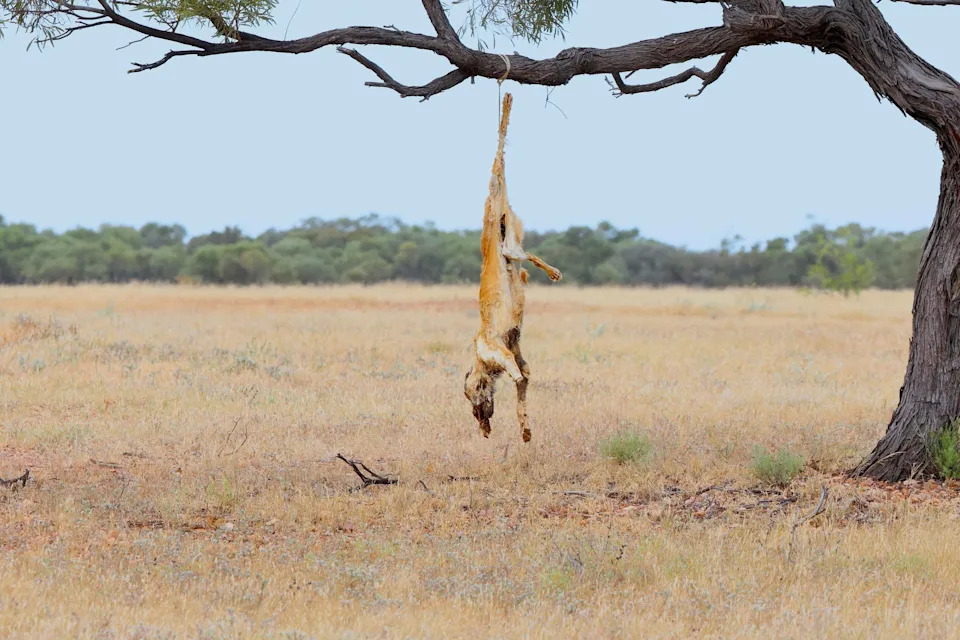
The strung-up dingo could clearly be seen from the Winton to Lark Quarry Road, which leads to the Dinosaur Stampede National Monument fossil site.
(Peter Valentine)
The scene was eerily similar to a sight he’d documented during a trip to the area in August 2020.
That year, he’d seen four carcasses hanging from a road sign. But almost six years on, he’d put that experience out of his head.
What struck Valentine this time around was the way the dingo’s body had been treated after it was shot.
“I was a farmer in Western Australia, and I killed sheep for our table for many years,” he said.
“So I’m not saying you mustn’t kill, I’m not quite as Buddhist as that.
“But I am saying you should do it with respect.”
Do you have a story about a dingo encounter? Contact newsroomau@yahoonews.com
Why dingoes are strung up from trees
Seeing wild animals killed and displayed on roadsides can be confronting to travellers, who data shows are overwhelmingly drawn to Australia to see its wildlife.
Dingoes are strung up from trees by hunters or farmers after they have been killed.
The practice has multiple purposes:
A sign to other landholders that the predators have been eradicated from a territory.
An attempt to deter other dingoes.
Paid trappers or shooters supplying proof of a kill to property owners.
Why there’s controversy around native dingoes
Dingoes have been present in Australia for up to 5,000 years and are considered a native species that is culturally important to its Indigenous peoples.
For over 200 years, the animals have been killed because they are known to sometimes kill the sheep introduced for wool and meat by European settlers.
Winton Shire Council regularly uses poison baits to kill dingoes and places bounties on their heads. In 2025, it offered $100 for each scalp presented.
Despite having a unique genetic line, state and local governments often refer to them as “wild dogs”.
“There’s a great deal of what I’d refer to as bulls**t about dingoes,” Valentine said.
“But one thing that’s real is that stringing a carcass from a tree in full view of public roads is horrible.”
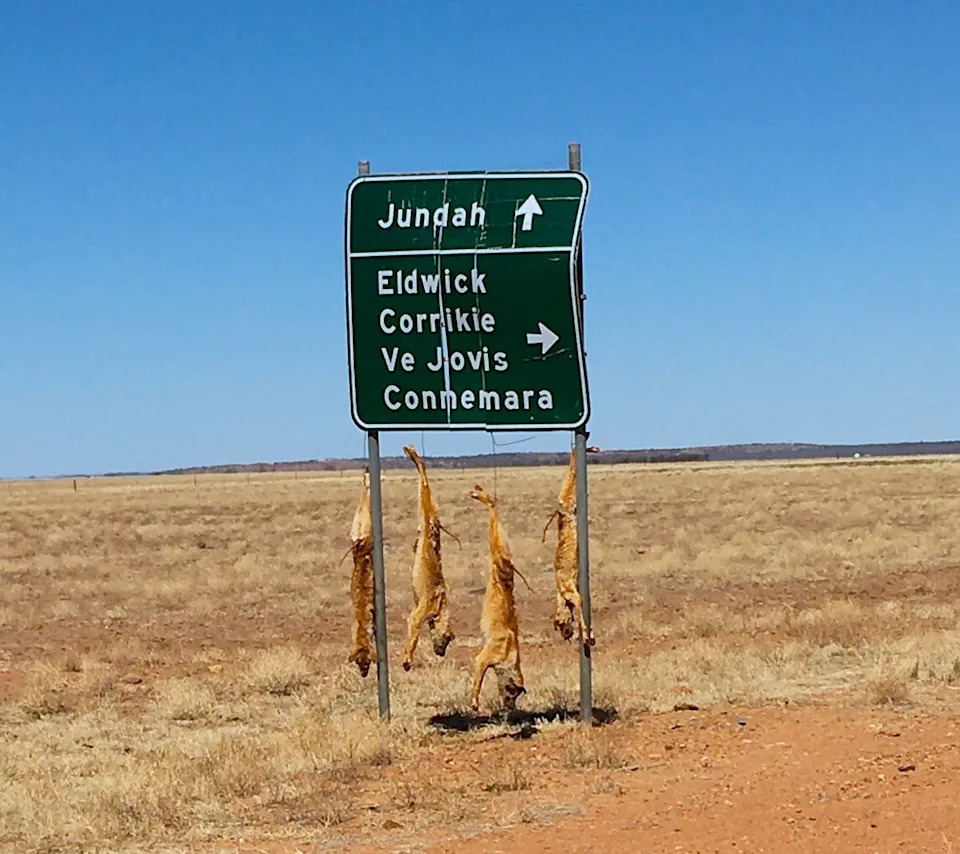
In 2020, Peter Valentine was shocked to see dead dingoes hanging from a road sign.
(Peter Valentine)Indigenous woman responds to stringing up of dingoes
Sonya Takau, a Jirrbal Rainforest Aboriginal woman living in Queensland, told Yahoo News the treatment of dingoes in Queensland is “heartbreaking”.
“I’ve got a very strong cultural relationship with dingoes as a First Nations person, and we see dingoes as family members,” said Takau.
“Seeing them like that brings back that colonial history of how my ancestors were treated.
“So it’s disheartening to see that in the year 2026, we still abuse native wildlife like that, I really don’t know what people are thinking.”
RELATED
Takau, who is also the founder of the Dingo Culture advocacy group, said it’s time to abolish “ancient” practices like culling dingoes.
“We need to move on together as proud Australians who have a long, beautiful culture that has been here for thousands of years,” she said.
You can also follow us on Facebook, Instagram, TikTok, X and YouTube.