
New funds and strategic collaboration with Merck Animal Health will support development of therapies targeting age-related diseases in pets.
Rejuvenate Bio has closed a $6 million financing round and entered a strategic R&D collaboration with Merck Animal Health – a pairing that brings one of the world’s largest animal health companies into direct contact with the emerging longevity biotechnology sector.
The round was led by VCapital, with Merck Animal Health, Kendall Capital Partners, Connecticut Innovations and Digitalis participating alongside. The collaboration will focus on a targeted gene therapy program for veterinary applications, drawing on Rejuvenate’s platform technologies and translational expertise; the funding will support continued pipeline development, including therapies for chronic and age-associated diseases in companion animals.
Rejuvenate Bio was founded on research from Harvard Medical School and has built its platform around gene therapy as a means of treating diseases of aging – first in companion animals, and with human medicine as a longer horizon. The Merck Animal Health collaboration reflects something broader: that chronic, age-related disease in pets is no longer a niche concern, but an increasingly active area for established players in animal health.
Longevity.Technology: The interesting thing here is not really the $6 million – useful, certainly, but hardly the sort of figure that turns heads in biotech venture capital – it is Merck Animal Health’s presence at the table. Longevity economics may well start with pets, not because companion animals are a convenient proving ground for human therapeutics, though they are, but because the veterinary market offers something human longevity still struggles to provide: clearer indications, shorter timelines, emotionally motivated customers and a route to revenue that does not require first persuading regulators that aging itself is a treatable condition – although Loyal’s recent regulatory milestones suggest that door is opening. Rejuvenate Bio’s gene therapy platform sits neatly in that gap between geroscience ambition and commercial pragmatism; chronic, age-associated disease in animals is both a real medical need and a translational testbed with teeth. The caution, of course, is that gene therapy remains complex, expensive and biologically unforgiving – the dog may be man’s best friend, but it is not a shortcut around evidence. Still, when a major animal health player begins exploring longevity-informed therapeutics, it suggests the field is edging from elegant hypothesis toward something more durable: a market.
To find out more about why companion animals may become longevity biotech’s first real commercial market, and whether gene therapy can move the field from measuring aging to modifying it, we sat down with Rejuvenate Bio CEO Dan Oliver.
From translational model to commercial market
Companion animals have occupied an unusual place in longevity biotechnology for some time – part patient population, part translational model. For Rejuvenate Bio CEO Dan Oliver, however, the distinction is important.
“These are patients in their own right with significant unmet medical needs,” he tells us. “Our primary goal is to develop transformative therapies that improve the quality and length of life for dogs and other companion animals.”
That does not diminish their scientific value. Dogs share our environments, many of our risk factors and, inconveniently for both species, many of the chronic diseases that accompany aging.
“Studying interventions in companion animals offers a unique opportunity to understand how modifying key biological pathways may influence healthspan in real-world populations,” says Oliver.
The result is something increasingly rare in longevity science – a setting where commercial opportunity, translational relevance and patient need are aligned rather neatly.
Moving beyond measurement
Longevity research has spent much of the last decade building increasingly sophisticated ways to measure aging. The obvious next question is whether those measurements can be acted upon.
“The field has made tremendous progress in understanding and measuring biological aging,” says Oliver. “But measurement alone does not improve outcomes.”
He believes the next phase of the sector will be defined by interventions rather than diagnostics – therapies capable of altering the biological processes that drive age-related disease.
Gene therapy is particularly attractive because of its potential durability.
“Rather than requiring lifelong treatment, gene therapies may allow us to modulate key biological pathways in ways that are difficult or impossible with traditional medicines,” he says.
Oliver is careful not to mistake biological promise for clinical proximity. The obstacles are familiar – evidence, manufacturing, delivery, regulation – and none of them are trivial. The likelier path, Oliver suggests, runs through specific age-related diseases first; broader interventions targeting common mechanisms of aging come later, if the early evidence holds.
Aging biology grows up
If the financing round attracted attention, Merck Animal Health’s involvement may prove more consequential. Large healthcare companies have historically approached longevity with a degree of caution; Oliver sees that changing.
 Noah Davidsohn, CTO of Rejuvenate Bio and former Wyss Institute Research Scientist, was inspired by his German Shepherd, Bear, to develop a gene therapy that can help dogs live healthier lives. (Credit: Wyss Institute at Harvard University)
“Historically, longevity was often viewed as a speculative area of research,” he says. “Today, the science is becoming increasingly rigorous, driven by advances in genetics, molecular biology and our understanding of the mechanisms that contribute to age-related decline.”
For established animal health companies, he argues, the opportunity is not simply to extend lifespan but to preserve function and quality of life as pets live longer.
More broadly, Oliver believes aging biology is moving steadily toward the scientific and commercial mainstream – a shift reflected not only in growing investment but also in the willingness of established industry players to engage with the field.
Treating aging – carefully
Whether aging itself becomes an accepted therapeutic target remains a more complicated question.
“I think we’re in a transition period,” says Oliver.
Medicine remains organized around individual diseases, and regulators still evaluate therapies through that lens – for now. The biology, however, is less tidy. Chronic inflammation, cellular dysfunction and loss of regenerative capacity sit beneath multiple age-related conditions simultaneously – and the case for targeting shared mechanisms rather than isolated symptoms is becoming harder to ignore.
Oliver is wary of putting too much weight on biomarkers alone.
“The most important question is not whether we can change a biomarker associated with aging, but whether we can improve meaningful outcomes such as mobility, cognitive function, cardiovascular health, disease-free years and overall quality of life,” he says.
That distinction may ultimately define the next chapter of the field. The future, Oliver suggests, is unlikely to involve abandoning disease-specific medicine; rather, it may involve treating diseases while simultaneously addressing the biological processes that make them more likely in the first place.
Longevity finds its market
For much of modern medicine, aging has been treated as an inevitability and age-related disease as its inevitable companion. That framing is beginning to shift. The question facing veterinary medicine is no longer simply how long companion animals can live, but how much function – cognitive, cardiovascular, metabolic – can be preserved along the way. Merck Animal Health’s presence at this particular table suggests the commercial logic is catching up with the biology; and when large animal health companies start placing bets on longevity science, the field has moved some distance from speculation.
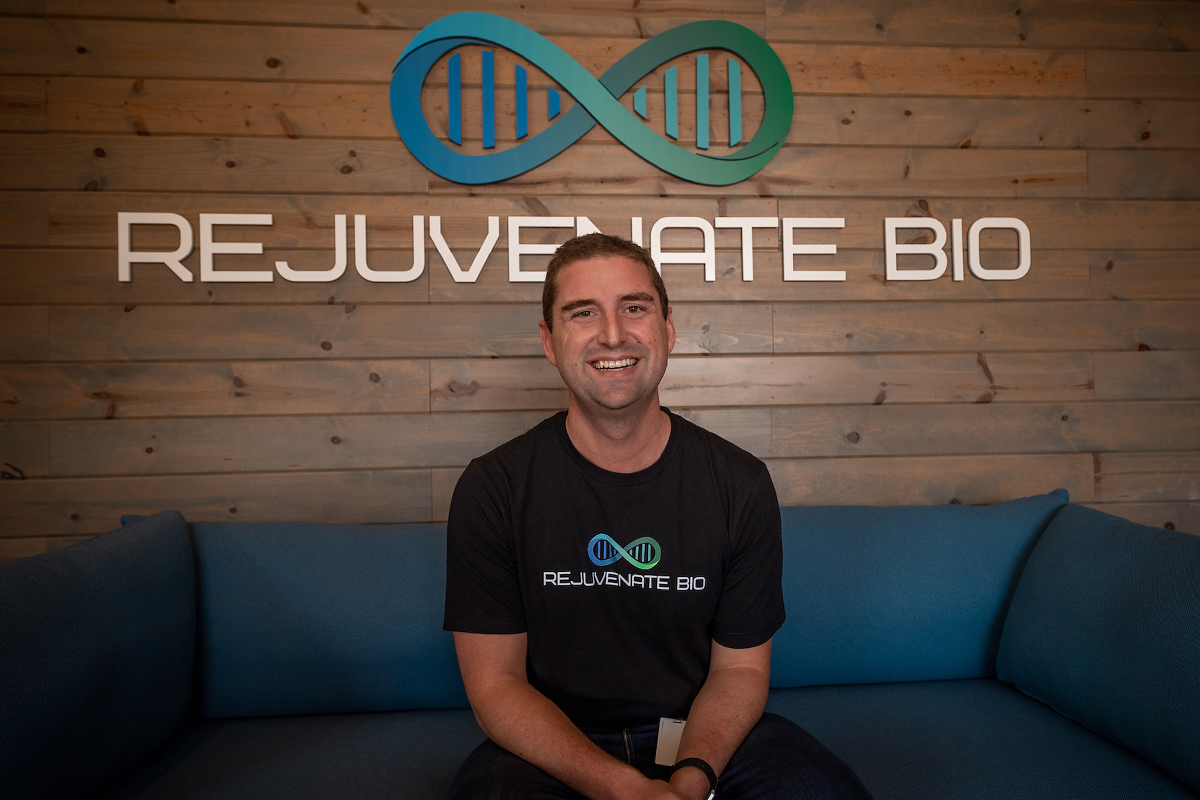
Main photograph is of Dan Oliver, CEO, Rejuvenate Bio. Credit: Rejuvenate Bio.