
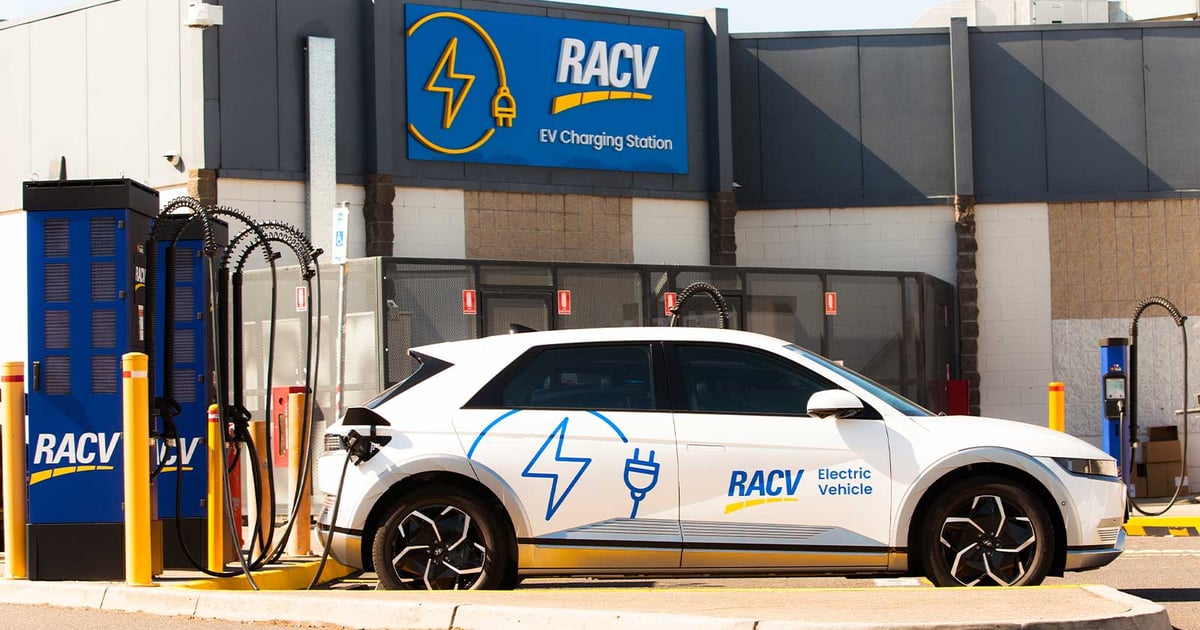
The Royal Automobile Club of Victoria (RACV) in Australia has started trialling a mobile DC fast charger fitted to its Emergency Roadside Assistance patrol fleet.
The trial aims to get stranded EV drivers back on the road faster than current towing-based solutions allow.
The trial equips a single Melbourne-based patrol van with a 20kW DC on-board charger, providing members with around one kilometre of range per minute of charging. In as little as 20 minutes, drivers can gain enough charge to reach their next charging stop or get home safely.
RACV roadside patrols have recorded an average year-on-year increase of more than 50% in EV out-of-charge callouts since 2023, including a 37% rise from 2024 to 2025, reflecting growing EV uptake across Victoria.
RACV general manager of automotive services, Makarla Cole, said the trial reflects the organisation’s effort to anticipate how roadside assistance needs to evolve.
“As EV ownership continues to grow, we’re seeing a steady increase in out-of-charge callouts. This trial is about looking ahead to what roadside assistance needs to deliver as more Victorians make the switch to electric vehicles,” Cole said.
“While traditional mobile charging solutions provide a small top-up, DC charging allows us to deliver a more meaningful boost in a shorter time, helping drivers get moving again sooner.”
The trial will begin in a single van, assessing demand, performance and operational fit before RACV considers a broader rollout. RACV will also begin trialling an EV-powered roadside patrol vehicle later in 2026 to understand how it performs in real-world conditions, including load capacity, range and suitability across different job types.
Cole said understanding whether an EV patrol vehicle can carry the equipment required for roadside assistance work is a key question the trial is designed to answer.
RACV’s Emergency Roadside Assistance service, which covers more than 1.4 million members, already provides support for EV drivers, including towing to the nearest accessible charging station if required, alongside common services such as tyre changes and lockout assistance.
The mobile DC charging trial complements RACV’s broader investment in public charging infrastructure across Victoria, including the Chargefox network.
A step up from existing mobile charging services
RACV’s 20kW DC trial represents a considerable increase in charging speed compared to the mobile EV charging services already operated by other Australian motoring clubs.
The NRMA, which covers New South Wales and the Australian Capital Territory, equipped patrol vans with mobile EV chargers that offer a 9.6kW charging rate from a 4.8kWh lithium-ion battery pack, adding around one kilometre of range every two minutes. This means a 10-minute charge delivers approximately 5km of range.
In Western Australia, the RAC’s approach has centred on a dedicated electric patrol vehicle rather than a charger retrofitted to an existing van.
RAC deployed an all-electric Mercedes-Benz eVito roadside assistance van equipped with a 7kW charger, capable of providing stranded vehicles with approximately 15km of charge in about 20 minutes.
South Australia’s RAA launched a comparable emergency EV charging service for the Adelaide metro area around the same time, coinciding with the addition of an electric Peugeot E-Partner to its fleet for a six-month trial.
At 20kW, RACV’s trial unit delivers more than double the charging rate of the NRMA’s mobile chargers and nearly triple that of RAC’s electric patrol van, translating into a meaningfully larger range top-up within a comparable callout window.
The shift toward higher-powered mobile charging units reflects a broader pattern across the roadside assistance industry, where the historical default, towing a stranded EV to the nearest fast charger, has been viewed as a stopgap rather than a long-term solution.
In most parts of Australia, an EV that has run out of charge is still typically recovered by a tow truck rather than charged roadside, with limited mobile charging options and the time benefits of trucking to a commercial fast charger winning out in most cases to date.