
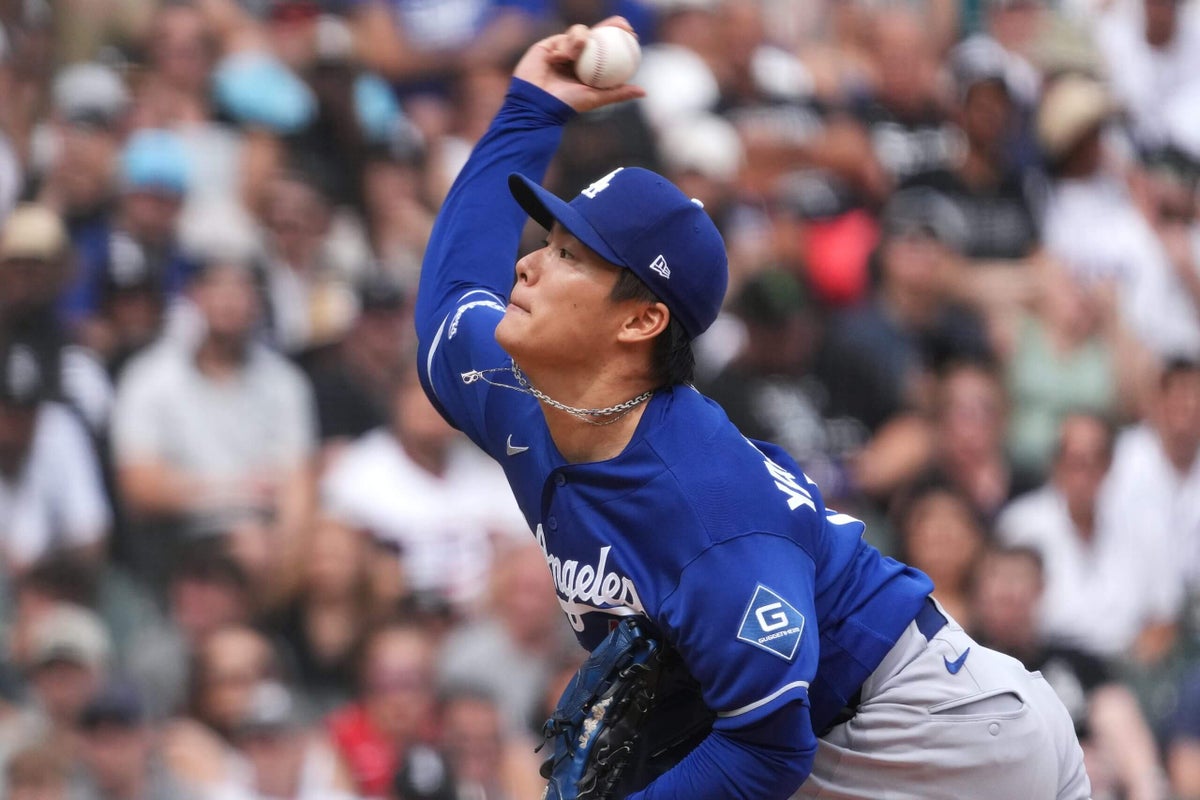
CHICAGO — Yoshinobu Yamamoto sauntered through the Los Angeles Dodgers clubhouse Saturday afternoon before a start that could have been etched in baseball lore. He popped his head into the manager’s office, said hello to Dave Roberts, and exuded a calm that would last through a run that fell one out shy of the greatest stretch of consecutive retired batters in Major League Baseball history.
“He’s special. We all know that,” Dodgers pitching coach Mark Prior said after an afternoon that could’ve even gone beyond the word “special.”
Mookie Betts’ error with two outs in the eighth inning on a ground ball from Chicago White Sox second baseman Chase Meidroth kept Yamamoto from matching Yusmeiro Petit’s record of retiring 46 consecutive batters — the longest such stretch in the majors since at least 1920 — and snapped Yamamoto’s bid for the 25th perfect game in MLB history.
Oh no…
Yamamoto loses his perfect game bid with 2 outs in the 8th as Betts can’t make this play at SS. pic.twitter.com/XfFDWWtebc
— FOX Sports: MLB (@MLBONFOX) June 13, 2026
A batter later, Jacob Gonzalez grounded out to end Yamamoto’s eighth no-hit inning of the afternoon. When they returned to the dugout, Yamamoto greeted Betts with a pat on the rear.
“Just a routine ground ball that I missed,” Betts said. “Not making any excuses.”
Then came another cruel twist, as White Sox outfielder Tristan Peters sent Yamamoto’s second pitch of the ninth inning and 105th pitch of the day into the seats for a home run to keep Yamamoto from his first no-hitter in the United States. When Yamamoto returned to the dugout after his day was done with 8 1/3 memorable innings to his name, Shohei Ohtani leaned over and said something. Yamamoto tilted his head back and laughed at how agonizingly close he was to something special, rather than just a 7-1 Dodgers win.
What did Ohtani tell him?
“It’s kind of a secret,” a smirking Yamamoto said through interpreter Yoshihiro Sonoda. “I can’t say that here.”
When the day was done, Ohtani stood behind Yamamoto and let a gap form between them. During the parade and hand-slaps and high-fives, Ohtani wanted to be sure Yamamoto was recognized on his own. Once again, Yamamoto was all anyone wanted to talk about.
Yamamoto has flirted with history before. The Japanese-born right-hander came within one out last September of the first Dodgers no-hitter since 2018, and the first solo no-hitter for the franchise since Clayton Kershaw in 2014. When that night ended in disaster, first with a Jackson Holliday home run to snap it and then a bullpen implosion to lose the game entirely, Yamamoto was just starting a brilliant run. The following month, as the Dodgers reeled off their second consecutive World Series title, Yamamoto etched his place into all-time lore by delivering three victories (including in relief in Game 7) in the matchup with the Toronto Blue Jays.
His latest brush with immortality started last week, in the midst of a blowout victory against the Los Angeles Angels. Yamamoto quickly and efficiently dispatched the last 22 batters he faced that night to complete his eight innings of one-run ball. Following that start, catcher Dalton Rushing giddily described Yamamoto’s brilliance, noting that even the reigning World Series MVP was able to experiment and try out some new sequencing while flexing his dominance.
“He’s always trying to add a new trick in his book,” Rushing said.
That continued into Saturday. Yamamoto’s artistry was in peak form, landing just about every pitch he wanted to on the edges of the plate. His experimentation continued. He tried throwing two-seamers inside to left-handed hitters, using the pitch’s movement to bleed back over and catch the corner of the plate. Against righties, he mixed in a cutter that broke back and nipped the edges of the zone at their front hip. Whatever he needed to do, he could.
“Everything was on,” Rushing said.
He did not reach a three-ball count until he fell behind 3-1 to Colson Montgomery to lead off the fifth inning. He got Montgomery to pop up the next pitch he threw. The White Sox nearly recorded their first hit of the day two batters later when Meidroth laced a ball down the left-field line … that landed just foul. Yamamoto got Meidroth to swing through a slider to complete his fifth perfect frame to start the game. Those five innings required just 64 pitches.
Following each three-batter sequence, Yamamoto sat and resumed a routine that had carried him even before he became the highest-paid pitcher in MLB history. He sat and went through a notebook, charting what seemed to work and did not to each hitter. Each time Yamamoto took the mound, his interpreter, Sonoda, sat on the dugout ledge, scribbling his own notes to help streamline Yamamoto’s process.
“Just really trying to get a handle on the first three batters each inning,” Prior said of the method. “How did we attack them last time? How are we going to attack them this time?”
On Saturday, everything seemed to work.
The only thing that slowed him down, it seemed, was the mound. Yamamoto asked the White Sox grounds crew to address the mound before the sixth inning, causing the lone brief delay of his afternoon. Then he retired the side on eight pitches.
Miguel Vargas, a former Dodger, had his chance in the seventh. He tapped his helmet to challenge what would have been a called strike three, successfully staying alive before lining a ball 103.2 mph to left field. It went right to Alex Call, who secured it with two hands to retire Yamamoto’s 42nd consecutive batter and secure at least the third-longest streak baseball has seen since 1920, trailing Petit and Mark Buehrle (45).
Montgomery worked another 3-1 count in the eighth inning, then laced a full-count splitter 110.3 mph directly into Freddie Freeman’s glove at first base to keep Yamamoto’s effort alive.
The bid lasted two more hitters. Yamamoto threw a slider that Meidroth reached out and chopped toward Betts. The shortstop, a Gold Glove finalist at the position a year ago, charged the ball but could not corral an errant hop. The ball bounced off Betts and toward Santiago Espinal at second base, too late to make a play and keep Yamamoto perfect.
“I did everything I was supposed to do,” Betts said. “Just didn’t catch the ball.”
Yamamoto was still cruising when Peters stepped into the box to lead off the ninth inning. Then he left a fastball up and over the plate, which Peters did not miss.
“(A) guy that has no…” a frustrated Rushing said, before stopping himself. “(Peters) jumped on a pitch that was really decently executed. I know we’re gonna have more opportunities with Yoshi like that, and I’m looking forward to it.”
Yamamoto’s brilliance has once again thrust him into one of the most competitive Cy Young Award races the National League has seen in years. Philadelphia Phillies ace Cristopher Sánchez set a major league record for left-handed pitchers at 50 2/3 scoreless innings earlier this season. The Milwaukee Brewers’ Jacob Misiorowski has throttled record velocity numbers and twirled a 15-strikeout gem in a one-hit shutout effort on Friday night. Ohtani, Yamamoto’s teammate and countryman, has a 1.06 ERA that is the lowest in the majors for a pitcher with at least 60 innings pitched.
Then there is Yamamoto, who continues to show he has another level to hit.
“Every time he takes the mound, we feel he’s got a pretty good chance to do something special,” Prior said.
This time, he nearly did.