
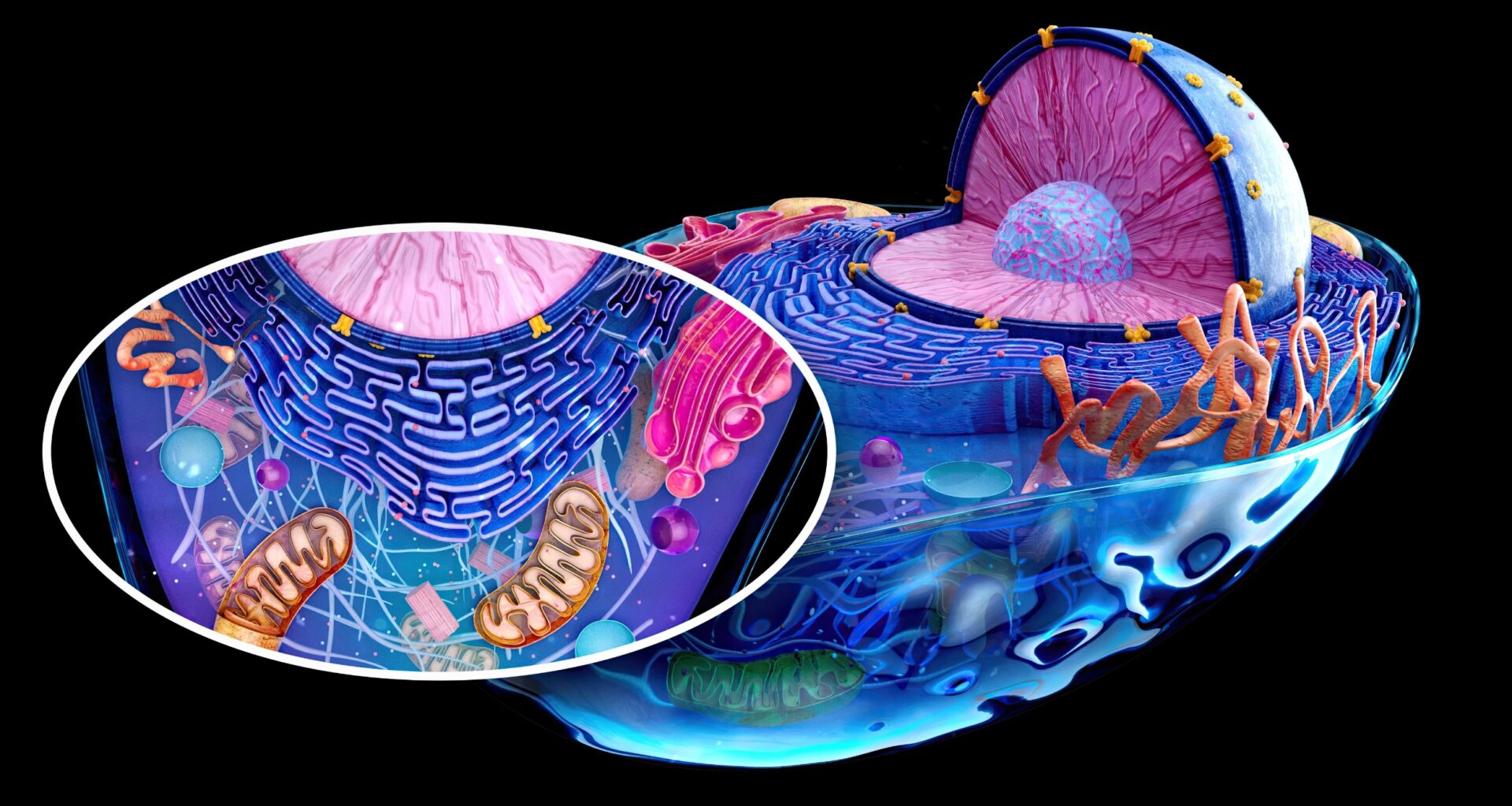
For decades, the assumption was simple. A cell makes its fuel in one set of internal structures, and it spreads outward on its own, reaching whatever part happens to be running low.
Energy went where it was needed, with no delivery plan required. It now looks like the cell’s biggest energy user never relied on that.

The nucleus, where the genome is stored and read, appears to pull in its own supply through a direct connection no one knew was there. How it manages that is the surprising part.
A hungry control center
Inside every one of your cells sits the nucleus, the compartment that holds and reads the genome. Running it is costly.
Switching genes on, copying DNA, and repacking it all require chemical energy, and studies suggest the nucleus consumes far more than researchers once realized.
That energy comes mostly from mitochondria, the structures that serve as a cell’s power plants. They make a molecule called ATP, the fuel almost every cellular job runs on.
For years, the standard answer to how ATP reaches the nucleus was that it simply floats over.
Ivan Menéndez-Montes, PhD, an assistant professor of medicine at the University of Arizona, was not out to rewrite anything.
Working with Dr. Hesham A. Sadek, who directs the Sarver Heart Center, Dr. Menéndez-Montes was investigating why heart cells stop dividing. What the team found was bigger.
Docking at the gates
Under the microscope, the same thing kept showing up. Mitochondria were not drifting freely near the nucleus.
They sat pressed against the openings in the nuclear membrane that molecules pass through, the nuclear pores.
To learn what held them there, the experts ran two searches for the proteins involved, and both pointed to the same pairing.
A protein dotted across the mitochondria’s surface gripped a thread-like protein fringing each pore. That handshake parks a mitochondrion right against the nucleus.
Scientists already knew mitochondria make contact, pressing against other structures inside the cell.
An earlier paper had even caught them brushing the nuclear membrane in stressed and cancerous cells.
But latching onto the pores themselves, in healthy cells, as a permanent fixture. That had never been described.
Energy delivery, not diffusion
Distance was everything. When the team slid mitochondria just 500 nanometers off the nucleus, a gap thousands of times thinner than a human hair, the energy inside the nucleus dropped almost to zero.
Move the source back a sliver, and the supply collapsed.
What they tracked was the pool of usable energy inside the nucleus itself.
With mitochondria docked close, that pool stayed full. Push them a hair’s breadth away and it drained, even though the mitochondria kept working fine, powering everything else.
Researchers had suspected for years that drifting alone could not keep the nucleus supplied. One study found that fuel spreading through the cell fell short of its needs.
What no one had pinned down was the missing piece – a direct, physical connection handling delivery.
Breaking the connection
To see what the connection actually does, the team broke it on purpose.
They engineered cells, and later mice, so the two proteins could no longer connect while leaving mitochondrial energy production untouched.
The power was still there. The delivery route was not.
Living animals showed the cost plainly. Mouse embryos carrying the severed connection died before birth, with severe defects in the heart and nervous system.
One tiny broken contact derailed whole programs of early development.
A discovery beyond heart cells
Given where the team began, it would be easy to file this under heart biology. But the contacts appeared in every cell type the researchers examined, not only heart cells.
The arrangement looks built into the complex cells of animals, plants and fungi.
“We think we have only scratched the surface,” said Dr. Sadek.
He expects the coming years to reveal how these contacts shape health and disease throughout the body.
For the researchers, this reads as a beginning rather than an ending.
“This was a surprising and fascinating result,” Dr. Menéndez-Montes said.
The discovery blindsided the team. Their original goal had been to trace how damaging molecules from mitochondria reach DNA and stop heart cells from dividing.
What the finding could mean for medicine
What is clear now is that the nucleus does not wait for energy to drift over. It draws power through a direct attachment to the mitochondria parked at its gates.
That single contact helps decide whether a young cell matures, and whether an embryo develops at all.
It also opens concrete questions for medicine. If these contacts fail in disease, restoring them could become a target in heart disease, cancer and aging, areas where the nucleus’s energy supply is already under suspicion.
Because the same contact appears in nearly every cell, labs far outside heart research can now look for it in their own systems.
The study is published in the journal Nature.
—–
Like what you read? Subscribe to our newsletter for engaging articles, exclusive content, and the latest updates.
Check us out on EarthSnap, a free app brought to you by Eric Ralls and Earth.com.
—–