
Just two weeks ago, the 2026 NHL Draft looked insignificant for the Detroit Red Wings.
After trading their first-round pick for Justin Faulk back in March, the Red Wings are slated for only Day 2 picks this year — a range in the draft that has yet to yield much for them under general manager Steve Yzerman. Detroit still needed to do as well as it could to find a player or two outside the first round, but realistically, the draft was shaping up to be a secondary piece of its offseason.
But as with so many other things about the franchise, Dylan Larkin’s trade request has turned that presumption on its head.
The Red Wings may still not make a first-round pick on June 26. But with the very real possibility Larkin is dealt before (or during) the 2026 draft, Detroit could easily find itself on the clock, making a suddenly key selection.
Odds are, it won’t be one of the true premium picks at the top of the draft. But the Florida Panthers, one of the reported teams on Larkin’s trade list, hold the No. 9 pick. The New Jersey Devils, with whom Larkin’s team USA teammate Jack Hughes plays, have the 12th. The Utah Mammoth, one of the most ideal potential trade partners for Detroit, have the 19th.
Here’s what you need to know in case the Red Wings end up with a pick in that range.
The centers
Once the Red Wings trade Larkin, they will have a glaring hole at the No. 1 center position in the present and the future.
Detroit used a pair of top-10 picks on centers Marco Kasper and Nate Danielson in 2022 and 2023, respectively, and both should have real value to the Red Wings’ lineup in the years to come. Kasper has already shown how impactful he can be at his best, and even if the offense doesn’t become high-end, it’s not hard to envision him as a matchup center in the mold of Vegas’ William Karlsson. Meanwhile, Danielson has a little more natural skill and playmaking, though Detroit will be looking for him to be more assertive with his game going forward. And last season’s breakout story, Emmitt Finnie, could eventually become a factor down the middle, too.
But still: None of them projects as a true No. 1 center. That’s a problem in the short, medium and long term.
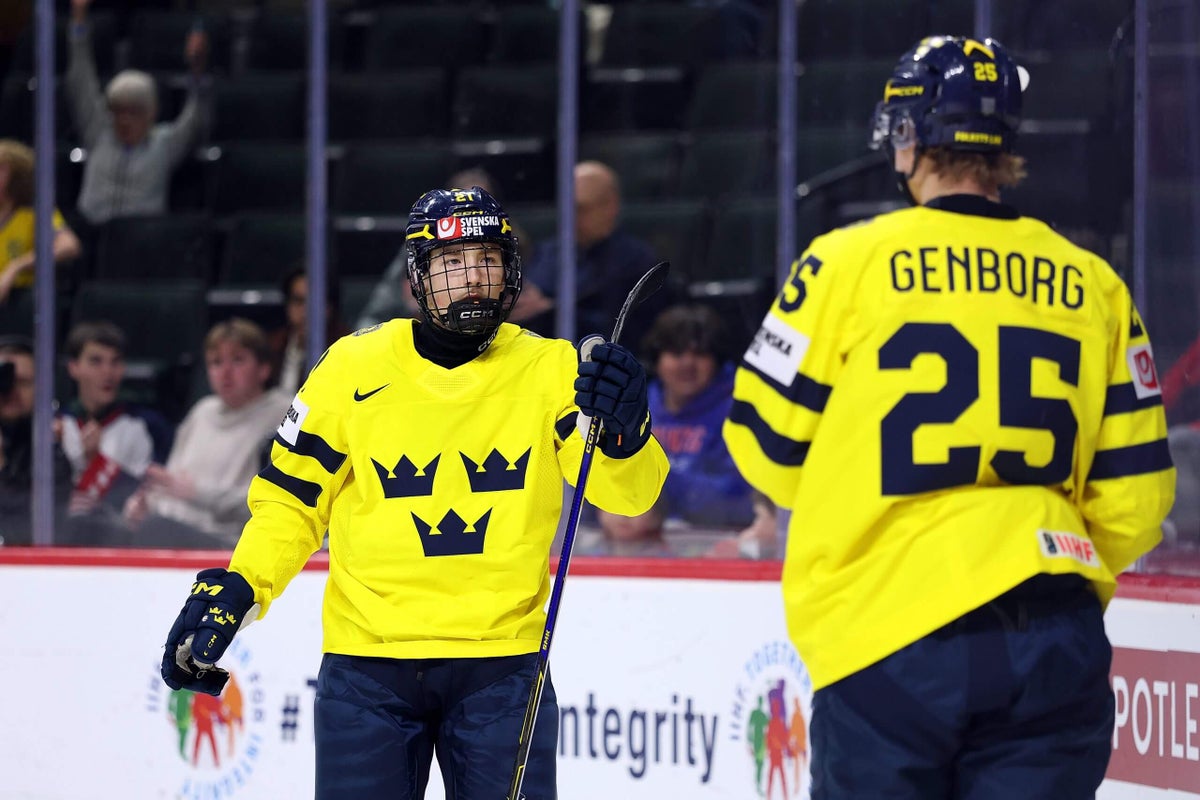
No matter what happens between now and June 26, the Red Wings almost certainly won’t be in a position to pick Brantford Bulldogs center Caleb Malhotra, expected to be the first center off the board this year. But if they were able to get into the top 10, specifically with the Panthers’ pick at No. 9, there is at least a chance they could draft Swedish pivot Viggo Björck — whom The Athletic’s Corey Pronman narrowly ranked as the best center in the class, but who could be picked later than that because of his size at 5 feet, 9 inches.
Of course, Björck’s size could be an issue for the Red Wings, too. In Yzerman’s time in Detroit, and at his previous stop in Tampa Bay (a combined 15 years of sample), he has only twice used a first-round pick on a forward below six feet tall: Lucas Raymond at No. 4 in 2020 and Jonathan Drouin at No. 3 in 2013. Neither was below 5-10.
Björck, then, would be an outlier. But then again, he is an outlier. That’s what makes him so exciting.
Despite his size, Björck has taken major minutes against men all year, including playing on the first line for Sweden at the World Championship. He’s smart, a good skater and competes hard — all the things that a smaller player needs to do to succeed. It’s still far from a guarantee he becomes a first-line center, and the more likely outcome would be as a good No. 2. But Carolina’s Logan Stankoven showed all through these playoffs how valuable that can still be.
If not Björck, the center options in the class, while still good, start to look a lot more like what Detroit already has in Kasper and Danielson. But that could still be useful: Adding another young center to the mix would be one more chance that one really breaks through.
Tynan Lawrence was at one point in the conversation toward the top of the class, but his offensive production really faltered after making the midseason jump from the USHL to NCAA hockey at Boston University. Not everyone was scared away from him, though, with one executive telling Pronman people were “overthinking this one” and actually comparing Lawrence to Larkin.
Meanwhile, Alexander Command (Sweden) and Oliver Suvanto (Finland) project as matchup-type centers in the NHL. Currently, neither surpasses the pivots Detroit has in the system — nor would fellow potential first-round centers Brooks Rogowski, Jack Hextall or Ilya Morozov — but it wouldn’t be shocking if one popped in the coming years.
The high end is what the Red Wings really need, though. And while Lawrence’s offense could certainly end up being decent rather than great, it’s also easy to envision him rebounding back to a more exciting projection.
Lawrence and Björck would be the most appealing candidates, though Command is intriguing too.
The defensemen
The circumstances dictate that a center be the highest priority target with any first-round pick the Red Wings acquire in the next week and a half.
But at a certain point, the “best player available” ethos still matters. And in a class with a strong top group of defenseman, Detroit could rate a blue liner as a clear BPA.
In the No. 9-12 range, the two names to know are Daxon Rudolph and Malte Gustafsson. Rudolph is a shot-pounding 6-2 righty in the WHL who scored 28 goals last season. He’s viewed as a potential power-play QB in the NHL, but with enough size not to be seen as just a specialist. That’s appealing, even with a strong right side already. Meanwhile, Gustafsson is more of a shutdown type, with prototypical size on the left side.
By handedness, the Red Wings’ need is certainly greater on the left, but either could be a future top-four defenseman, solidifying the blue line as an organizational strength.
WHL puck-mover Ryan Lin would be another relevant name in the teens, but I wonder whether Detroit will see too much similarity to Axel Sandin-Pellikka, a similar-sized offensive defenseman on the right side. It’s worth noting that The Athletic’s Scott Wheeler ranks Lin as the No. 10 overall player in the class and called him this draft’s smartest defenseman. That hockey sense will appeal to Detroit, but given that they have Sandin-Pellikka on the same side with a similar profile, my hunch would be that it hurts the case.
Later in the first round, Swedes William Håkansson (LHD) and Mans Gudmundsson (RHD) would become a factor as well, as big-bodied defenders with strong compete grades from Pronman. But as with the centers, it’s the higher-end types that would really move the needle from what the Red Wings already have.
The wingers
The Red Wings have used first-round picks in the early-to-mid teens on wingers in each of the last two seasons, drafting Michael Brandsegg-Nygård and Carter Bear. Oscar Hemming would be cut from a similar mold to Brandsegg-Nygård, and still valuable, but a couple of wingers who are even more notable would be Ethan Belchetz and Wyatt Cullen.
Cullen really popped at some of the showcase events this year as a skilled scoring winger who hit a big growth spurt, while Belchetz blends huge size (at 6-5) and offense for a true power-wing profile with top-six potential.
Those feel like the two players who could add a truly different element to what Detroit currently has on the wing. But to stick with the theme of this article: They would likely need a top-13 or 14 pick to get either of them.
That sums up one of the factors the Red Wings will have to weigh in the coming days. Getting a first-round pick in this draft would, of course, be helpful, with new needs opening up and others still waiting to be filled. But there’s a big difference between an early, middle and late first-round pick, and that’s something to keep in mind with any moves the Red Wings make.