
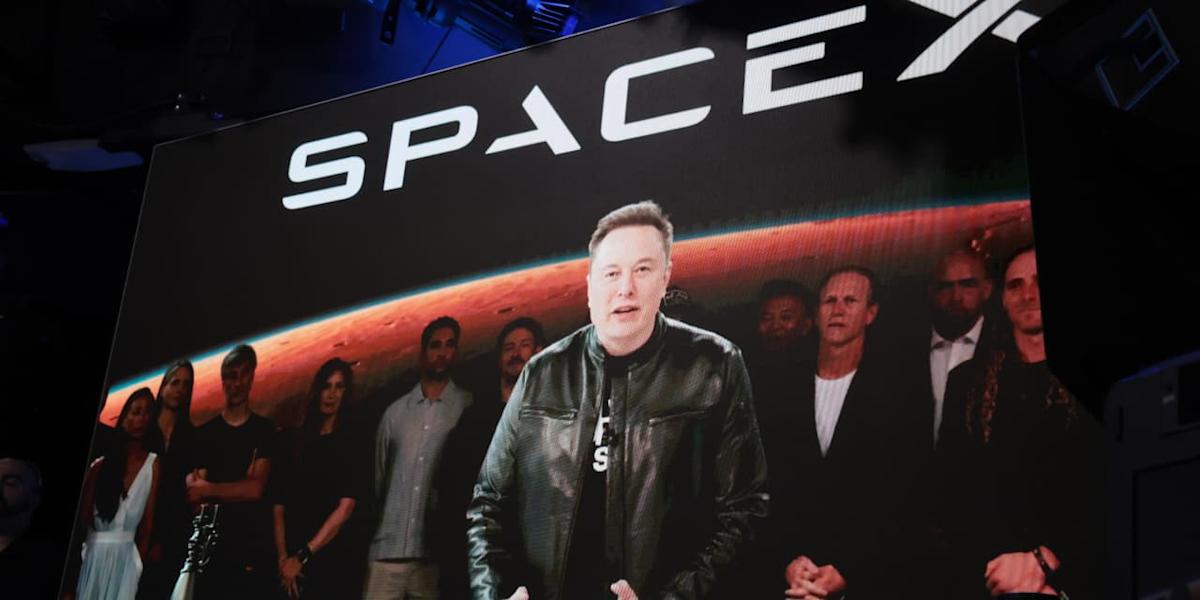
 SpaceX founder and CEO Elon Musk appears via video before the launch of the company’s initial public offering on June 12. – Getty Images
As the stock market digests SpaceX’s mega-IPO, investors would do well to remember that bigger is not necessarily better.
This relationship between size and stock-market performance has been largely overlooked in debates about whether SpaceX’s stock is an attractive investment. But history teaches us that stocks at or near the top of the market-cap rankings face stiff headwinds due to their size alone.
Most Read from MarketWatch
SpaceX SPCX definitely falls into this category. Its came to market as the sixth-largest U.S. company — and growing.
Research Affiliates, the investment advisory firm, studied the performance of stocks with the largest market valuations. The firm constructed a hypothetical portfolio that each year owned the world’s 10-largest companies.
Over the 40 years from the end of 1980 through the end of 2020 (the latest year for which Research Affiliates calculated this portfolio’s performance), it lagged a world-stock portfolio by 1.8 annualized percentage points. The performances are plotted in the chart below.
 –
–
This hypothetical portfolio nowadays would contain the familiar megacap stocks including Nvidia NVDA, Apple AAPL, Alphabet GOOG GOOGL, Microsoft MSFT and Amazon.com AMZN. For the year through June 12, the 10 U.S. stocks that at year-end 2025 had the largest market caps posted an average loss of 0.3%, versus an 8.5% gain for the S&P 500 SPX.
Another relevant statistic is the performance of a hypothetical portfolio that each year invests in the U.S. stock with the largest market cap as of the end of the previous year. From the end of 1980 to June 12 of this year, according to calculations from my performance-auditing firm, this portfolio has lagged the S&P 500’s total return by 3.1 annualized percentage points — 8.6% versus 11.7%.
Of course, this portfolio wouldn’t currently own SpaceX, which just went public and is not the U.S. market’s biggest stock. But the portfolio’s market-lagging return nonetheless demonstrates the obstacles that the largest stocks face.
See: How Elon Musk nailed the SpaceX IPO
The reason the largest stocks struggle to keep up with the market is that on average they are overvalued. Overvaluation causes a stock’s market-cap ranking to rise. Consider the 10 U.S. stocks other than SpaceX with the largest market caps right now. Collectively, their average trailing 12 months P/E ratio is 68.4, according to LSEG data, versus 25.1 for the S&P 500.
These are just some of the reasons that Research Affiliates several years ago introduced a different way of constructing indices known as “fundamental indexes,” which don’t weight constituent stocks by market valuation. These indices instead base a stock’s index weight on fundamental criteria such as book value, revenue, cash flow, dividends and buybacks — therefore weighting stocks according to their economic significance rather than investor sentiment. In an email, Robert Arnott, the firm’s founder, said SpaceX is ranked 520th in the firm’s index of large- and midcap U.S. stocks, with a float-adjusted weighting of just 0.0036%.
Mark Hulbert is a regular contributor to MarketWatch. His Hulbert Ratings tracks investment newsletters that pay a flat fee to be audited. He can be reached at
More: SpaceX IPO hype is massive — and the FOMO can ruin your retirement
Also read: Is it too late to buy SpaceX’s stock? Here’s how Tesla’s did after one day — and five years.
Most Read from MarketWatch