

Track your investments for FREE with Simply Wall St, the portfolio command center trusted by over 7 million individual investors worldwide.
Oracle (NYSE:ORCL) secured a US$395.8 million contract with the U.S. Office of Personnel Management to provide an AI-powered HR cloud platform.
The deal will support consolidation of HR systems for more than 100 federal agencies onto a single Oracle cloud environment.
The Centre for Addiction and Mental Health adopted Oracle Fusion Cloud Applications to run core operational and administrative functions.
For investors watching Oracle, these new contracts highlight how the company’s cloud and AI capabilities are being applied to large, operationally critical workloads. The U.S. federal HR win extends Oracle’s reach into public sector software, while the Centre for Addiction and Mental Health deal in healthcare shows its applications being used in complex, regulated environments.
These developments add context if you are assessing how Oracle’s cloud portfolio is used beyond commercial customers. The scale and sensitivity of federal HR and mental health operations give investors additional real world reference points for where Oracle’s products fit within longer term IT modernization efforts in government and healthcare.
Stay updated on the most important news stories for Oracle by adding it to your watchlist or portfolio. Alternatively, explore our Community to discover new perspectives on Oracle.
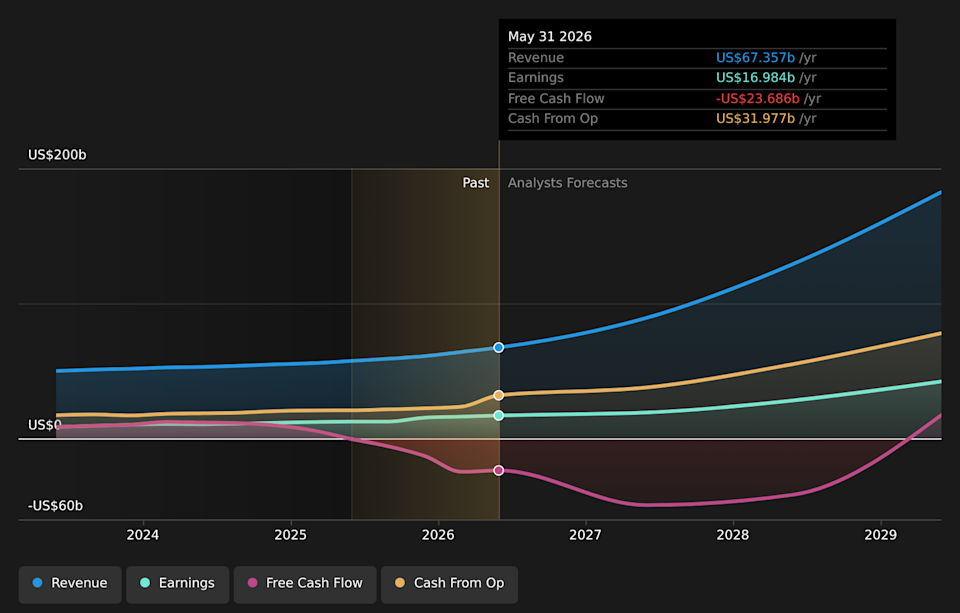 NYSE:ORCL Earnings & Revenue Growth as at Jun 2026
3 things going right for Oracle that this headline doesn’t cover.
For Oracle, the U.S. Office of Personnel Management contract and the CAMH expansion both point to the same theme: its AI powered cloud applications are being written into the core workflows of very large, complex organisations. The US$395.8 million OPM deal concentrates more than 100 HR systems onto Oracle Fusion Cloud HCM, while CAMH is using the full Fusion suite across finance, HR, supply chain, and customer experience. That puts Oracle in direct competition with Microsoft, SAP, and Workday for long duration, system of record roles where switching costs tend to be high and service quality is closely scrutinised.
How This Fits Into The Oracle Narrative
These wins line up with the narrative that Oracle’s AI enabled cloud stack is gaining traction with large enterprises, supporting expectations that AI workloads and integrated applications can feed multi year revenue streams.
The size and operational importance of a government wide HR platform also raise execution and service delivery expectations, which could pressure margins and timelines if implementation is more complex than assumed in the narrative.
The CAMH decision to run clinical and administrative operations on a single Oracle environment adds a healthcare use case that the narrative does not explicitly cover, giving investors another proof point outside the large AI infrastructure contracts that get most of the attention.
Knowing what a company is worth starts with understanding its story. Check out one of the top narratives in the Simply Wall St Community for Oracle to help decide what it’s worth to you.
The Risks and Rewards Investors Should Consider
⚠️ Oracle’s heavy reliance on AI related infrastructure spending and large, complex projects means execution risks, funding needs, and any slowdown in customer demand could affect how quickly contracted work turns into cash flow.
⚠️ Analysts have flagged the company’s high debt levels and a meaningful share of non cash earnings, so investors may want to consider how additional long term contracts intersect with balance sheet flexibility and reported profit quality.
🎁 The OPM and CAMH wins show Oracle’s AI powered cloud applications being adopted for mission critical workloads, which supports the view that its integrated stack can attract sizable, long term contracts across both public sector and healthcare.
🎁 These deployments also highlight Oracle’s ability to sell multiple product modules into a single customer, from HCM to ERP and CX, which aligns with the view that earnings and revenue have been growing and that the business is seen as good value on some metrics.
What To Watch Going Forward
From here, investors watching Oracle may want to track key milestones on the Federal HR 2.0 rollout, such as agency onboarding progress and any public disclosures on service quality or cost savings, as well as reference wins with other government departments. In healthcare, it will be useful to see whether CAMH’s use of the full Fusion Cloud suite leads to additional wins with hospitals or research centres that want to connect clinical and business systems. Competitive responses from Microsoft, SAP, and Workday in HR and ERP bidding, along with Oracle’s commentary on capital spending, debt, and free cash flow, will also help show how these contracts sit within its broader AI and cloud expansion plan.
To ensure you’re always in the loop on how the latest news impacts the investment narrative for Oracle, head to the community page for Oracle to never miss an update on the top community narratives.
This article by Simply Wall St is general in nature. We provide commentary based on historical data and analyst forecasts only using an unbiased methodology and our articles are not intended to be financial advice. It does not constitute a recommendation to buy or sell any stock, and does not take account of your objectives, or your financial situation. We aim to bring you long-term focused analysis driven by fundamental data. Note that our analysis may not factor in the latest price-sensitive company announcements or qualitative material. Simply Wall St has no position in any stocks mentioned.
Companies discussed in this article include ORCL.
Have feedback on this article? Concerned about the content? Get in touch with us directly. Alternatively, email editorial-team@simplywallst.com