
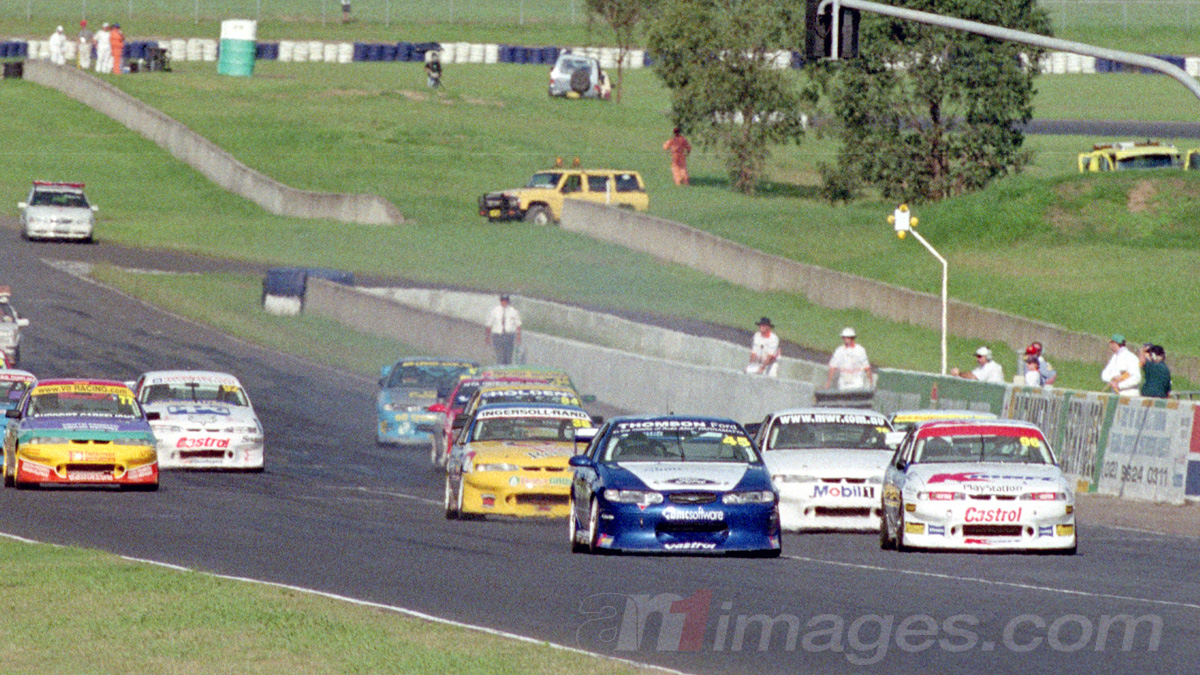
THE Dunlop Series for Super2 cars has provided a home for ex-Supercars for over a quarter of a century under a range of series banners.
But what was originally planned for the series’ implementation in 2000 that never eventuated, or indeed, took further years to come to fruition?
The series was announced by AVESCO back in 1999 as a new Development Series, a generic term used to describe the series ever since, though it was later reframed as the V8 Lites Series for the kick-off season.
“The V8 Lites Series will be a stand-alone competitive series designed to promote a development class for teams and drivers aspiring to drive V8 Supercars,” read an AVESCO release in December 1999 announcing the approval of the series by the AVESCO Board.
“At the same time it will relieve the over-subscribed grids of the highly successful Shell Championship Series, provide promoters with an additional V8 Ford versus Holden competition and give fans more of their preferred spot.”
Featuring de-tuned V8 Supercars it was originally announced as a five-round series across eastern states with a naming rights sponsor to be announced, that ultimately turned out to be Konica.

Initially it was reported the series would be a blend of stand-alone rounds and featuring at select marquee V8 Supercar Championship events, however the early years of the series saw a focus purely on the former.
The Development Series gave the opportunity for tracks that had lost their round of then-then Shell Series to continue as a V8 host; Mallala and Lakeside had lost their ‘main game’ rounds after 1998 but appeared on the 2000 Konica V8 Lites Series calendar.
“There are 73 registered V8Supercars at the moment,” AVESCO’s Tony Cochrane told Motorsport News at the time of the series’ initial announcement.
“By Bathurst (in November) there will be 80. Some privateers cannot afford the expense of travelling to all races. To overcome this, all races will be centred on the East coast.”

Two main elements announced for the series didn’t happen in 2000.
A 6500rpm rev limit (as opposed to the 7500rpm of V8 Supercars) was initially announced in a bid to make them cheaper to run, however this was not in place when the series made its debut, nor ever later implemented.
An unnamed team owner of the period was well against the lower rev limit; “These engines are designed to run to 7500,” he said. “6500 means changing cams, exhausts and engine mapping, which will cost $20,000. A second-hand Commodore is $120,000 already.”
Also initially announced was that both models of Commodore – VS and VT – and Falcon – EL and AU – from the main championship would be eligible for the new series.

The series’ policies were finally approved by the AVESCO Board in December 1999 and ended up limiting the series to the VS Commodore and EL Falcon and older models in year one in 2000.
The eligibility was opened the following year to allow the VT and AU onto the grid.
The inaugural series in 2000 was won by Dean Canto in an ex-Glenn Seton Falcon EL and is in its 27th year this season.
The Dunlop Super2 Series recommences for round two of 2026 for its first trip to Hidden Valley in Darwin on June 19-21.