
RATES INFLUENCE:
Liquidity is abundant, as reflected in a stock market rally, while a subsidy program for first-time homebuyers might help demand, a realtor said
By Crystal Hsu /
Staff reporter
Taiwan’s property market is likely to stabilize following the central bank’s decision on Thursday to leave interest rates and mortgage restrictions unchanged, a move market participants say signals that policymakers are comfortable with a gradual cooling, but are alert to potential financial risks.
Chinatrust Real Estate Co (中信房屋) deputy research manager Chuang Si-ming (莊思敏) said that speculative demand has largely been squeezed out after a series of credit-tightening measures, leaving owner-occupiers as the main support for the housing market.
Against this backdrop, the bank’s decision to maintain the policy stance suggests it is aiming for a soft landing while continuing to monitor market conditions closely, Chuang said.
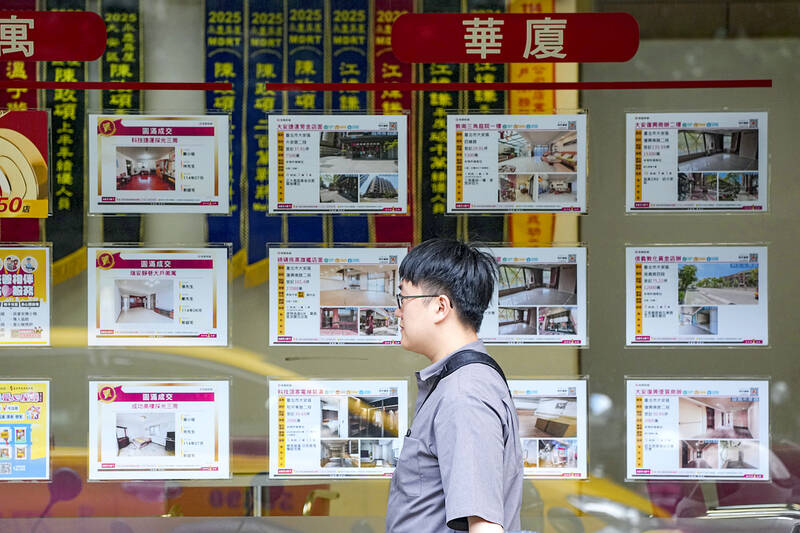
Photo: CNA
Liquidity remains abundant, as reflected in the continued strength of Taiwan’s stock market rally, while the government’s planned subsidy program for first-time homebuyers set for next month could offer additional support to end-user demand, she said.
As a result, policymakers are expected to remain in wait-and-see mode through the central bank’s third-quarter board meeting as they assess whether housing transactions stay contained after the new measures take effect.
The Ministry of Finance is expected to unveil a new housing subsidy program at the end of this month, as the current scheme is to expire next month.
The central bank’s decision to keep rates unchanged was broadly in line with expectations, with price-stabilization policies helping keep inflation contained.
Evertrust Rehouse Co (永慶房屋) echoed the view that policymakers are adopting a cautious stance.
Although the housing market has slowed, there has been no meaningful price correction, underpinned by a resilient economy and sustained gains in equities, Evertrust Rehouse said.
Even as the US and Iran agree to a ceasefire, geopolitical uncertainty lingers, limiting the central bank’s willingness to signal a more aggressive policy direction, Evertrust Rehouse deputy research head Chen Chin-ping (陳金萍) said.
The central bank is concerned about capital concentration in property lending, which could crowd out credit for productive investment in the broader economy, Chen said.
Banks are expected to be conservative in extending property-related credit in the near term, she said.
At the same time, the housing market has benefited from a wealth effect, as some investors take profits from equities and redeploy funds into real estate, she said.
Looking ahead, genuine end-user demand is likely to re-emerge as buyers move away from expectations of further price declines driven by tighter credit conditions, analysts said.
H&B Realty Co (住商不動產) said that the housing market is likely to consolidate in the second half of the year, with transactions remaining subdued and prices moving sideways within a narrow range.
H&B chief researcher Jessica Hsu (徐佳馨) said that as long as credit controls remain in place, speculative demand will stay muted, with investors continuing to favor alternative assets such as equities.
End-user demand might gradually return as buyers move off the sidelines, Great Home Realty Co (大家房屋) said, adding that the central bank’s signal that it will not introduce additional credit controls could encourage transaction activity among genuine homebuyers.