
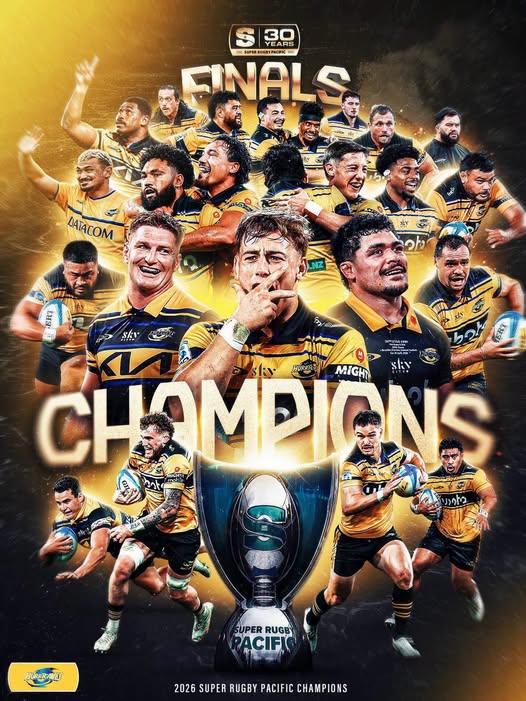
Happy Monday, G&GRs. Well, well, well! I don’t think anyone saw a ‘caning’ of that magnitude on the cards. Yes, the Canes were expected to win, the Rugby algorithm said so, the bookies said so. But 55 points? Let’s dive in and analyse the Grand Final, Brisneyland style. We will also have a look at the Bokke V Ba Ba’s game too. Go and pour a cup of liquid gold☕ and get that into you while we pull apart the Grand Final.

Coffee meme courtesy of J McD
Super Rugby Pacific Grand Final 2026
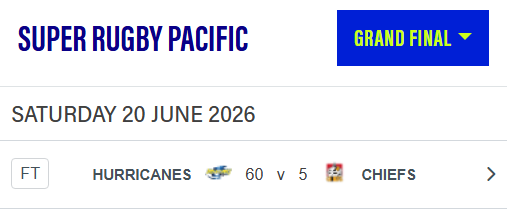
The Hurricanes 60 defeated the Chiefs 5
Cane Train Runs Over Chiefs To Claim Super Rugby Crown – Well, that escalated quickly. After spending most of the season looking suspiciously like the best team in the competition, the Hurricanes decided to remove all doubt in the 2026 Grand Final by absolutely steamrolling the Chiefs 60-5 in Wellington. Not only did the Canes secure their first Super Rugby title in a decade, but they also did it by producing what might just be the most devastating Grand Final performance the competition has ever seen.
The Chiefs arrived in the capital hoping to finally go one better after years of finals heartbreak. Instead, they found themselves trapped in a rugby version of a natural disaster. By the time the final whistle sounded, the Hurricanes had broken the record for the biggest winning margin in a Super Rugby Final and left a quality Chiefs side wondering what on earth had just happened.
The warning signs appeared early. Josh Moorby crossed after just six minutes to equal the single-season try-scoring record, and from that point onwards, the Hurricanes’ attack looked like it was operating on a completely different wavelength to everyone else on the field. Ruben Love then produced a moment of class, scooping up a loose ball and dancing through defenders to extend the lead.
With the wind swirling around Wellington doing its usual best impression of a mischievous twelfth defender, the Chiefs struggled to gain any sort of foothold. Twice, they sent restarts dead, handing possession straight back to a Hurricanes side that needed no second invitation. Fehi Fineanganofo then added his name to the history books. Following a sharp break from Callum Harkin, the winger popped up in support and dived over for his 17th try of the season, officially becoming the most prolific try scorer in a single Super Rugby campaign.
The Chiefs’ best opportunity of the opening half came when they were held up over the line, but otherwise they spent most of the first forty minutes desperately trying to contain a Hurricanes attack that simply refused to stop asking questions. As halftime approached, things somehow got worse.
Harkin crossed for another Hurricanes try before Love launched a long-range penalty to send the hosts into the sheds leading 29-0. It was the biggest halftime lead ever recorded in a Super Rugby Grand Final, and, frankly, the game already felt done and dusted.
The second half became less of a contest and more of a celebration. Moorby joined Fineanganofo on 17 tries for the season when he grabbed his second of the evening, while Devan Flanders marked his return from concussion with a try after charging onto a perfectly timed pass from Love. Jordie Barrett then got in on the act, producing another commanding performance in a Hurricanes jersey and adding his own five-pointer as the Wellington crowd began preparing for a very long night of celebrations.
But the highlight reel moment belonged to Love. After Peter Lakai burst clear downfield, the Hurricanes shifted the ball wide where their fly-half somehow managed to hurdle a defender, stay in the field of play, and crash over in one motion. It was outrageous, ridiculous, and entirely fitting for a player who finished the night with 25 points and one hand firmly on the man-of-the-match award.
The Chiefs at least avoided the unwanted distinction of becoming the first team held scoreless in a Super Rugby Final when Naitoa Ah Kuoi crossed late in the match. The brief consolation was quickly forgotten when Jone Rova added the Hurricanes’ final try on full-time, pushing the score out to an astonishing 60-5.
For the Hurricanes, it was the perfect ending to a near-perfect season. For the Chiefs, it was a brutal reminder that even outstanding teams can occasionally run into a side playing rugby from another planet. The Hurricanes have spent years threatening to fulfil their enormous potential. On Saturday night, they finally did—and they delivered a Grand Final performance that may never be topped.
Three Things We Learned
1. The Hurricanes may have just produced the greatest Super Rugby Final performance ever. – There have been dominant finals before, but very few have featured a quality opponent being dismantled this comprehensively. The Chiefs weren’t underdogs making up the numbers; they were one of the competition’s best sides. The Hurricanes simply made them look ordinary.
2. Ruben Love has arrived as a genuine superstar – The fly-half was magnificent all season, but Grand Finals are where reputations are made. Twenty-five points, two tries, and a catalogue of moments that had defenders reaching for fresh air. If there were any doubts about his status among the competition’s elite players, they’re gone now.
3. This Hurricanes squad could be building something special – Championships are hard to win. Dominating a Grand Final by 55 points is something else entirely. With young stars like Fineanganofo, Lakai, and Love leading the way, and experienced heads such as Jordie Barrett setting the standard, the rest of Super Rugby Pacific may have a new dynasty to worry about.
Springboks 80 defeated The Barbarians 31
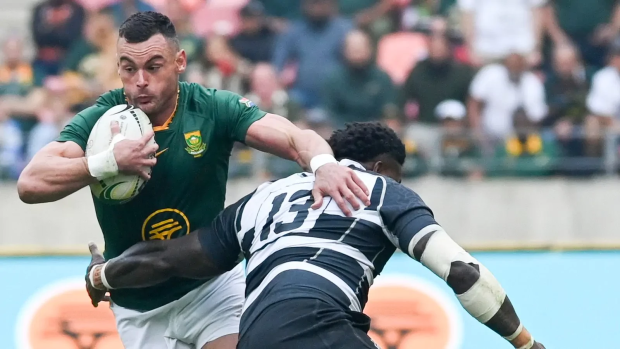
Boks put 80 on the Barbarians, but there’s still plenty for Rassie to grumble about – South Africa kicked off their 2026 campaign the way most people expected South Africa to kick off their 2026 campaign: by scoring a truckload of tries, physically intimidating anything wearing a different jersey and still finding enough mistakes to keep Rassie Erasmus awake at night.
The final score at Nelson Mandela Bay Stadium read 80-31, with the Springboks crossing for a dozen tries in a performance that was equal parts devastating and occasionally baffling. If you only looked at the scoreboard, you’d think the Boks spent the evening leisurely dismantling the Barbarians from start to finish. The reality was a little messier. Still, when you score 80 points, nobody’s exactly filing a formal complaint.
The Barbarians struck back quickly through Virimi Vakatawa after some less-than-vintage Bok defence, but normal service resumed soon enough. Pieter-Steph du Toit barged over, Jasper Wiese followed, and the hosts looked well on their way to an uncomplicated evening.
The fireworks started early. Four minutes in, skipper Siya Kolisi produced a lovely piece of distribution to send Edwill van der Merwe racing away down the left edge. The winger would spend the evening reminding everyone that South Africa’s production line of dangerous outside backs remains alarmingly healthy. Of course, rugby rarely cooperates with such plans.
The Baa-Baas managed to collect 🧀 like they were supermarket reward points. First, TJ Perenara departed for a high shot, then Miracle Fai’ilagi followed him after failing to roll away. South Africa happily accepted the invitation. Van der Merwe grabbed his second, Quan Horn showed some nice touches at flyhalf and debutant lock Riley Norton crashed over for a memorable first Test try.
At 35-12, the game looked headed towards complete annihilation. Then the Boks decided to make things interesting. Grant Williams was shown a 🧀 for a deliberate knockdown, and suddenly the Barbarians found life. Franco Molina crossed, Andrew Kellaway got in on the act, and Perenara completed a remarkable turnaround that cut the margin to just nine points. What had looked like a comfortable training run briefly became an actual contest.
The Springboks needed somebody to settle things down and, naturally, Cheslin Kolbe volunteered. With Williams still in the bin, Kolbe scooted from the base of a scrum, stepped past defenders and dotted down just before the break. It was classic Kolbe: part scrumhalf, part winger, part magician. The score sat at 42-26 at halftime, which probably wasn’t the sort of defensive report card the coaches had in mind.
Fortunately for South Africa, the second half resembled something much closer to the script. Jean-Jacques Kotze powered over from a maul shortly after the restart, and the air began escaping from the Barbarians’ balloon. Veteran halfback Faf de Klerk arrived and immediately increased the tempo, Van der Merwe completed his hat-trick, and the green machine gradually shifted through the gears.
Kellaway picked up a second try for the visitors, but by then the Springbok bench was beginning to flex its considerable muscles. Vusi Simphiwe Moyo, De Klerk, Jesse Kriel, Andre Esterhuizen and Zachary Porthen all crossed during a brutal final quarter that turned a competitive contest into a scoreboard demolition.
The result ultimately served its purpose. South Africa got game time into new faces, saw promising signs from Norton and Horn, watched Van der Merwe finish everything put in front of him and gave the home crowd plenty of reasons to celebrate. But don’t expect Erasmus to be framing the scoreline.
Eighty points are wonderful. Conceding five tries to a scratch Barbarians outfit? Less wonderful. Which probably means the review meeting will be considerably less enjoyable than the post-match highlights package.
Three Things We Learned
1. Edwill van der Merwe is making himself impossible to ignore – A hat-trick is a pretty effective way to start a season. Van der Merwe finished clinically, looked dangerous whenever he touched the ball and continues to strengthen South Africa’s already ridiculous depth chart on the wing. Competition for back three spots remains fierce, but performances like this move players up the queue quickly.
2. South Africa’s attack is evolving nicely – The Boks have spent years building their reputation on forward dominance and defensive suffocation. Those foundations remain, but their attacking shape continues to look more varied and ambitious. Twelve tries don’t happen by accident, and players like Quan Horn showed there is genuine intent to move the ball and challenge defences differently.
3. Defensive accuracy still needs work – The scoreline masks some concerning moments. The Barbarians scored five tries and repeatedly found space when South Africa lost discipline or defensive structure. Against a Tier One opponent, those lapses won’t be forgiven so easily. The attack will earn headlines, but the defensive review will probably receive most of the coaching attention this week.
Anyway, GAGRs, that’s enough for today. Wallaby Tests inbound. Squad discussions etc etc. Have at it!