
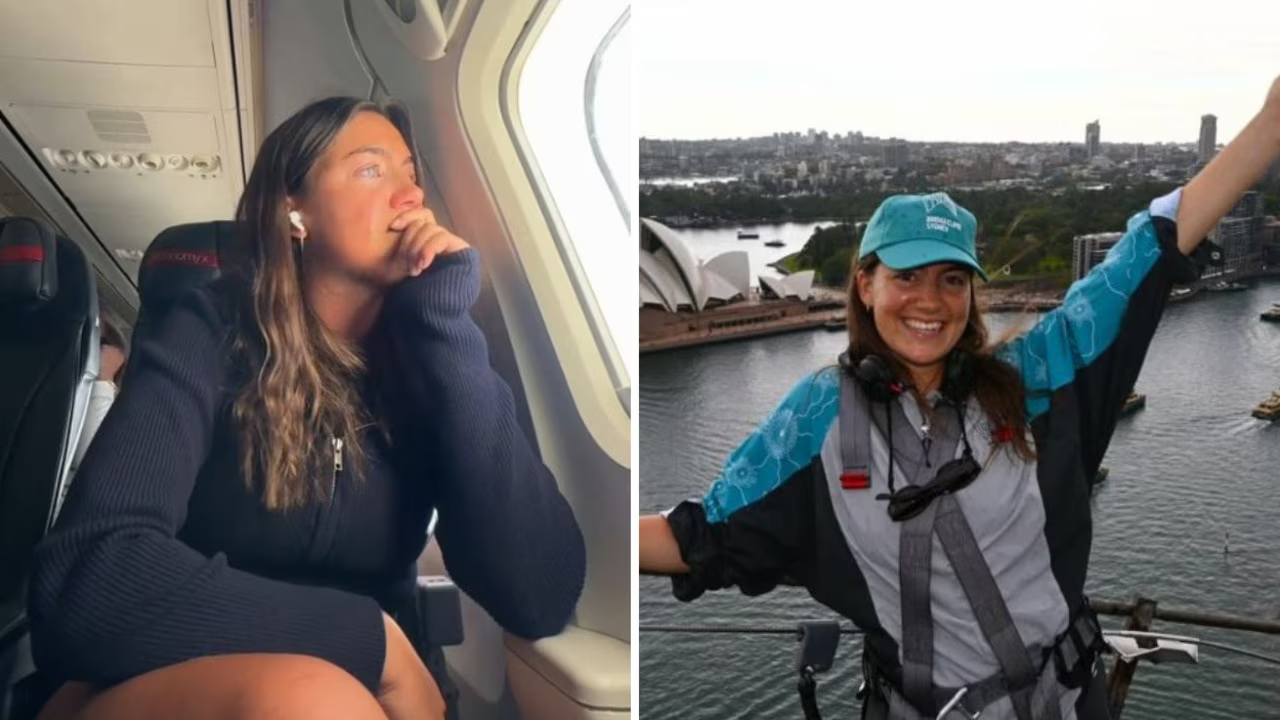
Australia is one of the best countries in the world, and has many foreigners eager to move here.
It is the place people dream of moving to when they finish university or want a change in careers, with a sunny coastline, beautiful beaches and great coffee.
Most of the time, Australia welcomes foreigners with open arms, although not everyone can say the same about Australian people.
Beneath the selfies one may send to their families and friends back home lies a stark post-Covid reality.

Australia is currently grappling with a youth loneliness epidemic.
Sophie Scott, an Adjunct Professor at the University of Sydney’s Prevention Research Collaboration, who writes about emotional wellbeing on Substack, told news.com.au a troubling landscape: a landmark University of Sydney study found that over 40 per cent of young Australians aged 15–25 report experiencing loneliness, with those between 18 and 25 most susceptible to “persistent loneliness” lasting two years or more.
For young expats, some find themselves in a profound isolation that feels amplified by how visibly connected everyone else seems to be.
A young expat’s experience in Australia
24-year-old April, known on TikTok as @aprilarchives0, who regularly posts what life is like moving to Australia as a foreigner, moved to Brisbane from England with her boyfriend last July to escape a repetitive path back home.
“In my head, Australia was painted as somewhere I could fill the gaps in my life,” April told news.com.au.
“I hated the inevitable loop of finishing uni, getting a 9–5, and falling into a routine of dark mornings and dark evenings.”
While the lifestyle benefits proved true, April quickly hit an unexpected wall.
“Building friendships as someone on a working holiday visa is harder than I expected,” she shared.
“A lot of people already have established lives. Trying to fit into that, I realise that I must seem temporary.
“Why should I be added to their everyday life when it’s inevitable that I leave one day?”
This thought highlights a unique facet of Australian sociology.
Research from Griffith University looking at how migrants experience social life in regional cities echoes that locals are warm on the surface, but hesitant to form deeper connections.
Olivia Clayton, a clinical psychologist and director of Collected Minds — an online psychology practice providing mental health support across Australia — as well as a member of the Australian Association of Psychologists, explains that this wall isn’t malicious.
“Many people form their closest friendships in school or university and maintain them over decades,” Ms Clayton told news.com.au
“In Australia, we have a culture of longstanding friendships.
It’s less about Australians being closed off and more that people are time-poor and already have their social needs met. They’re ‘socially saturated.’”
April agreed with this sentiment, claiming Australians already have “quite established friendship groups”.
“As someone coming in later, it can take more effort to find your place socially.
“There can be a natural difference between people who are settled long-term and those who are here temporarily.”
The weakening of the ‘social muscle’
This structural insularity is compounded by a generational crisis: the diminishing of collective social skills.
Experts from the University of Vermont recently identified a sharp decline in young people’s ability to build new relationships, noting that post-lockdown, students transitioned into adulthood with poorly developed skills to communicate emotions non-verbally and regulate emotional displays.
Ms Clayton views this as a direct disruption of a critical developmental window.
“Many young people spent those formative years in lockdowns, studying remotely and socialising primarily online,” Ms Clayton said.
“The opportunities to practice initiating conversations and tolerating the awkwardness that comes with building new friendships were reduced.
“Social confidence works like a muscle. If we don’t use it, it weakens.”
To cope, many young migrants rely on a digital tether to home.
While maintaining close ties provides vital emotional security, Ms Clayton warns it can become a double-edged sword.
“If all emotional needs are met online with people thousands of kilometres away, there can be less motivation to tolerate the discomfort that comes with building a new life locally,” she claimed.
The physiological effects of loneliness
The price of failing to build that local network extends far beyond emotional sadness.
Ms Scott points to a stark medical consensus, where a 2025 research paper found that social isolation and loneliness produce profound autonomic nervous system dysregulation, contributing to cardiovascular problems and increased inflammation.
Socially isolated individuals face a 29 per cent higher risk of heart disease and a 32 per cent elevated risk of stroke, risks that can accumulate quietly over years, beginning in young adulthood.
“The body’s fight-or-flight system interprets prolonged social disconnection as a threat,” Ms Clayton explains.
“Over time, chronic loneliness is associated with increased cortisol levels, poor sleep, anxiety, and depression.
People become hypervigilant and start expecting rejection, creating a vicious cycle where withdrawal further reduces opportunities for connection.”
Cost of living impacts us socially
Crucially, economic factors play a massive role.
“Young adults are experiencing housing stress and cost-of-living pressures,” Clayton shared.
“Connection requires time, energy, and money. If you’re working two jobs and worried about paying rent, social connections become something you intend to prioritise later.
“Loneliness isn’t just a psychological issue; it’s about creating environments where connection is possible.”
Forcing the ‘social muscle’ to work
Despite these steep hurdles, the friction of expat isolation can act as a transformative catalyst for growth.
Stripping away familiar support structures forces a self-reckoning that a comfortable local routine rarely demands.
To break the cycle, April aggressively pushed past her comfort zone, forcing her “social muscle” to work by using friendship apps and reaching out to people through TikTok comments in Brisbane.
“It took a long time, but over time I have built a small community here,” she revealed.
“Back in England, I probably would have stayed in a predictable routine without stepping back and reassessing things.
“Coming to Australia gave me the privilege of realising I need to do a deep internal questioning of myself.
“I’ve had to completely break down who I thought I was, and I have only just begun to rebuild it.”
Australia’s loneliness era is real, but changing the narrative requires moving past the shame of isolation, demanding structural spaces that foster community, and finding the collective courage to tolerate the awkwardness of reaching out.