
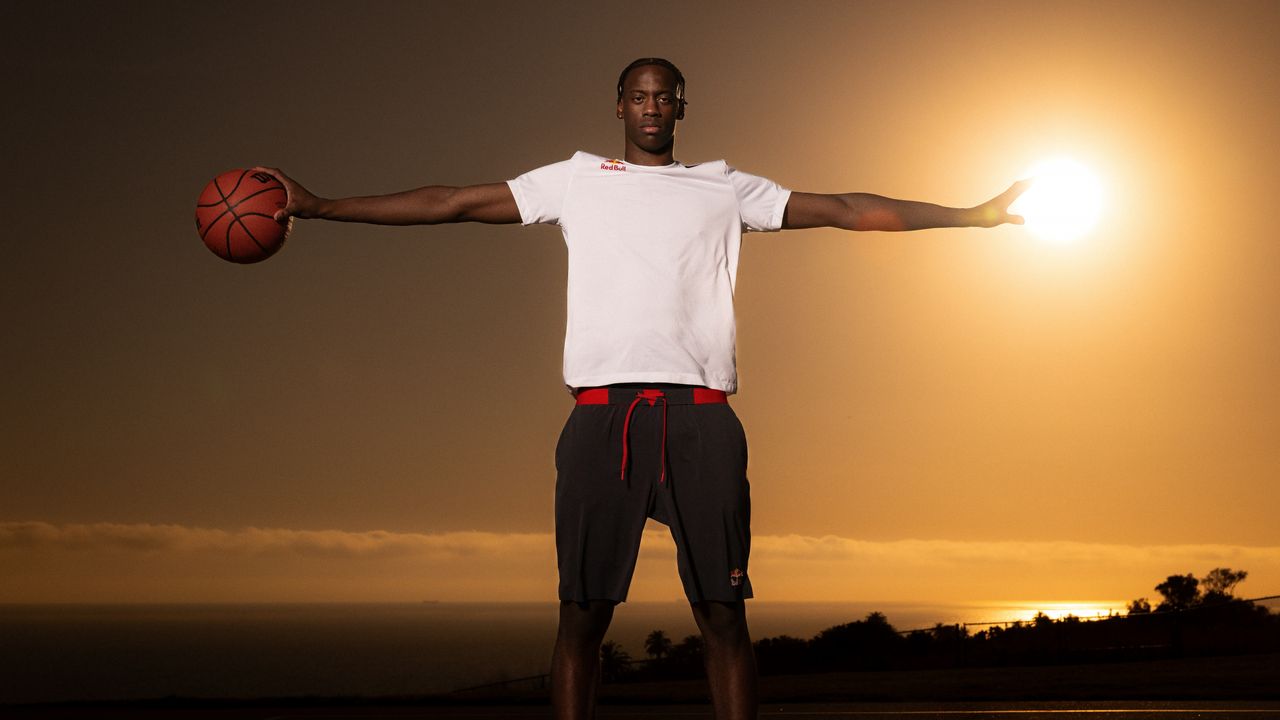
Earlier that day, I first met up with Dybantsa in Santa Monica as a trainer put him through a morning circuit. As a Red Bull athlete, Dybantsa has all-inclusive access to the Red Bull Athlete Performance Center, a standalone building at the energy-drink company’s LA headquarters. The aspirational grooves of Rod Wave and 21 Savage’s “Turks & Caicos” rattled the speakers. The tricked-out gym boasts all the high-end amenities one might expect of a health-and-fitness palace funded by Red Bull, where snowboarders and cliff divers train alongside the potential first pick in the NBA Draft. There’s a biomechanics lab and a mental health performance center, an area where athletes can receive shockwave therapy, and a section where they can transition between an infrared sauna and a cold plunge. Immediately upon entering, visitors are greeted by a dark accent wall with “F*** THE LIMITS” painted on it in bold, defiant letters. I am told that the Peter Drucker quote, “What is measured, improves,” serves as a guiding principle for everything that happens here, which is why every movement, every lift, seemingly every breath is tracked. For Dybantsa, whose lone season of college basketball ended in March, the last three months of detailed work have all been in the name of that—measured improvement. Because, as the guy who broke 19 school records at BYU tells me later in the day, experiencing any sort of wait on draft night would be a mountainous letdown. “I work so hard, to be anything less than number one would just kind of be like I did something wrong,” Dybantsa says. “I’d kind of be disappointed.”
By mid-afternoon, we were sitting at the fabled Venice Beach basketball courts—forever immortalized in White Men Can’t Jump—where the most rugged and competitive outdoor pickup games this side of the Mississippi take place. Dybantsa was there taking in the scene with his dad, his trainer, and his videographer, as well as a few others. He was wearing head-to-toe Nike—the company has already given him his own signature logo, a star composed of his initials—and our interview served as a bit of a warm-up for him before the grilling he was due to receive from coaches and front office executives at the NBA Combine a week later.
To understand what makes Dybantsa tick, one must first understand why he—a Black kid from Brockton, Massachusetts—chose to attend Brigham Young University, the overwhelmingly white and notoriously strict Mormon institution in Provo, Utah. Ever since committing to play for the Cougars as a high schooler, Dybantsa has stuck to the line that he chose BYU because he wanted his college experience to be distraction-free. There’s certainly some logic to that: BYU rigidly prohibits drinking, smoking, and premarital sex; in 2011, the school dismissed a player from its men’s basketball team after he admitted to having sexual relations with his girlfriend. For Dybantsa, those restrictions helped create a placid, basketball-focused environment in which he spent most of his off hours “just in the crib.”
“I remember we had an off week in the summer, and it’s like, there is nothing to do,” Dybantsa says. “You do want to go out with your teammates to go do something, and you can’t. That wasn’t a bad thing, though!” You start to believe him—that this self-imposed virtuous lifestyle wasn’t all that bad—when you consider the extensive list of programs he could have played for instead. He had offers from schools in bigger cities (USC, Georgetown, Washington) as well as ones with a much stronger basketball pedigree (Duke, North Carolina, Kentucky). UConn, Providence, and Boston College all gave him the chance to stay closer to home. But Dybantsa—who identifies as Catholic, not Mormon—chose the rule-heavy campus where even caffeine can be a bit taboo. “When I first got there, I’m like, well, I have a Red Bull deal, so I don’t know what y’all want to do,” he says, laughing. (Dybantsa says he prefers the flavored Red Bulls like watermelon over the OG offering, though his real goal is to get his own flavor.)