
It took 12 days, but the 2026 World Cup has had its first weather delay as the controversial new rain rule triggered a deluge of criticism on social media.
Heavy rain and thunderstorms prompted a delay of two hours in Tuesday’s (AEST) World Cup match between France and Iraq in Philadelphia.
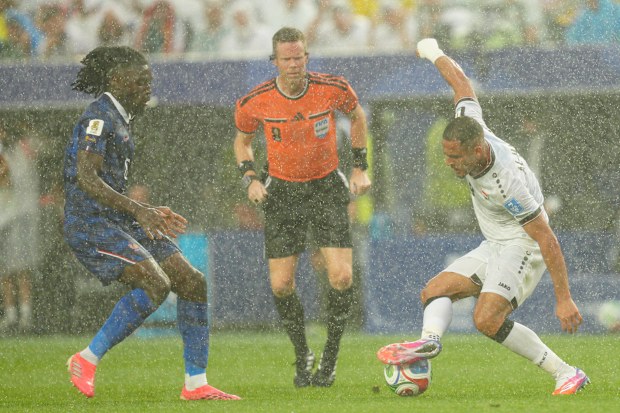
France’s Manu Kone marks Iraq’s Ali Alhamadi. AP Photo/Derik Hamilton
Before this tournament, FIFA long had a reputation for continuing matches through extreme weather.
A 2014 game between the United States and Germany continued in Brazil even after a torrential downpour that flooded parts of Recife.
With France leading 1-0 at halftime thanks to Kylian Mbappé’s stunning strike, scoreboard messages directed the crowd to take shelter in the stadium’s covered areas, warning that a severe storm was on the way.
Sheets of rain fell through halftime as thousands of fans huddled in the concourse and under balconies.
The stoppage was initially expected to extend the 15-minute halftime break by another 15 minutes.
As the delay dragged on, stadium officials announced that “the game will resume when deemed safe.”
FIFA pauses games for 30 minutes if lightning is detected within eight miles (12.9km). Each strike resets the clock.
France and Iraq initially played through the downpour that started in the 37th minute. Fans donned ponchos and most stayed in their seats until they were told to find shelter at halftime.
‘THIS CAN’T BE REAL’
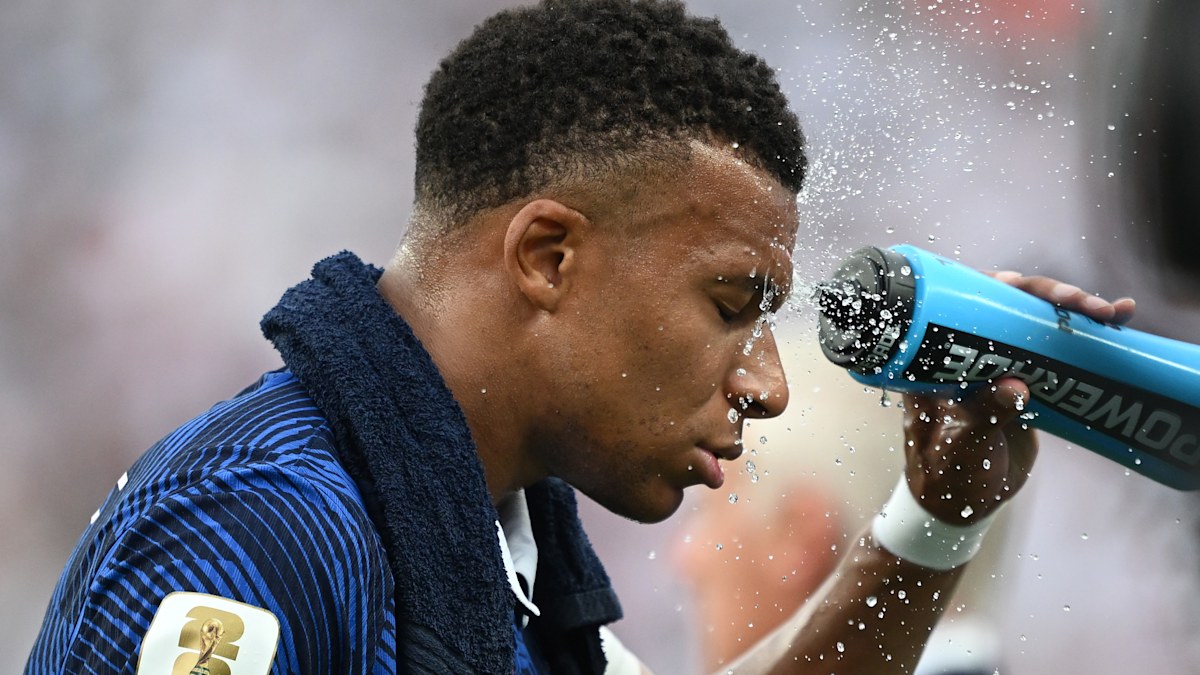
Still, even with lengthy delays, the mandatory three-minute hydration breaks in the middle of each half still take place.
“Hydration break while it is raining, this can’t be real,” one fan wrote.
It was the first time in at least several decades that a World Cup match was delayed mid-game because of inclement weather.
There was also heavy rain ahead of Tuesday’s (AEST) game between Norway and Senegal in New Jersey.
The stadium seating bowl was briefly cleared during a downpour with possible flooding in the forecast, but the match kicked off on time.
World Cup regulations say that “in the case of a match being abandoned as a result of force majeure after it has already kicked off… the match shall recommence at the minute at which play was interrupted rather than being replayed in full, and with the same scoreline.
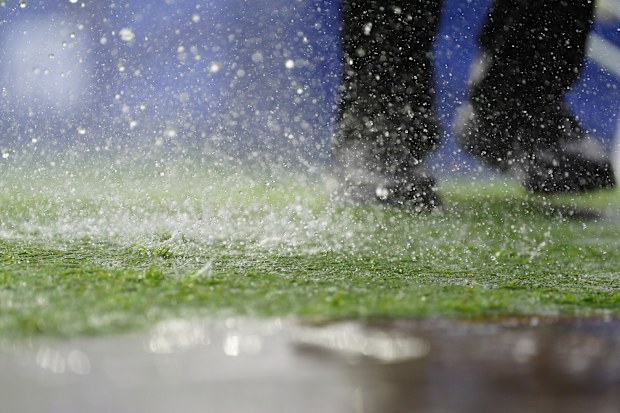
Heavy rain falls during the World Cup match between France and Iraq in Philadelphia. AP Photo/Derik Hamilton
“The match shall recommence where play was stopped when the match was interrupted (e.g. with a free kick, throw‑in, goal kick, corner kick, penalty kick, etc).
“If the match was abandoned while the ball was still in play, it shall restart with a dropped ball from the position of the ball when play was stopped. The kickoff time, date, location and any other matter shall be decided by FIFA.
“FIFA has the right to cancel, reschedule or relocate one or more matches (or the entire FIFA World Cup 26) for any reason at its sole discretion, including as a result of force majeure or due to health, safety or security concerns.”
HYDRATION BREAKS FRUSTRATING FANS
The hydration breaks in matches are proving as controversial as they are cooling, with players split over interruptions that some say kill the flow of the game while coaches embrace them as tactical timeouts.
The breaks were introduced after the sweltering Club World Cup in the United States last year when soaring temperatures and oppressive humidity fuelled concerns among players, coaches and fans.
Although not all fixtures are played during the day, hydration breaks have been mandated in each game at the World Cup in the interest of fairness and uniformity.
Broadcasters are allowed to cut away to commercials 20 seconds after the referee signals a hydration break but must return to live action 30 seconds before the restart.
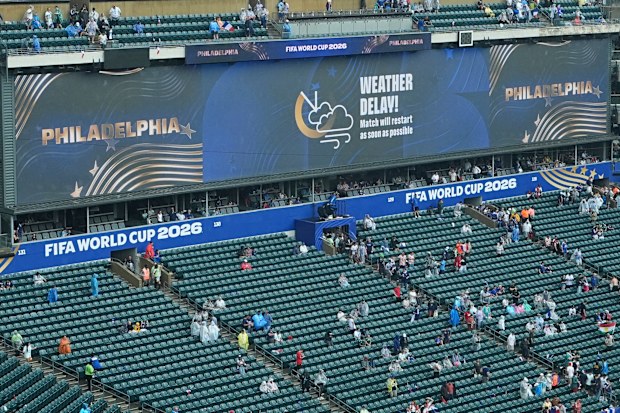
A sign advising fans of a weather delay. AP Photo/Matt Rourke
However, some broadcasters in England and Spain opted not to show commercials to preserve the sanctity of the live game so that fans can watch the players and coach interact.
Critics say hydration breaks can also harm teams, affecting their momentum. World Cup debutants Curaçao were in dreamland when Livano Comenencia equalised against Germany in their group opener in the 21st minute, only for the referee to signal a hydration break soon after, allowing Germany coach Julian Nagelsmann to rally his troops to a 7-1 victory.
WHAT THE MEDICAL EXPERTS SAY
On the other hand, medical experts believe the hydration breaks are necessary and that they need to be much longer than three minutes.
“The hydration break in each half absolutely needs to be longer than three minutes. At least five minutes for each break and preferably six,” said Douglas Casa, CEO of the Korey Stringer Institute that develops practical strategies to prevent sudden death in sport.
The call for extended breaks comes amid growing alarm over heat-related risks, according to Mike Tipton of the Extreme Environments Lab at the University of Portsmouth.
“As it stands and due in part to climate-change-driven increases in environmental thermal stress, some of the venues for the 2026 World Cup are likely to exceed the recommended heat-related ‘high risk’ threshold – especially during afternoon kickoffs,” Tipton said.