
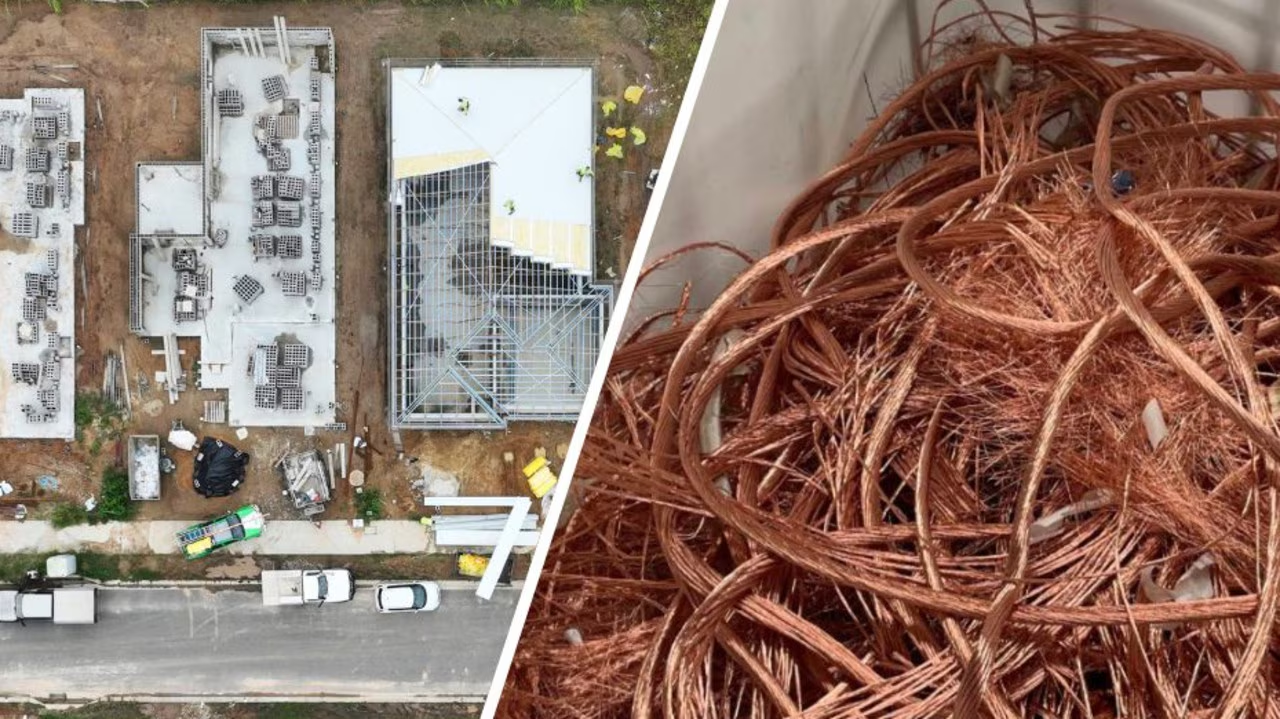
Victoria’s residential building industry is facing millions of dollars in repair costs and lengthy delays as brazen copper thieves target construction sites to loot installed wiring.
News.com.au can reveal the suburbs most likely to be hit by opportunistic crooks looking to make a quick buck on stolen copper, which they then take to a competitive market of scrap metal dealers promising to pay “top dollar” for the material.
While the crime is occurring right across the state at schools, factories, hospitals and even brothels, residential properties and new home construction sites appear to be the easiest target, according to data obtained from the Crime Statistics Agency Victoria.
There were more than 2300 incidents of copper theft between 2022 and 2026 across Victorian building sites and new dwellings under construction, with a further 2170 thefts occurring across already established residential properties.
Premises under construction made up almost a quarter of stolen copper incidents between the five-year period, and a third of incidents in 2026 alone.
Melbourne’s western suburbs were a hotspot for thieves capitalising on high-growth corridors where there are high volumes of new residential developments.
This included Wyndham, where a total of 472 thefts occurred between 2022 and 2026 – the most in the state.
The council granted building permits for 150 dwellings and 9 units in January 2026, with the suburbs of Tarneit, Werribee and Mambourin recording the most approvals.
The city of Melton was another area recording a substantial number of incidents, with 279 thefts recorded. This was followed by Hume in the northwest, which had 103 reports.
The city of Casey was an outlier in terms of location, with it being one of the only suburbs outside Melbourne’s west to be a key target.
The inner southeastern locality recorded a total of 335 thefts between the five-year period, making it the second-most preyed upon locality in the state.
The council approved 2469 houses and 456 other dwellings in the 2025-26 financial year, suggesting why it’s such an easy target.
Other regions where new homes were ransacked for copper included Brimbank, Melbourne, Greater Dandenong, Whittlesea, Greater Geelong and Cardinia.
Have you been impacted? Get in touch: rebecca.borg@news.com.au
Housing Industry Association (HIA) regional director Keith Ryan told news.com.au Victoria’s growth areas had the exact conditions thieves looked for – unfinished homes, exposed wiring, multiple trades moving through sites and materials that could be stripped quickly and sold for scrap.
“This is not a victimless crime. When copper wiring is ripped out of a home under construction, it does not just mean replacing a few cables,” he said.
“It can mean damaged walls, damaged switchboards, rework by electricians, new compliance checks, insurance claims, delays to handover and extra supervision costs.”
While the damage bill can vary, a small theft alone can still set back a builder several thousand dollars.
“In more serious cases, builders report costs running into the tens of thousands once repairs, labour, delays and damage to the home are included,” Mr Ryan said, adding the bill is usually borne by the builder, the subcontractor, the insurer or the client, depending on the contract, timing and insurance arrangements.
“At a time when Victoria and Australia need more homes built faster and more affordably, this is another unnecessary cost and delay.”
While cameras and security systems are set up to deter thieves, Mr Ryan acknowledged it didn’t stop every theft as they still managed to cut fences, pose as tradies and move quickly before police respond.
“Builders are doing what they can, including locking up materials, delaying installation where possible, using cameras, fencing sites and increasing patrols,” he said.
“But builders cannot solve this alone. There needs to be stronger enforcement, tougher penalties and better controls on the resale of stolen copper.”
While legitimate scrap metal dealers must be registered and comply with strict rules, there are some dodgy traders using platforms such as Facebook Marketplace to purchase the stolen goods without even questioning it.
News.com.au analysed some ads and reached out to sellers who were prepared to offer a price without even asking where copper wiring had been sourced from.
One seller offered $13 per kilogram for “clean copper” and $9 per kilogram for “not clean”.
When asked what the difference was, the seller said “not clean” refers to the wire coating still being intact, while “clean” refers to the wire being stripped.
Another seller wanted to pay $15.30 per kilogram for stripped shiny copper, $15 per kilogram for clean copper and $13.50 per kilogram for dirty copper.
Consumer Affairs Victoria defines scrap metal as any commercially valuable item comprising or containing metal, acquired or sold for recycling or reprocessing.
Traders wishing to purchase scrap metal and copper must be registered second-hand dealers and adhere to strict regulations, including a ban on cash transactions for both buying and selling.
Master Builders Victoria (MBV) chief of public affairs Dr Corrie Williams said copper theft was another burden for builders already doing it tough.
“Nearly half of our members who responded to a recent MBV survey reported project cost increases of six to 10 per cent, while one in five is facing increases of more than 11 per cent,” she said.
Losing valuable tools and materials is a low blow to our builders who just want to get on with delivering homes for Victorians.”
Due to the scale of thefts, Dr Williams said some businesses were reluctant to claim their losses on insurance due to the excess.
“Most of the losses from thefts are being absorbed by builders, especially small to medium enterprises, which operate on fixed-priced contracts,” she said.
Volume builder Metricon’s general manager of Victorian housing, Peter Temopoulos, added theft from building sites was “an unnecessary and frustrating setback for builders, trades and customers”.
“We support stronger awareness and coordinated action across industry, police, suppliers and scrap metal channels to help reduce this type of crime,” he said.
A Victoria Police spokeswoman said its officers work alongside its public transport and road infrastructure partners to deter, detect, investigate and prosecute copper thieves.
“While copper is not one of the most common items generally stolen in Victoria, the impact can be quite significant when it does occur – from train delays and impacts to roadways and construction sites,” she said.
“It’s also extremely dangerous to have live wires exposed out in the community.”
The spokeswoman said dedicated transit police monitor local train lines, tram routes and transport hubs in uniform and plain clothes at all times of the day and night.
“Roadways, new estates, construction sites and manufacturing locations are also often areas targeted by copper thieves,” she said.
“These areas are regularly patrolled by local police through a range of targeted operations across the state.
“Local Crime Investigation Units will investigate any reported thefts of copper.”
Anyone with information on copper theft is encouraged to contact Crime Stoppers.
Read related topics:Melbourne