
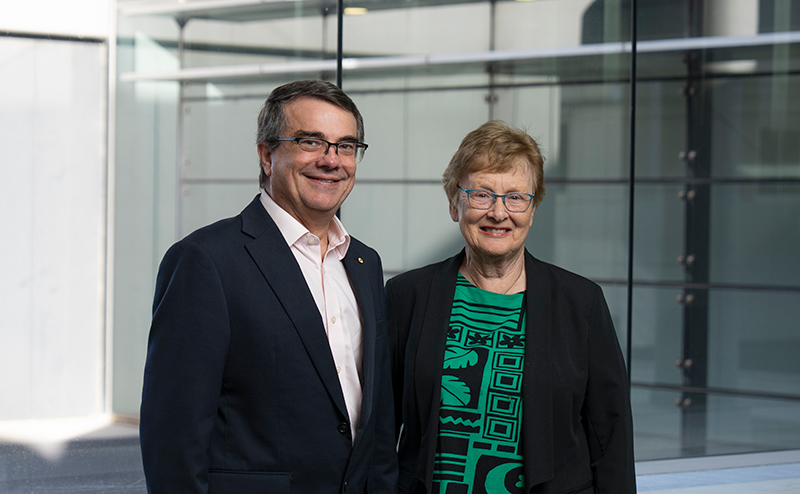
Professor Suzanne Cory is one of Australia’s most distinguished molecular biologists, with a record of significant achievements in immunology and cancer research.
She served as director of WEHI from 1996-2009, where she made dedicated efforts to promote science policy and elevate the institute’s profile on a global scale. She is currently Honorary Professor Emeritus at WEHI and a Vice-Chancellor’s Fellow of The University of Melbourne.
What inspired you to study hematology?
In the mid-1970s, two American researchers named Michael Bishop and Harold Varmus made a groundbreaking discovery that revealed cancer-causing genes (oncogenes) found in viruses actually originate from normal, healthy cellular genes.
Their discovery revolutionised understanding of cancer as a genetic disorder and was aptly awarded the 1989 Nobel Prize.
Prior to this finding, I was working on immunogenetics – itself a very exciting field. But as soon as my team read about the oncogene discovery, we immediately started exploring this new field to find an entrée.
This sparked two key research interests in me: understanding the fundamental cause of different kinds of cancer (molecular genetics) and how cell death can contribute to cancer development (apoptosis regulation).
Working at WEHI with its rich history of haematology under Don Metcalf, it was natural that we then gravitated towards blood cancers.
What is your most notable research accomplishment?
I am most proud of two findings – both made jointly with my scientific and life partner, Jerry Adams.
In 1983 we became amongst the first in the world to discover that chromosome translocations involve a known cancer-provoking oncogene called MYC. We went on to show that MYC deregulation is the fundamental cause of Burkitt’s lymphoma, by generating one of the first transgenic mouse models of cancer in collaboration with US scientists Ralph Brinster and Richard Palmiter. These findings advanced the view that many of the DNA alterations found in tumours have contributed to cancer development.
Subsequent research by Professor David Vaux and Professor Andreas Strasser – then PhD students – led to the surprising discovery that Bcl-2, the oncogene activated by chromosome translocation in human follicular lymphoma, helps keep cells alive. This was a groundbreaking discovery that transformed the study of oncogenes and apoptosis, underpinning the development of venetoclax.
What is one thing that most people would probably be surprised to learn about you?
Growing up, I dreamed of being a novelist. Science sort of crept up on me. Hearing about the discovery of the DNA helix made a deep impression – I fell in love with DNA and have never lost the wonder and excitement of wanting to understand the molecular basis for the life process and how it goes awry in disease.