
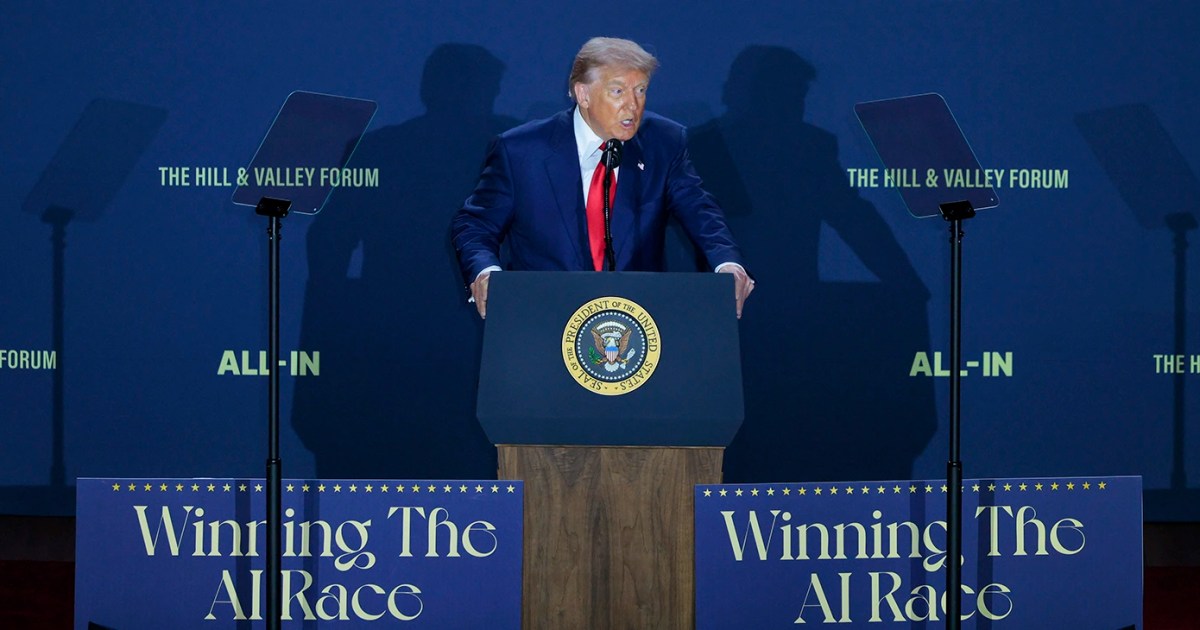
President Donald Trump’s social media feeds are a pig trough of artificial intelligence slop, packed with low-effort images churned out by content farmers wielding generative AI.
On any given day, he posts or reposts AI-generated versions of himself endowed withthe sculpted biceps of the Rock, the steely gaze of an assassin or the swagger of a madman with his finger on the nuclear button (and everyone remembers the time he played Jesus). It’s as if AI arrived just in time to serve as ringmaster for the political circus Americans voted for in 2024.
But Trump isn’t just the first president to embrace AI as a communications tool. He’s also benefiting from it in a far more consequential way — whether he realizes it or not. AI companies are helping prop up much of the economy during his second term.
The scramble to cash in on Silicon Valley’s latest gold rush is keeping economic growth alive and masking the damage from Trump’s own policies, including his relentless tariffs on imports and the energy shock triggered by his confrontation with Iran. Trump’s approval ratings are underwater. Without the AI boom, they might be in the Mariana Trench.
Gross domestic product grew at an annualized rate of 1.6% in the first quarter of this year, but nearly all of that growth came from investment in AI, data centers and related technologies. Consumer spending, the traditional engine of the U.S. economy, remained well below its historical average. Business investment outside the AI sector actually contracted, falling about 0.3% during the quarter.
“Outside of AI, there is zero vitality in the US economy,” economist David Rosenberg of Rosenberg Research wrote in a recent analysis. “The AI euphoria is masking a narrowing market and a weakening economy.”
AI is also helping drive the stock market, which has gained roughly 22% over the past year. That matters because rising asset prices increasingly support consumer spending among wealthier households. Stocks tumbled after Trump launched the Iran war on Feb. 28, forcing investors to reckon with the prospect of a sudden energy shock. But the sell-off lasted only two months. Technology companies tied to the AI boom soon reported blockbuster earnings that crushed expectations, reigniting the rally. Investors jumped back in. Not even a war was enough to interrupt the AI buying frenzy.
To measure the market’s dependence on AI, Goldman Sachs created an index in February that removes AI-related companies from the S&P 500. The results are striking. Since Feb. 20, the AI-free index has gained just 1.4%, compared with a 7.3% rise for the broader S&P 500 and a 12.3% jump for the tech-heavy Nasdaq. Strip out the companies powering the AI boom, and much of the market’s momentum disappears.
Stocks are not the same as the real economy, but they matter politically for Trump because they are one of the few indicators working in his favor. The last couple of monthly jobs reports have been solid, but the broader picture is less encouraging. The economy has experienced five months of job losses over the past year, and job growth remains much slower than it was for most of the Biden presidency.
Inflation has climbed to 4.2 percent, while real income growth has turned negative. In other words, prices are rising faster than wages, leaving the typical worker worse off. University of Michigan consumer sentiment surveys consistently show a sharp divide between investors and noninvestors: Households with significant stock holdings remain relatively optimistic, while those without stocks are far more pessimistic about the economy.

Rick Newman is founder of The Pinpoint Press, a newsletter on money and politics, and author of four books.

© 2026 Versant Media, LLC
