

Requiring only a draw to finish second and progress to the knockout stages automatically, Australia drew 0-0 with Paraguay in Santa Clara in a comfortable performance in which the Socceroos had the better chances.
Though the game itself never really got out of second gear, there were plenty of important takeaways from the match ahead of a Round of 32 clash with Egypt in Dallas.
A new-look right side
With Jacob Italiano injured, and now ruled out of the World Cup entirely, Tony Popović opted to move Jordan Bos to right wing-back with Aziz Behich slotting in on the left. Ahead of Bos was Cristian Volpato, who made his first World Cup start after a sensational cameo against the USA.
The results, in my opinion, were mixed.
Bos and Volpato are two of Australia’s most dangerous attacking players and to see them paired together was a view into an exciting future of Australian football. Volpato, in particular, started strongly, completing three early dribbles and attracting significant attention from the Paraguayan defence. A Volpato run to the byline culminating in a right-footed cutback created an early half-chance for Jackson Irvine – who formed the third point of the right side’s attacking pyramid – though apart from this chance, the right side produced little end product in the first half.
At times, Bos seemed somewhat uncomfortable both overlapping and underlapping on the right side, while Volpato’s desire to attack the byline restricted Bos’ ability to run at defenders. Both Bos and Volpato love to cut onto their left foot, and this commonality made Australia’s attack down this side threatening but predictable. Ultimately, Bos was more dangerous after Volpato was substituted, making several outstanding runs into the box late in the game, at least one of which probably should have resulted in a stronger test of Paraguay’s goalkeeper. With Ajdin Hrustić taking up more central positions than Volpato, Bos had more space to run at defenders, often taking on (successfully) two or three defenders at once.

Bos’ second-half, particularly the last 20 minutes, saw his best football of the tournament, and demonstrated just how good he is. He has just about every attribute for a modern wing-back: speed, physicality, 1v1 and 1v2 dribbling ability, aerial strength, the ability to create and score goals, two-footedness and 1v1 defence.
The question is now, with Jacob Italiano out for the rest of the tournament, whether he remains on the right, or whether he reverts to the left with a player like Kai Trewin playing at right wing-back.
While Australia’s right side saw 7 shots in the box alone, Australia’s left side did not create a single chance of note. I feel Cristian Volpato may be better paired with a right-footed wing-back who is more comfortable overlapping and thus drawing defenders away from Volpato, while Bos is even more dangerous playing on the left. It will be very interesting to see what Tony Popović decides to do against Egypt.
Control out of possession
While not as exciting as Bos and Volpato running at defenders, the most impressive aspect of Australia’s performance was their defensive control. Playing against a significantly smaller Paraguayan team, Australia’s midfield and defence exerted almost total control of second balls and 50/50s, and all but completely stifled Paraguay’s threat in transition.
Aiden O’Neill and Jackson Irvine were big contributors to this – with Irvine in particular repeatedly anticipating second balls successfully and O’Neill doing well to consolidate possession. Julio Enciso, Paraguay’s best player, struggled to impose himself on the game in the first half, and Irvine, O’Neill and Alessandro Circati deserve a lot of credit for limiting such a dynamic player. While Enciso was more lively in the second half, Australia still kept him relatively quiet and Paraguay were limited to potshots either from outside the box or the edge of the penalty area. This would please Australia’s coaching staff a lot.
Irankunda as a nine
Following on from his second half cameo as a centre-forward against the USA, where he posed problems for the American defence, Nestor Irankunda was picked to start there against Paraguay ahead of Mohamed Touré and Tete Yengi. The biggest difference between Irankunda and Touré as centre-forwards is their movement out of possession.
Touré largely operates on the shoulder of the final defender, waiting for a moment to get in behind, while Irankunda is much more eager to drop in and compete to receive the ball. According to data from the FIFA Training Centre, against Turkey and the USA, Touré offered to receive the ball 14 times (including only once against the USA), while against Paraguay alone, Irankunda offered to receive the ball 22 times. This may seem trivial, but it reflects a measurable difference in the way they play and, in turn, the way Australia play.
Irankunda contributed a lot in buildup, consistently seeking to link play.
While not always successful, this afforded Australia a degree of control in possession that they didn’t have against either Turkey or the USA. Moreover, Irankunda’s willingness to contest and his ability to win aerial duels helped Australia win second balls that they did not win against the USA. Conversely, Irankunda’s repeated movements into deeper positions restricted his ability to make runs in behind. One of the few occasions in which he did make a run in behind resulted in a shot, from a typical Irankunda goalscoring position, which flashed across the face of goal. The contrast between Irankunda and Touré as centre-forwards poses a real conundrum for Popović and the coaching staff. They will be hoping to get more attacking threat out of their strikers generally; across the three games, Australia’s starting strikers have taken 4 shots with a combined xG of 0.14.
The duality of the midfield duo
After Paul Okon-Engstler started alongside Aiden O’Neill in Australia’s first two group games, Australia’s most experienced midfielder Jackson Irvine was preferred to Okon-Engstler for the Paraguay game. Irvine’s attributes are significantly different to Okon-Engstler’s. Irvine has a stronger running game, covering a lot of ground and making dangerous forward runs, while also making a real impact anticipating and winning second balls.
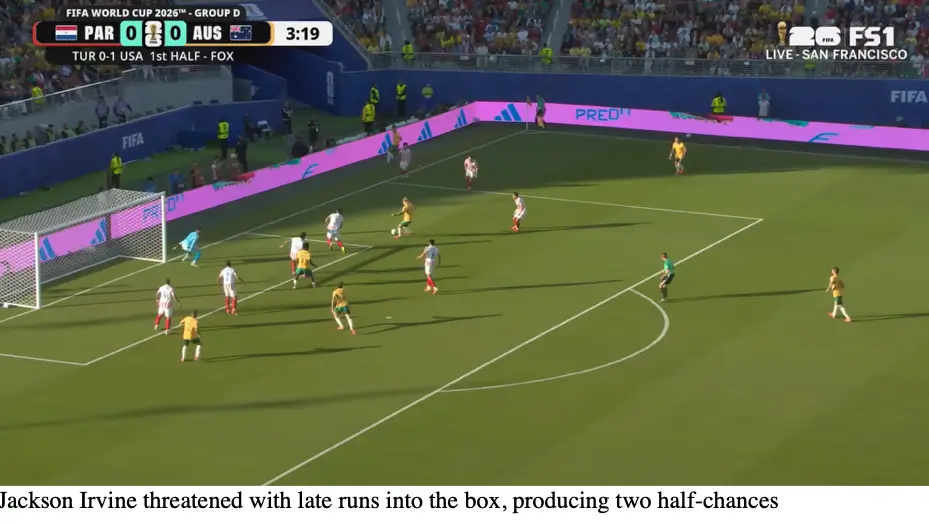
In contrast, Okon-Engstler is more comfortable and progressive in possession and more active in winning the ball out of possession. These differences were clearly seen in Irvine’s performance; his presence added attacking impetus in the final third with his dangerous late runs into the box, producing two shots in the box. These runs simply aren’t part of Okon-Engstler’s game – he is a classic holding midfielder. That said, while Irvine threatened going forward, his reticence to turn forward when receiving the ball in space in deeper areas at times stifled Australia’s buildup play.
This, on the other hand, is a strength of Okon-Engstler: his ability to consistently receive the ball in buildup, turn forward and find progressive passes is what differentiates him from Australia’s other midfielders. This duality poses another big question for the Socceroos’ coaching staff.
What is more important: control in possession or an extra presence in the final third making late runs into the box?

Set-pieces
Set-pieces were something I identified as an area to exploit before the game, given Australia’s significant height advantage over Paraguay, who have fielded some of the tournament’s shortest starting elevens. In reality, Australia’s set-pieces against Paraguay resulted in no significant chances created, which has been a theme throughout the tournament. In fairness, Australia only had three corners, all in the first half, though none of the corners reached an Australian head and two were easily cleared by Paraguay at the front post.
Australia have several towering defenders who should be significant goalscoring threats at set-pieces, and with a week’s break before the Egypt clash, set-pieces should be a focus, particularly given, like Paraguay, Egypt are not a particularly tall team. Their tallest likely starter, centre-back Rami Rabia, stands at only 186cm, which is the same height or shorter than Harry Souttar, Alessandro Circati, Lucas Herrington, Jackson Irvine, Cristian Volpato, Tete Yengi, Mohamed Touré and Paul Okon-Engstler. Suffice to say, set-pieces are an area in which Australia has an advantage over Egypt, and this hopefully will be reflected on Friday in Dallas.
All in all, the Socceroos will be pleased to progress to a second consecutive World Cup knockout phase, having again finished second in their group. The performance against Paraguay was comfortable and controlled, particularly out of possession, though there is room for improvement in chance creation and several big selection questions remain for the coaching staff.