
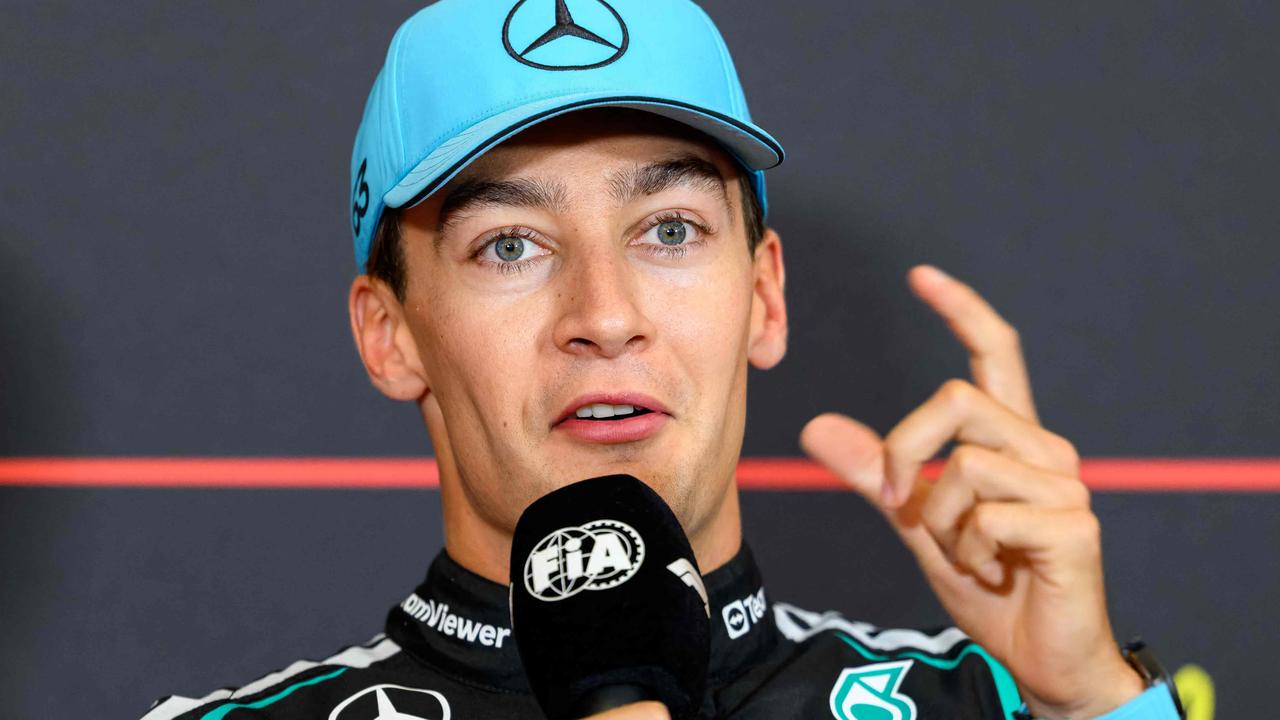
A little bit of luck is what George Russell thinks he’s been missing as he’s slipped further and further adrift of title-leading teammate Andrea Kimi Antonelli this season.
A little bit of luck is what he got in qualifying for the Austrian Grand Prix, where a “quite crazy” decision on yellow flags gave him a chance to wield his years of additional experience to his advantage and take pole in Spielberg while Antonelli flopped to fourth.
Of course Russell had already benefited from the considerable slice of luck of having Antonelli retire for the Barcelona-Catalunya Grand Prix just after the Italian passed him for second place, amounting to an instant 21-point championship swing in his favour.

But Russell now has a rare chance to punish his junior teammate for a mistake, having taken beatings from Antonelli at almost every race since Australia, and make the Italian pay in points.
We’re in the thick of the most important part of the season, and Russell has earned himself a lifeline.
WHY WAS THERE SO MUCH CONFUSION?
There was a brief moment after qualifying when Russell seemed almost certain to lose his pole position — and, worse, perhaps even cop a penalty for the egregious sin of ignoring yellow flags.
The cause of the consternation was Max Verstappen flying off the road at turn 9, the penultimate corner. The Dutchman had been only 0.061 second off the pace with his first lap, and he was reaching for what would have been a sensational against-the-odds sixth pole position in Spielberg — and he’d just set the fastest middle sector of the day.
But a sudden and inexplicable loss of rear downforce — caused by damage at the back of the car — sent him hard into the barrier, immediately triggering yellow flags.
Verstappen had been the third-last driver on the road in Q3. Only Antonelli and Russell were behind him.
Charles Leclerc and Lewis Hamilton had just provisionally locked out the front row, and the crash seemed certain to lock that in.
Within the same minute, yellow flags were upgraded to double waved yellow flags — the race control notification system lists both as having happened at 5pm.
The distinction between yellow and double yellows is important.
A single yellow flag requires drivers to “reduce their speed and be prepared to change direction”.
A double yellow flag requires driver to “reduce speed significantly and be prepared to change direction or stop”.
Double yellow flags are more serious — enough that lap times are automatically deleted in qualifying for any driver who passes through a double yellow zone to discourage gaming the system.
Also happening at 5pm: Antonelli and Russell driving past the crash scene. When Antonelli abandoned his time frustratedly — “F***! That was the lap, man!” he shouted — it seemed certain that he had responded to double yellows and backed out.
It seemed certain too that Russell, then, must have ignored them to take pole position by a hefty 0.236 seconds.
When he was put under investigation by the stewards for a yellow flag infringement, it seemed like a done deal that he would have his time deleted and likely even incur a penalty.
Unnoticed, however, was that around 20 seconds passed between the single yellows being upgraded to double yellows.
Those 20 seconds were just enough for both Mercedes drivers to enter and exit the yellow zone and cross the line.
Russell claims controversial Pole | 01:47
RUTHLESS RUSSELL, AMATEUR ANTONELLI
Just as the rules are clear that a lap under double yellows doesn’t count, they’re also clear about what has to happen for a lap under single yellows to stand.
“In order for the stewards to be satisfied that any such driver has complied with these requirements they are expected to have braked earlier and/or discernibly reduced speed in the relevant marshalling sector,” the regulations say.
In the nervous minutes between being put under investigation and cleared, Russell mounted a defence of his driving.
“I saw the yellow, I had a big lift into the corner,” he said. “I was 0.5 seconds up and I came out the last corner 0.25 seconds up.
“It was a single yellow as well, not a double, so it should be okay.”
He said he’d lifted 100 metres earlier into the affected corner.
The telemetry shows he came off the throttle just past halfway down the straight between turns 8 and 9 and rolled to turn 9.
The speed difference between the affected lap and his previous lap peaked at 14 kilometres per hour into the corner.
The margin over his previous best time had been 0.403 seconds and bottomed out at 0.352 seconds before he got back on it into the last corner.
That, the stewards declared, was enough to satisfy the rules.
“I did everything right to be very much under control,” he said.
It was an impressive bit of driving from the Briton on two counts.
The first count is how much faster he was on that lap in the first place. He would have been close to half a second quicker had he completed the lap without the need to lift for yellows, and given he was around 0.1 seconds up on Antonelli’s developing lap at the time, he seemed likely to get pole either way. It wouldn’t have been the first time this season he pulled a great final lap seemingly from nowhere.
But the second impressive count was his knowledge of the rules — not only the meaning of a yellow flag but understanding and perfectly executing the bare minimum required to get away with setting the fastest lap of the day with part of the track under caution.
Antonelli, meanwhile, saw yellow flags and assumed his lap was over.
“I aborted the lap and that was it, so my mistake in execution,” he said, per Autosport.
“I heard ‘yellow, yellow’ [from engineer Peter Bonnington on the radio], but I was looking at the marshal and probably I saw wrong. I just saw two flags instead of one and I aborted.
“Also it was hard to see because there was the sun in my face. I just looked at the marshal because the panel [on the steering wheel] went yellow — but of course you don’t know if it’s a single or double, so I looked at the marshal and it was hard to see. I just saw double yellow instead of one.”
To be fair to Antonelli, he had far less time to react, with the yellows appearing just as he entered the affected area. But the direction of travel at that corner is east, so him saying the sun was in his face at 5pm felt like a driver looking for any explanation for their mistake.
We’ve been wondering all season whether Russell’s experience could make the difference in the title battle with his teammate.
On Saturday afternoon it was the difference between him starting fourth behind Antonelli and him taking pole with his teammate three places behind him on the grid.
Of course there are no points for being clever on Saturday. Russell must still force Antonelli to pay in Sunday’s race — and given their relative form this season and this weekend, that’s certainly no guarantee.
But with Russell having been scrambling for solid ground on which to mount his fightback for the last several rounds, there’s no telling how important this speed-based, experience-enhanced result will mean to his championship campaign.
Verstappen gives Russell the finger | 00:07
WHY WAS THERE ONLY ONE YELLOW FLAG ANYWAY?
That explains what happened. Why it happened, though, is more controversial.
The confusion over whether Russell had passed double yellow flags was twofold. First there was the notification system listing everything as having happened in the same minute, which left the situation unclear — plus what turned out to be Antonelli’s overly cautious approach.
But the second was that every driver — except for the wily Russell — expected a crash at the 235-kilometre-per-hour penultimate corner to be worth at least double flags, if not a red flag.
“There was a car in the wall in a fast corner, so I think in this situation I don’t know why they didn’t go double yellow straight away,” Antonelli said.
“It’s a super quick corner, and if you go off at the same time [after another crashed car], it can end up very badly.
“It was a bit confusing, but it is what it is.”
Verstappen was shocked to learn his session-crash, leaving him stranded and vulnerable in the run-off zone, hadn’t resulted in a more serious caution.
“That’s quite crazy,” he said, per Racer.
The approximately 20-second delay in yellow flags being upgraded to double yellows is down to how marshalling works.
It’s up to trackside marshals to immediately display yellow flags as soon as they see an incident, but it’s race control that upgrades them to double yellows or red flags.
It’s not the first time we’ve seen race control take time to assess a situation if its severity isn’t immediately obvious.
In this instance Verstappen’s car didn’t drop any debris and seemed intact from the overhead camera. Race control may have wanted to wait to see if his car could continue and move itself out of the way, in which case a single yellow would have been the maximum required.
There’s a virtue to not wanting to unnecessarily call off a session, particularly after the chequered flag has already fallen in Q3.
The question put Russell in a somewhat awkward position, also being a director of the safety-focused Grand Prix Drivers Association.
In this case, though, he said “common sense” had prevailed.
“It’s a corner where you can see quite a lot, and I just did a huge lift and I was going to assess the situation as soon as I got to the corner, if the car was there,” he said.
“But as it was a single yellow, I was pretty confident there was no danger.
“As soon as I turned into the corner, I already saw the green up ahead, and I actually thought the car had continued, because I didn’t see the car at all — it was so far off the track, I didn’t see the car whatsoever.
“I think in that instance a single yellow was correct, because as I said, a double yellow is immediate danger.
“Lifting 100 metres before a corner or lifting off with a single yellow, you’re never going to lose control of the car. Verstappen, the only reason he was in the wall that far away is because he was attacking and lost the car.
“I think the single yellow was correct.”
Right or not, Russell was the only one of the Mercedes drivers to react to the prevailing conditions, and he executed with devastating precision.
WHAT ABOUT FERRARI?
In those moments of uncertainty, Ferrari briefly looked like it had taken a shock front-row lockout, with Charles Leclerc marginally ahead of Lewis Hamilton for what would have been the first non-Mercedes grand prix pole of the season.
The Italian team never seemed likely to be as far off the pace as it had looked on Friday, but though some overnight work had made it a much closer match, its power unit was still clearly decisively the difference between pole and, in Leclerc case, second place.
The 0.236-second gap is the team’s third-best qualifying performance of the season after Barcelona and Monaco when adjusted for the short duration of the lap.
That might not seem like a big tick for the engine upgrade, but it’s worth remembering that Austria is a particularly challenging track for the power unit, especially when this year’s complex energy recovery regime is added to the mix.
“We knew coming into this weekend it would be tough with the long straights we’ve got here, and the deficit looked bigger than other circuits that we’ve been at,” Hamilton acknowledged.
“Maybe it’s altitude; I’m not sure. I can’t really predict what’s going to happen in the future.
“I just know when we get to the long straight circuits it’s going to be our Achilles heel for a while.
“I’m really proud of the team for continuing to work. We got this upgrade, that’s the first step, but we need to make a bigger step naturally to really close the gap with them.”
It’s the second weekend of the year — and second in a row — that Ferrari has been the second-quickest qualifying car.
Red Bull Racing slotted into third even with Verstappen failing to complete his final flying lap, while McLaren was relegated to fourth in the pecking order for the third time this year with its second-biggest qualifying deficit since the Chinese Grand Prix.
Lando Norris, who pipped Oscar Piastri by 0.009 seconds to qualify sixth and seventh, summed up the team’s situation.
“Realistically, this is probably where we currently are in the pack,” he said.