
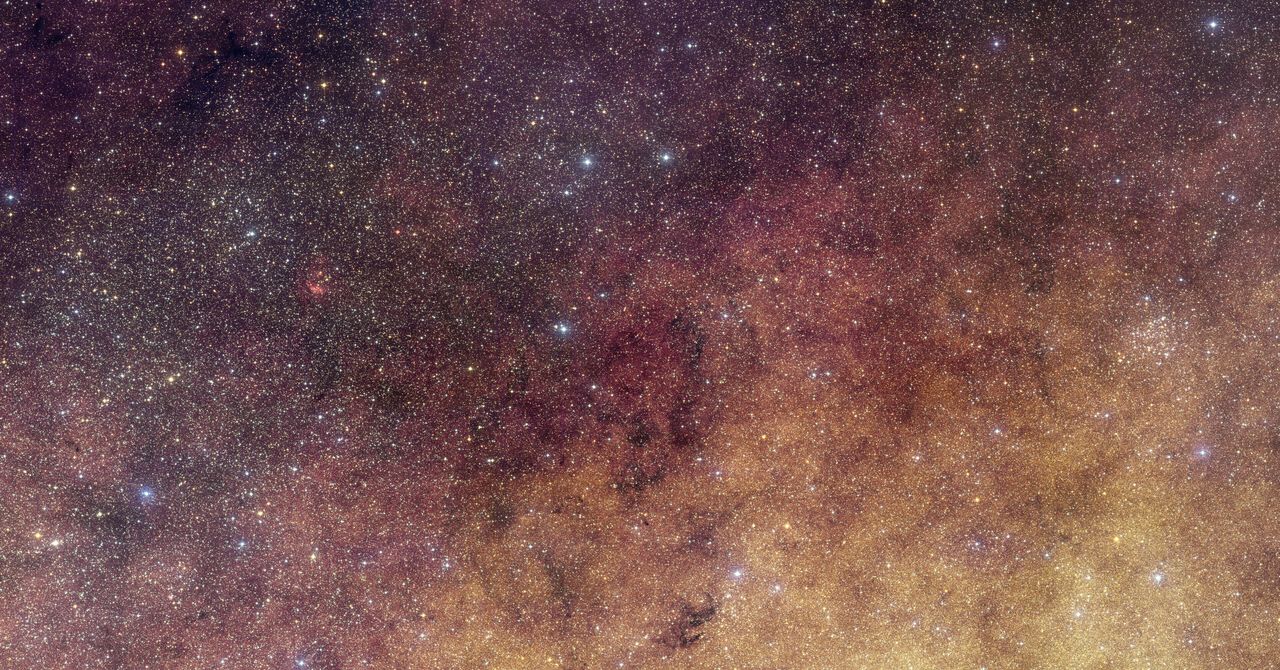
The Image of the Milky Way
Euclid’s image has captured over 60 million stars, as well as nebulae and star clusters, found at the centre of the galaxy – a densely populated region that is an ideal place to search for exoplanets via gravitational microlensing.
“[For scientists] to detect microlensing, it is necessary to observe portions of the sky crowded with stars, such as those near the centre of our galaxy, ” explained Jean-Philippe Beaulieu, the lead researcher of the observation campaign. “Over the past 20 years, nearly 300 exoplanets have been discovered using this technique, all with ground-based telescopes and all in the direction of the centre of our galaxy. This image from Euclid includes 51 known planetary systems and will contribute to the study of many others that will be identified.”
Measuring Planetary Masses
Although detecting a microlensing event takes several weeks – which means no new ones were identified during Euclid’s short timeframe of few hours – what makes this image important is that it provides the data needed to measure the masses of already known planets, as well as those of yet to be discovered.
“In 24 hours, Euclid has already captured the stars involved in all future microlensing events that the Roman Space Telescope will detect – but before the stars and planets involved have aligned, ” said Natalia Rektsini, who led the data release. “This means that anyone who detects a microlensing event in the same region – for example, with Roman – will now be able to use Euclid’s data as a temporal reference in the past and see what the stars looked like before they overlapped,” she explained.
Essentially, Euclid’s data will serve as a reference archive for future missions and will enable the study of exoplanets and their masses.
“Euclid has provided unique data on the centre of the Milky Way, offering a broad and clear view of this region,” said Valeria Pettorino, scientific lead for the Euclid project at ESA. “This data can also be used for other scientific applications, ranging from brown dwarfs and binary stars to stellar motions and dust within our galaxy.”
This story originally appeared on WIRED Italia and has been translated from Italian.