
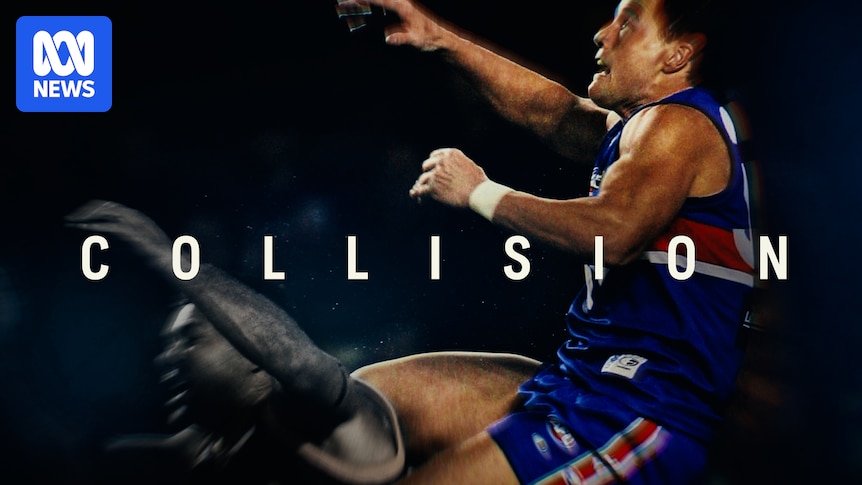
‘Collision’
29/6/2026
Four Corners
JESSICA HALLORAN, REPORTER: The country’s richest sporting code is built on the courage and sacrifice of its players.
JESSICA HALLORAN, REPORTER: But it comes at a cost. Brain injuries caused by hit, after hit, after hit.
JESSICA HALLORAN, REPORTER: There is a myth that the condition known as CTE only affects older, retired players.
GAME COMMENTARY: Hunter! Eagles by 7!
JESSICA HALLORAN, REPORTER: But the brain disease is claiming modern-day heroes…
JOANNE BROWN, ADAM HUNTER’S MOTHER: He just used to say. I think I’ve got CTE. Yeah, he knew.
CEREMONY ANNOUNCER: Nick Lowden!
JESSICA HALLORAN, REPORTER: And striking down the young.
KERRY LOWDEN, NICK LOWDEN’S MOTHER: To hear your son say, “Mum, what’s wrong with me?” And he wanted to be well. He did everything to be well, didn’t he?
TONY LOWDEN, NICK LOWDEN’S FATHER: Yeah, he did.
JESSICA HALLORAN, REPORTER: Now we can reveal startling new evidence of the AFL’s brain trauma crisis.
JESSICA HALLORAN, REPORTER: We’re aware of multiple cases of CTE diagnosed in Australian rules players. We’re talking players in their 20s, 30s, 40s.
LAURA KANE, AFL HEALTH & FOOTBALL OPERATIONS: What we’ve learned is that repeated head trauma is incredibly undesirable.
MATTY ROBBINS, FMR AFL PLAYER: Let’s get around each other, let’s go.
JESSICA HALLORAN, REPORTER: And allegations the AFL has failed to protect its players.
ADJ. PROF. ALAN PEARCE, NEUROSCIENTIST: CTE is a preventable environmental disease. We could have saved lives with this. the AFL does have blood on its hands.
JESSICA HALLORAN, REPORTER: We interrogate the AFL’s record of keeping parents, players and fans in the dark.
LAURA KANE, AFL HEALTH & FOOTBALL OPERATIONS: Our job is not to communicate every single aspect of risk that exists in our game. It’s a shared responsibility.
KERRY LOWDEN, NICK LOWDEN’S MOTHER: Stop evading and denying this degenerative disease and do something about it.
GAME COMMENTATOR: Here’s Lowden … good to see him back from the back injury … Here’s Lowden, found some space, left footed kick.
TONY LOWDEN, NICK LOWDEN’S FATHER: I know he’s my son, but he was a natural.
GAME COMMENTATOR: Snap around the body … it’s a beautiful goal off the boot of Nick Lowden!
TONY LOWDEN, NICK LOWDEN’S FATHER: He played in the under 10s through to the under 14s and Nick won five best and fairest awards in a row.
JESSICA HALLORAN, REPORTER: From the beginning … Nick Lowden had a reputation as a team player.
KERRY LOWDEN, NICK LOWDEN’S MOTHER: He was just so happy playing and doing what he loved, wasn’t he?
TONY LOWDEN, NICK LOWDEN’S FATHER: Yeah.
JESSICA HALLORAN, REPORTER: By sixteen, Nick’s dream to play in the AFL was getting closer to reality.
TONY LOWDEN, NICK LOWDEN’S FATHER: He’d be asking me, you know, “Do you think I’m good enough, Dad?” And, and I said, “Of course you are.”
JESSICA HALLORAN, REPORTER: It was right here that Kerry and Tony were watching Nick play on a cold winter’s afternoon in August 2017. In the last quarter, then 17-year-old Nick was badly concussed.
TONY LOWDEN, NICK LOWDEN’S FATHER: He went up for a mark and it looks like he’s had his legs taken out from underneath him and then he just come down, hit his head on the ground. You could tell he was out for a couple of seconds.
JESSICA HALLORAN, REPORTER: Against the AFL’s own junior footy concussion protocols, Nick was sent back out to play.
TONY LOWDEN, NICK LOWDEN’S FATHER: I think I said to you, I said, “Oh, Nick’s back on.” He played, but he didn’t really have any impact on the game. When we went in after they won, you could see his eyes were rolling. I thought, “He’s not even here with us.”
JESSICA HALLORAN, REPORTER: In the club rooms after the game, Kerry and Tony could see their son looking up to the wall where the team song was written.
KERRY LOWDEN, NICK LOWDEN’S MOTHER: You can see he’s not with it. He didn’t know the words and he’s looking for the words.
JESSICA HALLORAN, REPORTER: Nick’s concussion came after a decade playing the game and absorbing repeated hits.
KERRY LOWDEN, NICK LOWDEN’S MOTHER: We noticed over the next 12 months he started to deteriorate. He was a healthy strapping young man and he’d keep getting flu-like symptoms, sensitivity to light, mood changes, depression, which was absolutely horrendous for a young man that he had so much going for him to have depression. We couldn’t understand it. He was also a little bit quick to anger, frustrated and then the self-doubt and we were like, “What’s this?” He, you know what we would say to him, “Nick, you’ve got everything going for you.”
JESSICA HALLORAN, REPORTER: Nick said medication and psychologists weren’t lifting him out of his depression.
KERRY LOWDEN, NICK LOWDEN’S MOTHER: He said, “Mum, they’re not working.” He said, “Why am I like this? What is wrong with me? What is wrong with my brain?”
JESSICA HALLORAN, REPORTER: Despite his struggles, by 2022 Nick was playing in the South Australian National Football League for Norwood. He won a premiership with them.
TONY LOWDEN, NICK LOWDEN’S FATHER: Just seeing the smile on his face and the happiness.
CELEBRATION ANNOUNCER: Nick Lowden!
TONY LOWDEN, NICK LOWDEN’S FATHER: and then you started to think, maybe there is a chance.
JESSICA HALLORAN, REPORTER: Nick played on with Norwood in 2023, but he was still struggling … and he’d call his parents for support.
KERRY LOWDEN, NICK LOWDEN’S MOTHER: He was sliding quickly.
TONY LOWDEN, NICK LOWDEN’S FATHER: He was sliding and he made both of us cry and he was crying himself when he was on the phone.
KERRY LOWDEN, NICK LOWDEN’S MOTHER: He said, “Mum, I’m 23 and what have I achieved?” I hoped when we talked to him we could, you know, empower him and keep him going and push him on.
JESSICA HALLORAN, REPORTER: Weeks later, after Nick hadn’t returned their calls, Kerry and Tony rushed home to check on him.
KERRY LOWDEN, NICK LOWDEN’S MOTHER: I couldn’t wait to get in to see him. I’m yelling out because I thought he might have been upstairs and I was calling out Nick, Nick, and there was no answer and then when I walked back past the window, I looked out and I saw him and I just thought, “Oh my God.” And I screamed and screamed … but he was gone and we’ll never unsee that.
JESSICA HALLORAN, REPORTER: After Nick’s death the Lowdens received a call from the coroner’s office, asking if they would consider donating Nick’s brain for research.
KERRY LOWDEN, NICK LOWDEN’S MOTHER: Our rationale was, the girls and I said to Tone, well, maybe they can study a depressed brain, because we just thought Nick had a depressed brain.
JESSICA HALLORAN, REPORTER: They were shocked to learn that Nick had been suffering from a degenerative brain disease called chronic traumatic encephalopathy – CTE. And the most likely cause: 16 years playing footy.
KERRY LOWDEN, NICK LOWDEN’S MOTHER: I just can’t believe that we didn’t know about it and that the general public don’t know about it.
JESSICA HALLORAN, REPORTER: So you did not know what CTE was?
KERRY LOWDEN, NICK LOWDEN’S MOTHER: No.
TONY LOWDEN, NICK LOWDEN’S FATHER: No.
JESSICA HALLORAN, REPORTER: Nick Lowden is the youngest Australian Rules footballer to be diagnosed with CTE.
KERRY LOWDEN, NICK LOWDEN’S MOTHER: That beast had the power to push him to that point that he would never have done if his brain was normal. If it wasn’t affected by CTE, he would never have done that. And now it’s too late. He’s gone and all the things that we’ll miss. We won’t see him marry or have children. He’s not going to see his beautiful nephew who’s named after him. All that taken away from him and taken away from us and that’s why something has to change.
JESSICA HALLORAN, REPORTER: The AFL is not just a sport. It’s a billion-dollar industry with a plan to grow to one million players by 2033. The stars of the show are adored heroes. Their athleticism is staggering. And they’re the centrepiece of a game that is faster and harder than it’s ever been.
JESSICA HALLORAN, REPORTER: Repetitive trauma to the head and body is the only known cause of CTE. The disease has been found in people who’ve served in the military, and those who’ve experienced epileptic seizures and domestic violence. But it’s mainly been found in footy players.
MICHAEL BUCKLAND, NEUROPATHOLOGIST, AUST. SPORTS BRAIN BANK: What drives CTE risk is exposure to repeated head impacts. Most of those won’t give you any signs or symptoms, they’ll be just be part of the rough and tumble of the game, but each of one of those is doing microscopic damage, which in most people is fine, because you only get hit in the head maybe a dozen or two dozen times in a normal person’s life. But if you play a lot of contact sport, you’re being exposed to thousands if not tens of thousands of these impacts and it’s that cumulative exposure that drives risk of developing CTE.
JESSICA HALLORAN, REPORTER: CTE can only be diagnosed after death. Associate Professor Michael Buckland has looked at more than a hundred and fifty athletes’ brains.
MICHAEL BUCKLAND, NEUROPATHOLOGIST, AUST. SPORTS BRAIN BANK: I set up the brain bank to be able to allow families to have an option to donate their loved one’s brain after death, to get an answer about what sort of disease was affecting them in life.
JESSICA HALLORAN, REPORTER: What is CTE?
MICHAEL BUCKLAND, NEUROPATHOLOGIST, AUST. SPORTS BRAIN BANK: CTE is a degenerative brain disease, just like Alzheimer’s disease or Parkinson’s disease or even motor neuron disease. It’s got a very distinct appearance under the microscope.
MICHAEL BUCKLAND, NEUROPATHOLOGIST, AUST. SPORTS BRAIN BANK: So in here we do all the brain examinations …
JESSICA HALLORAN, REPORTER: So, this is where it all happens …
JESSICA HALLORAN, REPORTER: CTE occurs when deposits of an abnormal protein called tau builds up in nerve cells in the brain, causing them to malfunction and eventually die. Commonly reported symptoms in CTE include problems with mood, memory and impulse control.
JESSICA HALLORAN, REPORTER: It was Michael Buckland who found CTE in Nick Lowden’s brain.
JESSICA HALLORAN, REPORTER: Can you remember your early conversations with Kerry and Tony Lowden and conveying the diagnosis to them?
MICHAEL BUCKLAND, NEUROPATHOLOGIST, AUST. SPORTS BRAIN BANK: It’s, it’s uniquely hard, talking to families … let’s move on.
MICHAEL BUCKLAND, NEUROPATHOLOGIST, AUST. SPORTS BRAIN BANK: As you said, Nick was only 23 years old. When I look in the frontal cortex of a 23-year-old, I would expect to see no deposition of tau. In this case, I didn’t have to look that hard to find the CTE lesion.
JESSICA HALLORAN, REPORTER: Until now we’ve known of five AFL players to be diagnosed with CTE. Michael Buckland has examined the brains of 60 Australian Rules players. He has startling new figures showing the number of CTE cases is in fact 6 times higher … at 33. That includes 19 professional and semi-professional players and 14 amateurs.
MICHAEL BUCKLAND, NEUROPATHOLOGIST, AUST. SPORTS BRAIN BANK: I think it tells all of us that there’s a problem that playing a lot of contact or collision sport leads you to have risk of CTE later in life and it’s a problem that needs to be urgently addressed.
JESSICA HALLORAN, REPORTER: Nineteen of the Australian Rules brain donors died by suicide; fifteen had CTE. Four did not.
MICHAEL BUCKLAND, NEUROPATHOLOGIST, AUST. SPORTS BRAIN BANK: We don’t really understand, we don’t really have enough data, to draw a sort of a causal link between the two, but that’s a disturbing association, which I think needs more investigation.
MATTY ROBBINS, FMR AFL PLAYER: So this is one of the hits I’ve got at the MCG and a handball over the top and just got crunched.
JESSICA HALLORAN, REPORTER: Yeah.
MATTY ROBBINS, FMR AFL PLAYER: And you see my hand up, it’s like, yeah, pretty well knocked out. And then obviously, ended up coming back on in the last quarter, which is just crazy.
JESSICA HALLORAN, REPORTER: I mean, what goes through your mind now when you watch that?
MATTY ROBBINS, FMR AFL PLAYER: Oh, it’s just, I wish I hadn’t come back on. Yeah, it’s hard to watch because, yeah, I felt every bit of that one.
JESSICA HALLORAN, REPORTER: Concussion is the second most common injury in the AFL. But concussions are just one factor – it’s the head hits that don’t show symptoms that mainly cause CTE.
ADJ. PROF. ALAN PEARCE, NEUROSCIENTIST: CTE and other neurodegenerative diseases like motor neurone disease and dementias is due to what we call sub-concussive impacts. Now, these are things like bumps, tackles being thrown to the ground, getting back up, running on with no apparent signs or symptoms.
JESSICA HALLORAN, REPORTER: Former Western Bulldogs player Matty Robbins still feels the effects of the impacts today.
MATTY ROBBINS, FMR AFL PLAYER: Anyone that plays AFL is courageous. Anyone that keeps their eye on the ball is someone that is super courageous and they’re the ones that pay the price, I reckon.
JESSICA HALLORAN, REPORTER: Matty played 11 seasons of AFL, 146 games, and copped some huge hits. Two decades after retiring from the professional game he says he’s suffering.
MATTY ROBBINS, FMR AFL PLAYER: Oh, I’m paying the price. No one walks away unscathed. From the age of probably 42, I started to deal with memory loss and stuff.
JESSICA HALLORAN, REPORTER: Today Matty is 49. He knows several fellow players now suffering dementia and he’s scared about what might lie ahead.
MATTY ROBBINS, FMR AFL PLAYER: That’s my biggest fear, that I’ll develop dementia.
JESSICA HALLORAN, REPORTER: Can I ask you what conversations you’ve had with your wife about the future?
MATTY ROBBINS, FMR AFL PLAYER: I don’t want to go through dementia. I don’t, I won’t put my kids through that, so we’ve got to come up with a solution, but I don’t know what that’s going to be, but I won’t put my kids through that. I won’t ever do that.
JESSICA HALLORAN, REPORTER: You’re saying you don’t want to live?
MATTY ROBBINS, FMR AFL PLAYER: Yep.
JESSICA HALLORAN, REPORTER: Matty Robbins believes he has CTE.
MATTY ROBBINS, FMR AFL PLAYER: I’ve got all the symptoms, I’ve clearly got, clearly got this.
JESSICA HALLORAN, REPORTER: Despite his fears, he still loves the game and coaches his local under 16 team.
MATTY ROBBINS, FMR AFL PLAYER: OK so through my time boys, milestone, milestone games are the most important games, and you want to be able to look the look the bloke in the eye when you come off the field.
JESSICA HALLORAN, REPORTER: He’s donating his brain to the Australian Sports Brain Bank.
MATTY ROBBINS, FMR AFL PLAYER: It’s more just for education, to learn, learn more about it and that’s what I can do and pass on something and then I’ll do it.
MATTY ROBBINS, FMR AFL PLAYER: Lead them out, lead them out! From the start. From the start, boys!
JESSICA HALLORAN, REPORTER: Matty Robbins recently applied for an AFL Severe Injury Benefit payment. It’s a lump sum of up to $600,000 for former players left severely injured by the game.
JESSICA HALLORAN, REPORTER: Despite a scan showing significant brain damage, he failed the criteria for compensation, which requires players to prove their capacity to work is reduced by 40% or more.
MATTY ROBBINS, FMR AFL PLAYER: They just think you’re chasing cash. It’s like, mate, like, I’m financially stable. I don’t owe any debts, I haven’t got anything like that so it’s not money for me. It’s to set my family up, make sure that once fucking turns pear shaped when I get fucking dementia that my family are looked after. That’s why I’m doing it. No other reason.
ADJ. PROF. ALAN PEARCE, NEUROSCIENTIST: I think anyone can try and do the math on the accumulation of force impact that the brain is sustaining.
JESSICA HALLORAN, REPORTER: Alan Pearce is a neuroscientist who has been researching AFL players’ brains, including Matty Robbins, for nearly two decades. He says their heads are subjected to extraordinary forces.
ADJ. PROF. ALAN PEARCE, NEUROSCIENTIST: We get large impacts of well over 100Gs in hits that can be obviously causing concussions, but even worse, brain bleeds, more serious traumatic injuries to the neck. And yeah, they’re rarer, but they’re real and they happen.
JESSICA HALLORAN, REPORTER: The AFL has built much of its response to player safety around concussion. But Alan Pearce says CTE is not simply a concussion issue.
ADJ. PROF. ALAN PEARCE, NEUROSCIENTIST: The concussion protocols do not protect against CTE. These are the small impacts that come into the tens of thousands over a player’s career from when they start, through to when they retire.
JESSICA HALLORAN, REPORTER: These impacts have been well established in the United States for years.
REP. TIM MURPHY: We’re here today because a lot of people are paying attention to the issue of concussion.
JESSICA HALLORAN, REPORTER: In 2013 a class action was settled by the NFL which has now paid out over $2 billion Australian dollars, and in 2016 the league made a bombshell admission.
REP. JAN SCHAKOWSKY, 4 MARCH 2016: Do you think there is a link between football and degenerative brain disorders like CTE?
JEFF MILLER, NFL VP OF HEALTH & SAFETY, 4 MARCH 2016: The answer to that question is certainly yes.
JESSICA HALLORAN, REPORTER: Boston University’s Dr Ann McKee is considered one of the world-leading experts in CTE.
DR ANN McKEE, NEUROPATHOLOGIST, UNITE BRAIN BANK: Well, CTE is rare in the general population, but it is not rare if you’ve experienced repetitive hits to the head. In fact, in our brain bank, which, you know, we include cases that have had exposure to hits to the head, we see it quite commonly, in about 60 to 70% of the cases that come in.
JESSICA HALLORAN, REPORTER: If you consider NFL brain donors alone, it’s even higher. More than 500 ex-players have been found to have CTE — over 90 per cent of those who donated their brains.
DR ANN McKEE, NEUROPATHOLOGIST, UNITE BRAIN BANK: We must do something about it as urgently as possible in order to protect our future athletes.
JESSICA HALLORAN, REPORTER: In 2016, when the NFL was admitting a link between football and CTE, the AFL was playing it down, advised by Dr Paul McCrory.
DR PAUL McCRORY, NEUROLOGIST: NFL football. For all the carry on and hoo-ha you hear from the United States, it actually has the lowest rates of concussion of any of these sports, right down the bottom.
JESSICA HALLORAN, REPORTER: At the time, Dr McCrory was very influential. He was advising major bodies like FIFA and the International Olympic Committee.
DR PAUL McCRORY, NEUROLOGIST: The feared CTE, chronic traumatic encephalopathy that you’ve heard about … the best guess from the group that is pushing this most strongly says the risk is about 4% of retired athletes get it. The other way of looking at it is that 96% of athletes do not get it.
JESSICA HALLORAN, REPORTER: In this 2016 Melbourne University lecture which has been removed from public view, Dr McCrory challenged the science, and targeted the Boston researchers who’d helped expose the NFL’s brain injury crisis.
DR PAUL McCRORY, NEUROLOGIST: The biggest group in the world pushing this area is the Boston University Group, led by Ann McKee and Bob Cantu. And they’ve presented 64 athletes with so-called CTE.
DR ANN McKEE, NEUROPATHOLOGIST, UNITE BRAIN BANK: It’s always amazed me that individuals like Paul McCrory, but there have been many others, who have no experience in neuropathology, weigh in on the work.
DR ANN McKEE, NEUROPATHOLOGIST, UNITE BRAIN BANK: The sports leagues are well financed. There’s a potential financial benefit of pretending that these sports don’t have risks. But I think the scientific data is incontrovertible.
JESSICA HALLORAN, REPORTER: In 2022 Paul McCory’s career ended in disgrace after he was found to have plagiarised multiple articles, and misquoted crucial findings about when players should cease playing contact sport.
JESSICA HALLORAN, REPORTER: The British Journal of Sports Medicine suggested he’d warped the concussion narrative and said his actions were “an offence against science”
NEWSREADER, 9 SEPTEMBER 2019: The football community has been shocked by the sudden death of St Kilda legend Danny Frawley.
JESSICA HALLORAN, REPORTER: The death of the beloved Danny Frawley in 2019 triggered a coronial investigation that shone a light on CTE. A key recommendation was the AFL should actively encourage brain donation to the Australian Sports Brain Bank.
NEWSREADER, 20 JULY 2020: Former Richmond AFL player Shane Tuck has died, aged 38. Tuck played 173 games for Richmond …
JESSICA HALLORAN, REPORTER: In 2023 another coronial inquest was held which dealt with CTE; this one was into the death of Richmond player Shane Tuck. The coroner looking at Tuck’s death reinforced the importance of the AFL partnering with a brain bank.
JESSICA HALLORAN, REPORTER: Five years after it was first recommended the AFL is yet make it happen.
JESSICA HALLORAN, REPORTER: Anita Frawley, Danny’s widow, released a statement to Four Corners:
ANITA FRAWLEY STATEMENT: ‘Why has it taken so long to deliver something the coroner recommended years ago? And why is the football community still without a clear, nationally recognised pathway to support vital brain research? This is not about blame, it’s about leadership, accountability, and player welfare. The football community deserves answers. More importantly, players, past, present, and future deserve action.’
JESSICA HALLORAN, REPORTER: We asked the AFL’s CEO Andrew Dillon to be interviewed for this story. He declined. Instead, the AFL put forward Laura Kane; the executive whose brief includes player health and concussion.
JESSICA HALLORAN, REPORTER: It’s been five years. That’s a long time. Why is there a delay?
LAURA KANE, AFL HEALTH & FOOTBALL OPERATIONS: We’re committed to a long-term study that includes brain donation and we will make sure that we deliver that research program with the overlay of brain donation, if our players want to, in the safest way possible and there, that’s all being contemplated right now as part of our brain health initiative.
JESSICA HALLORAN, REPORTER: In 2023 the coroner also recommended the AFL reduce players’ exposure to high impact hits by limiting physical contact in training sessions.
LAURA KANE, AFL HEALTH & FOOTBALL OPERATIONS: So right now we are considering, and are likely to implement contact training limits.
JESSICA HALLORAN, REPORTER: When might that happen?
LAURA KANE, AFL HEALTH & FOOTBALL OPERATIONS: Imminently.
JESSICA HALLORAN, REPORTER: Next season or-
LAURA KANE, AFL HEALTH & FOOTBALL OPERATIONS: Ahead of next season.
SENATOR JANET RICE, 26 APRIL 2023: I declare open this hearing of the Senate Community Affairs References Committee Inquiry into concussions and repeated head trauma in contact sports.
JESSICA HALLORAN, REPORTER: The AFL acknowledged a link between head trauma and CTE at a 2023 senate inquiry.
STEPHEN MEADE, AFL GENERAL COUNSEL, 26 APRIL 2023: Senator we did, in our submission we set out the position that we acknowledge there is an association between head trauma and neurodegenerative disease, including CTE.
SENATOR LIDIA THORPE, 26 APRIL 2023: Do you have a policy on CTE, given you acknowledge the links?
STEPHEN MEADE, AFL GENERAL COUNSEL, 26 APRIL 2023: In terms of a specific policy that deals with non-concussive head trauma or CTE, no, we do not.
SENATOR LIDIA THORPE, 26 APRIL 2023: Do you think you should have one?
STEPHEN MEADE, AFL GENERAL COUNSEL, 26 APRIL 2023: I don’t think that we need to have a policy to show how seriously we take CTE in our sport.
JESSICA HALLORAN, REPORTER: The AFL doesn’t have an official policy on CTE, but says it does inform players.
LAURA KANE, AFL HEALTH & FOOTBALL OPERATIONS: Every year our chief medical officer will educate our players on everything from the reporting of symptoms, the management of concussions, the long-term risks and there’s education and training that’s conducted annually.
JOANNE BROWN, ADAM HUNTER’S MOTHER: Adam, from a very, very early age was going to play football. And when his teachers asked him to do homework, I don’t need to because I’m going to play AFL. And he was going to play for the Eagles.
JESSICA HALLORAN, REPORTER: Adam Hunter was a country boy who loved fishing and footy. His greatest dream came true when he was drafted to the West Coast Eagles in 1999. And he gave it his all.
ROD BROWN, ADAM HUNTER’S STEPFATHER: It was just 110% dedication, full on just eat the right food, train, sleep, recover, train, sleep, eat, recover. He never wanted to be in the spotlight either. He just wanted to be a no-name backman.
JESSICA HALLORAN, REPORTER: Adam’s commitment to the game would cement him in a now iconic West Coast Eagles team. During the 2006 premiership he had a starring role.
GAME COMMENTARY: The hand pass on to Hunter! And Hunter runs to goal and kicks it
JESSICA HALLORAN, REPORTER: Adam Hunter was a fearless player. He put his body on the line. Earlier in 2006 he suffered a horrendous collision when his head hit the interchange bench.
GAME COMMENTARY: Close to the line, Hunter the target. But I think it’s out on the full. Takes Hunter out with him. Could be in trouble here, Hunter. Yeah that was nasty.
JOANNE BROWN, ADAM HUNTER’S MOTHER: Adam said to me, said to us when he got home that if it had been an inch one way, it would’ve been fatal.
JESSICA HALLORAN, REPORTER: He came back on and played out the game. In the final year of his AFL career Adam started to unravel.
JOANNE BROWN, ADAM HUNTER’S MOTHER: Probably the last year he played and then through retirement, his personality changed and addictions started coming in.
JESSICA HALLORAN, REPORTER: He later started to express to his mum Joanne and his stepdad Rod that something was wrong with his brain.
JOANNE BROWN, ADAM HUNTER’S MOTHER: He just used to say- I think I’ve, I think I’ve got it.
ROD BROWN, ADAM HUNTER’S STEPFATHER: I don’t feel right. I don’t feel right. I know there’s something wrong.
JOANNE BROWN, ADAM HUNTER’S MOTHER: I think I’ve got CTE. I didn’t know a lot about CTE. I knew it was from head trauma, but I didn’t know, but yeah, just looking back now and knowing a bit more about CTE, yeah, he, he knew.
JESSICA HALLORAN, REPORTER: Adam Hunter started turning more and more to drugs in his final years.
JOANNE BROWN, ADAM HUNTER’S MOTHER: I know he tried a lot of different drugs, and I think they just try for something that’s going to make them feel better.
JESSICA HALLORAN, REPORTER: Adam overdosed and died in February last year.
NEWSREADER, 5 FEBRUARY 2025: The West Coast Eagles have paid tribute to 2006 premiership player Adam Hunter, who died overnight at his Bunbury home.
JOANNE BROWN, ADAM HUNTER’S MOTHER: Still doesn’t seem real.
ROD BROWN, ADAM HUNTER’S STEPFATHER: Yeah, I know. It’s, you’d be lying if you said you don’t, didn’t think about it 10 times a day.
JESSICA HALLORAN, REPORTER: His parents donated his brain and Adam’s suspicion that he had CTE was confirmed.
JESSICA HALLORAN, REPORTER: How does it feel knowing that Adam was battling a degenerative brain disease?
ROD BROWN, ADAM HUNTER’S STEPFATHER: As a parent, it was soul destroying. It just hits a real nerve. You just can’t describe it; how painful it is.
JESSICA HALLORAN, REPORTER: Michael Buckland believes Adam and other players with CTE who struggled with addiction have been unfairly treated.
MICHAEL BUCKLAND, NEUROPATHOLOGIST, AUST. SPORTS BRAIN BANK: There can be a bit of a culture of victim blaming. There is no evidence that drugs and alcohol cause CTE. In fact, there is evidence of the opposite, and I’m just a bit stumped why sports associated doctors continue to trot out that what to me seems like an excuse. ‘It’s their fault they’ve got it’. It’s always someone else’s fault. It’s not the code’s fault.
JESSICA HALLORAN, REPORTER: Have you heard from the AFL since he was found to have CTE?
JOANNE BROWN, ADAM HUNTER’S MOTHER: No.
ROD BROWN: No.
JESSICA HALLORAN, REPORTER: What does that say to you?
ROD BROWN, ADAM HUNTER’S STEPFATHER: The Players’ Association have been amazing, with support, but the AFL itself has given us nothing. Like we, we’re not asking for anything, so.
JOANNE BROWN, ADAM HUNTER’S MOTHER: Yeah. I think, I think it’s just denial.
ROD BROWN, ADAM HUNTER’S STEPFATHER: Yeah.
JESSICA HALLORAN, REPORTER: I just wanted to talk about Adam Hunter’s diagnosis. Why has no one from the AFL executive reached out to his family?
LAURA KANE, AFL HEALTH & FOOTBALL OPERATIONS: I firstly, again, it’s really sad. These stories are really sad and they’re hard and they’re complex. I can’t talk to the communication that my individual colleagues have, but what I, and I mean at my AFL colleagues, but what I do know is that our players are so well supported by their clubs and the relationship that the clubs build with these players and their families, is strong. We’re the governing body, we’re always, you know, available to talk to people when they’re ready. We’re available to answer questions.
JESSICA HALLORAN, REPORTER: Women and girls are central to the AFL’s future. They’re the key to the AFL’s goal of growing its player base to 1 million people. Heather Anderson played in the first AFLW season and won a premiership with the Adelaide Crows. And she suffered hits.
JESSICA HALLORAN, REPORTER: Heather’s death by suicide in 2022 caused shockwaves through the women’s game. She was just 28.
MICHAEL BUCKLAND, NEUROPATHOLOGIST, AUST. SPORTS BRAIN BANK: I was lucky enough to be able to speak to her family who were incredibly supportive about brain donation.
JESSICA HALLORAN, REPORTER: Heather is the first known female professional athlete in the world to be diagnosed with CTE.
MICHAEL BUCKLAND, NEUROPATHOLOGIST, AUST. SPORTS BRAIN BANK: Heather is the canary in the coal mine. We are seeing the explosion of popularity of contact sports in the female sphere. We know that there is literature about women may be more prone to concussions and so the nightmare scenario is that, in fact, they’re also more prone to CTE.
JESSICA HALLORAN, REPORTER: The AFL has long maintained the safety of its players is its top priority, pointing to the introduction of 30 new rule changes over the past decade ‘to protect the brain health of players.’ Three years ago, it announced a new 25-million-dollar project. Laura Kane says that’s on track.
LAURA KANE, AFL HEALTH & FOOTBALL OPERATIONS: The Brain Health Initiative, it’s a longitudinal research study that we launched. We had two clubs go through the pilot program of the Brain Health Initiative. So from a research perspective the Brain Health Initiative is where we house both research, but also innovation. And so innovation with equipment, whether it be mouth guards, which feature as part of the Brain Health Initiative, of course, brain scans and other medical overlay that we can apply through the research all the way through to protective equipment and learning here at the AFL about what the options are to help us reduce head trauma.
JESSICA HALLORAN, REPORTER: While the football community waits for any results to emerge from the Brain Health Initiative, the league will be under pressure to preserve the game that’s such a huge part of Australian culture. Some experts suggest lifting the tackling age from 9 to 14.
JESSICA HALLORAN, REPORTER: Dr McKee believes the game should go further.
DR ANN McKEE, NEUROPATHOLOGIST, UNITE BRAIN BANK: I know people say 14, but there’s nothing magical about 14. I’d like it to be raised to 18 or even higher when a person is able to give their own consent for playing the sport and enduring the risks. There are risks to getting your head hit, risks to these sports and I would like a player to be fully informed about the potential risks before they engage in it.
JESSICA HALLORAN, REPORTER: Reducing players’ exposure to hits could include limiting contact training, officially monitoring all impacts and reducing the length of the season. But the AFL is considering extending the season.
JESSICA HALLORAN, REPORTER: The Players Association says it needs more time to consider it.
JAMES GALLAGHER, CEO, AFL PLAYERS ASSOCIATION: I think one of the things to consider is, if we were to have more games, how long are those games? How long is the training that sits around it and the preseason training that sits around it? So I think it’s about looking at the cumulative load across the course of 12 months or a player’s career. At this stage, it’s something that, you know, we know is a possible topic of discussion that the AFL would like to have with us. It’s not something we have a formed position on yet and we’re currently discussing with our members.
JESSICA HALLORAN, REPORTER: Dr Ann McKee and her colleagues have been working on the holy grail: finding a way to diagnose CTE in life.
DR ANN McKEE, NEUROPATHOLOGIST, UNITE BRAIN BANK: I expect to be able to diagnose CTE during life within the next three years.
JESSICA HALLORAN, REPORTER: What would it mean to that person who’s suffering CTE, and their understanding of their symptoms?
DR ANN McKEE, NEUROPATHOLOGIST, UNITE BRAIN BANK: I think diagnosis during life will be revolutionary. To understand that there is a disease, a brain injury that is causing these symptoms, it’s not them, it’s not their weakness, their, you know, their inability to stave off small complaints. It, it’s not them, it’s actually a disease and they are coping with it. And that realisation is extraordinary for patients.
JESSICA HALLORAN, REPORTER: Kerry and Tony Lowden believe the AFL is choosing to protect its billion-dollar brand.
KERRY LOWDEN, NICK LOWDEN’S MOTHER: They’re putting money before people, it has to stop.
JESSICA HALLORAN, REPORTER: Four Corners raised Nick Lowden’s death with Laura Kane – and that his mum Kerry had been unaware of what CTE was.
LAURA KANE, AFL HEALTH & FOOTBALL OPERATIONS: Those stories are incredibly sad. They’re sad for anyone who’s close to those people, you know, he, the story you just described is someone’s son. It’s really, it’s really hard. What it tells me is that we all need to learn and there’s more to learn about CTE and the, and, understanding again the link between contact sports and CTE. But our job is not to communicate the research findings of others necessarily. Our job is not to communicate every single aspect of risk that, you know, exists in our game. Our job is to govern our sport and it’s a shared responsibility and it’s a responsibility shared by everyone who works in contact sport.
JESSICA HALLORAN, REPORTER: Can you speak to what she said about risk?
KERRY LOWDEN, NICK LOWDEN’S MOTHER: Risk is their responsibility. One hundred per cent. The risks involved in that game is one hundred per cent their responsibility. So I’m absolutely gobsmacked that she’s saying that they will act when they have the right findings, and saying that risk isn’t their responsibility, of course it is. Unless someone knows what the dangers are, they can’t protect themselves, like our son didn’t know, we didn’t know.
JESSICA HALLORAN, REPORTER: In the days after Nick Lowden died, his family found his journals.
KERRY LOWDEN, NICK LOWDEN’S MOTHER: This one sums things up. This one he called angst. “What is this unease that I feel? I’m dying slowly. How much longer can I keep this facade up? How much fuel does this fire have left? It’s barely staying alight. I stay alive for my family and friends, yet I am drifting away from them slowly. This dread follows me and I can’t shut it out.”
KERRY LOWDEN, NICK LOWDEN’S MOTHER: So that gives you an idea of what he was going through, battling this brain, his brain that wasn’t functioning properly. It’s so powerful CTE.
TONY LOWDEN, NICK LOWDEN’S FATHER: You know quite often I sit and think about Nick and I think how lonely he must have been on that night that he took his life. That he didn’t have family around him to comfort him. And that really eats at me quite a lot.
KERRY LOWDEN, NICK LOWDEN’S MOTHER: I’d like the AFL to know what it was like the day we found him. No one can put that into words. But after we found him, we just laid with him and cried because we couldn’t let him go. And I don’t think they understand what that’s like for a parent. And then the last day that you see them in the viewing and you just think your boy’s going to go in the ground and this is your last time to see him. And you just, we couldn’t let go of his hands
JESSICA HALLORAN, REPORTER: In light of Nick’s death, what’s your message to the AFL?
KERRY LOWDEN, NICK LOWDEN’S MOTHER: Let’s stop this, this, you know, evading and saying that you haven’t got the findings and we’re well past that. Everybody knows what causes CTE. Take accountability. Come and walk in our shoes for a day.