
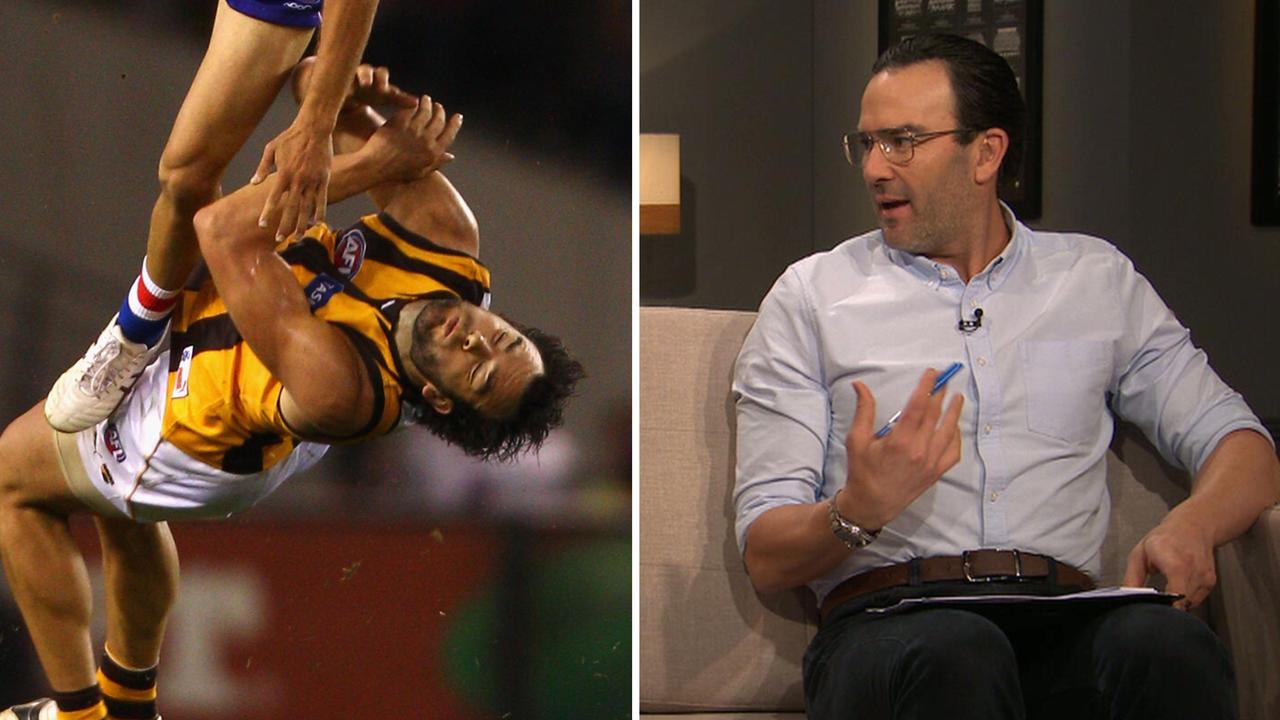
Four-time premiership Hawk Jordan Lewis has been left stunned by revelations the AFL allegedly didn’t act on a blatant global concussion warning for nine years.
Lewis in 2010 suffered one of the most sickening concussions in the AFL era when he was knocked unconscious by Jarrod Harbrow during a marking contest late in the second term in a Western Bulldogs-Hawthorn clash at Marvel Stadium.
Watch every match of every round of the AFL Premiership Season LIVE and ad-break free during play on FOX FOOTY, available on Kayo Sports | New to Kayo? Join now and get your first month for just $1.

The champion midfielder was stretchered off the ground but, remarkably, returned to the field at the start of the fourth quarter.
The horrific scenes prompted change, with the AFL introducing a rule in 2011 banning players from returning after being concussed in the same match.
Yet a special CODE Sports report from Herald Sun chief football writer and First Crack host Jay Clark last week revealed a Concussion in Sport Group — made up of the world’s leading head trauma experts — had recommended in 2001: “When a player shows ANY symptoms or signs of concussion: the player should not be allowed to return to play in the current game or practice.” That ‘consensus statement’ came nine years before Lewis’ incident.
Jarrod Harbrow of the Bulldogs clashes with Jordan Lewis of the Hawks in 2010. Picture: Ryan Pierse/Getty ImagesSource: News Corp Australia
Clark reported the AFL’s handling of concussion between 2001 and 2011 would be the centrepiece of an upcoming $1 billion class action regarding head trauma in football.
Speaking on Fox Footy’s On The Couch on Monday night, triple premiership Tiger Jack Riewoldt said the “timeline there has piqued the interest of the playing group through the 2000s of the ones who have suffered concussions”, adding: “There’s a 10-year window that leaves players like us in the abyss.”
Lewis said he “would like to know why they (the AFL) didn’t act” on information around the risks of overlooking concussion.
“I think for a lot of players reading that article, it was news to me,” Lewis told On The Couch.
“Out of respect, Jay called me during the week to let me know that article … is coming.
“After reading that article, I think the disappointing thing for me was to understand that there was information out there that had been backed by the top head trauma guys in the world – and the AFL had been provided that information – yet still didn’t act. And it was 10 years later that that happened.
“The AFL set the guidelines for players to enter the competition. I take responsibility for the concussion, but I think what happened after that could have been certainly held, or done better, by the AFL, understanding the information that they had been given.
Freo charge to top of Premiership Window | 02:30
“That (action that led to the concussion) is going to happen, that’s part of the game … and that’s at all levels, every single level understanding that it is a sport that involves contact.
“But I’m just disappointed that the AFL had information and didn’t act on it from the experts that are in this field. I think a lot of players would feel the same way.”
Lewis’ comments came on the same day Crows AFLW superstar Chelsea Randall announced her retirement because of ongoing concussion-related issues. Meanwhile, Eagles defender Harry Edwards was ruled out for the remainder of the 2026 season after the AFL Concussion Panel recommended a specialist rehabilitation program.
CODE Sports writer Jon Ralph also reported on Fox Footy’s On The Couch on Monday night that three more former players – Ty Zantuck, Chad Rintoul and Nigel Kellett – had received severe injury payouts in the last few weeks, with Rintoul and Kellett’s cases being concussion-related.
An AFL statement was included as part of the CODE Sports report.
“The AFL continues to undertake significant work to make the game safer,” the statement read.
Gerard TEES OFF on ARC system | 05:34
“Considerable resources have been placed around better understanding the link of repeated head trauma and neurodegenerative disease.
“Head trauma is a consideration for all contact sports around the world and as a professional sporting body who govern a contact sport, the AFL has clear governance, policy and guidelines around how our game is played.
“The AFL has made more than 30 changes to on-field rules and Match Review and Tribunal guidelines over the past two decades to further protect the safety of players in the game and as a league we continue to be guided by medical experts on this.”
Riewoldt, who suffered multiple concussions during his playing career, said there was “plenty of grey area”.
“There’s grey area in the timeline of when the AFL and whatnot have done this,” he said.
“There’s obviously a grey area in SCAT testing post that.
Hawthorn’s Jordan Lewis is taken off the field after a heavy collision. Picture: AAP Image/David CroslingSource: AAP
“But there will be grey area in players like us and players that have suffered far worse than us for the rest of their lives around decision-making and head trauma – and the fact that multiple concussions show that there is a high chance of having CTE.
“It’s certainly a worrying thing that we’ve got to this and information has been withheld from a playing group.”
Seven-time All-Australian Nathan Buckley said the AFL “would hate seeing that vision” of Lewis’ concussion.
“It’s really hard when we sort of look at it to judge something that happened in 2001 on 2026 standards,” Buckley told On The Couch.
“By any standard now, the AFL are doing everything in their power to remove contact from the game, to hold players accountable to duty and care and to look after the welfare of players in terms of head knocks and concussion and potential detrimental effects long-term.
“But there is a grey area there. There’s a period there, that article is suggesting, that the AFL didn’t act quick enough.
“When you think about 25 years ago that actually happened, it is mind-blowing to think that was only that short time ago that was OK.”