
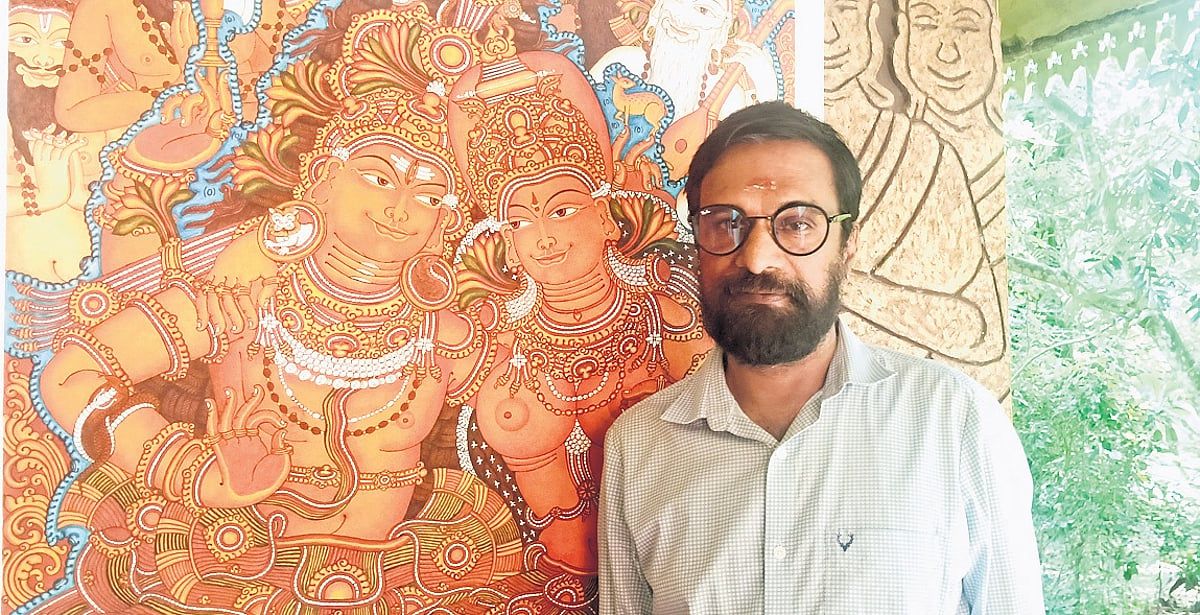
THRISSUR: Red, yellow, green, black and white. The five colours at the heart of Kerala’s traditional mural painting have inspired vibrant creations that have adorned temples and homes of aristocrats over the ages.
With its emphasis on the use of natural paint, the art form has attracted the attention of connoisseurs at home and abroad. Among its few remaining proponents is Ajith Anamika, of Meloor, Chalakudy, who is fighting to keep alive a tradition that is on the verge of going extinct.
At 53, Ajith is a widely respected mural artist whose work on portable panels have been sold to institutions and enthusiasts in 15 countries including Germany, the United Kingdom, Japan and Australia.
His creations are unique for their use of the five earthy tones, known as ‘panchavarna’, which he makes at home. As an artist, Ajith is diligent — refusing to compromise on the time-honoured techniques and conventions associated with the traditional art form.
“The panchavarna colours are unique. They are soothing to the eye and last longer, if prepared and applied the right way,” Ajith tells TNIE. “Though it may seem simple to extract natural colours, it is a long-drawn process. “It needs a lot of patience, but the results can be magnificent,” he notes.
Red is made from the red laterite bricks sourced from Rajasthan. He extracts yellow from the yellow laterite bricks from the banks of the Souparnika River in Karnataka. Lime is used to draw out white, while black is derived by burning cotton threads, on which certain medicinal plant extracts are applied.